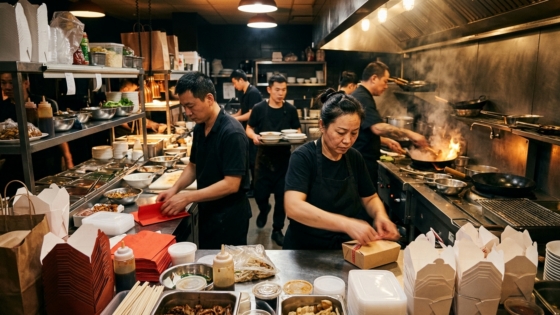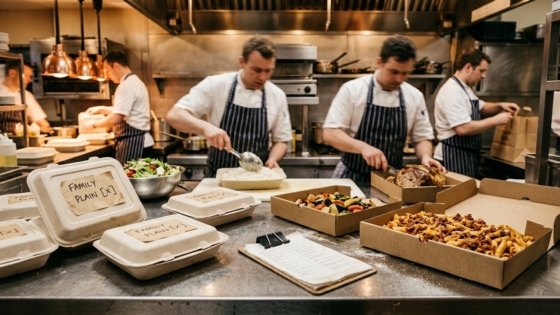
The wrong dish lands in front of a customer. Or worse, it lands in a pickup bag that’s been sealed, driven across town, and opened at the dinner table. By that point, the cost of the error isn’t just the remade dish — it’s the customer who won’t call again, and possibly a negative review that shapes the next hundred people’s first impression of your restaurant.
Most order errors at Chinese restaurants serving English-speaking customers don’t originate in the kitchen. They originate in the communication chain: from caller to staff, from staff to ticket, from ticket to kitchen. Fix the communication chain and the kitchen can do what it’s already good at — making food correctly.
Here’s the four-layer framework that addresses every point in that chain.
Key Takeaways
- Most phone order errors are communication errors, not kitchen errors — they’re created before a single ingredient is touched.
- Menu language is Layer 1: dish descriptions, allergen flags, and modification vocabulary prevent errors at the source.
- Staff call protocol is Layer 2: scripted, consistent call handling eliminates error variation across staff members and shifts.
- Kitchen ticket format is Layer 3: modifications and special instructions must be visible and unambiguous when they reach the kitchen.
- AI voice ordering is Layer 4: it removes the human transcription step from the chain entirely, achieving 95%+ accuracy systematically.
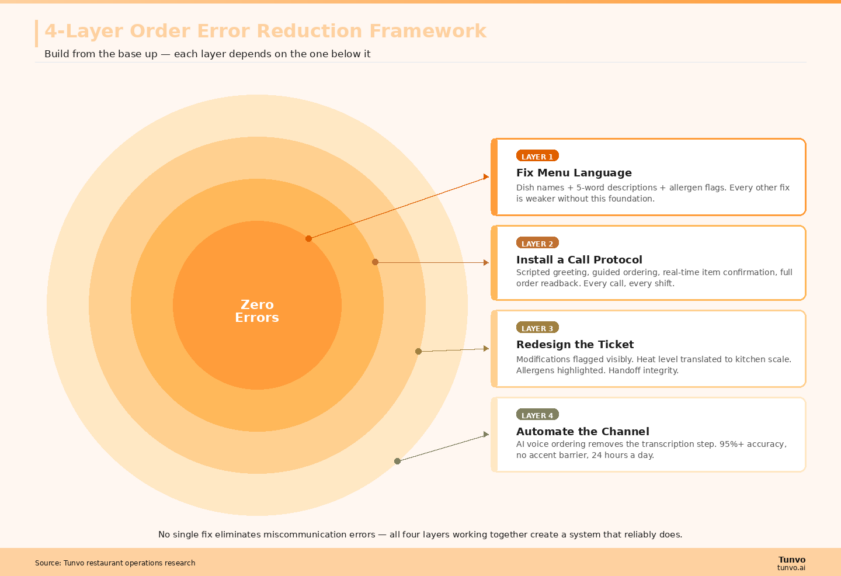 Each layer closes a different gap in the communication chain — implementing all four creates a system that reliably produces accurate orders regardless of staff experience or call complexity.
Understanding Where Errors Actually Come From
Before fixing errors, it helps to know where in the chain they’re entering. Most restaurants that diagnose their order error problem find that it’s not evenly distributed — it’s concentrated at one or two specific handoff points.
The most common failure points in Chinese restaurant phone order chains are, in order of frequency: misheard dish names (especially Pinyin or Chinese-named dishes), unconfirmed or lost modifications, heat level mismatches (the customer said “medium,” the kitchen made it “spicy”), and allergen requests that weren’t flagged through to the kitchen. Each of these is fixable with a targeted intervention.
Research on restaurant communication barriers shows that improving communication practices can boost operational efficiency by up to 20% — and that the returns concentrate in the phone ordering channel, which is the highest-friction point in the customer-to-kitchen chain.
Layer 1: Menu Language — Fix the Source
Every other error-reduction measure is working downstream from the menu. If your menu has unclear dish names, missing descriptions, or no allergen information, staff will improvise when taking phone orders — and improvisation is where errors enter.
A phone-ready menu has three components: a clear English name or phonetic name for every dish, a five-word description covering protein, cook method, and sauce, and an allergen flag system that staff can reference immediately when a caller asks about ingredients. This doesn’t require a full menu redesign — it requires adding a single reference document for phone staff that covers your top 30 most ordered items.
The discipline here is updating this document when your menu changes. A reference document that’s three months out of date is worse than no reference document, because staff will trust it and be wrong.
The Allergen Gap Is the Highest-Stakes Issue in Layer 1
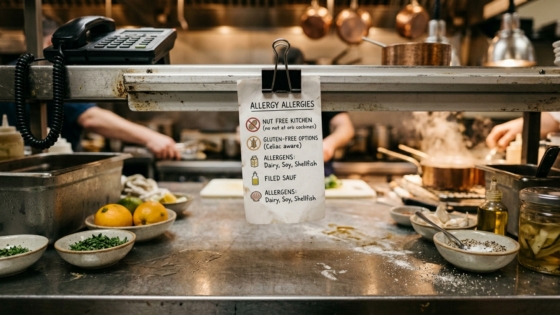
Dish descriptions and name clarity are important, but allergen communication is where the consequences of getting it wrong are most severe. Research shows that food allergy incidents in restaurants represent a significant public health issue, with a substantial share of serious reactions occurring in eating establishments. Your menu’s allergen flagging is a safety system, not just a convenience.
Train staff to distinguish between preference requests (“no mushrooms”) and allergen requests (“I’m allergic to shellfish”). The response to an allergen request includes confirming with the kitchen about cross-contact risk — not just omitting the ingredient from the dish.
Layer 2: Staff Call Protocol — Eliminate Human Variability
The single biggest source of inconsistency in phone ordering is that different staff members handle calls differently. An experienced staff member who’s taken a thousand calls has a reliable informal protocol. A newer staff member improvising their third call has a much less reliable one. When errors cluster around certain shifts or certain days, it’s often a Layer 2 problem — the protocol isn’t consistent across all staff.
A written, trained, posted call protocol eliminates this variability. The protocol should cover five moments in every call: the opening (scripted greeting), the ordering phase (guided by category, dish descriptions available), item confirmation (every item repeated back immediately), modification handling (clarified and written down), and the close (full order readback before hanging up).
Post the protocol at the phone station. Review it in staff briefings. Spot-check it during busy periods. Consistent communication protocols are a foundational element of effective restaurant operations — treating the call protocol as a standard operating procedure, not a suggestion, is what makes it reliable.
The Confirmation Step Is the Highest-Leverage Moment in Layer 2
If you could only implement one thing from Layer 2, it would be real-time item confirmation. Repeating each item back immediately after it’s ordered — before moving to the next one — catches errors at the cheapest possible moment: while the caller is still on the line and can correct them. Item confirmation prevents the large majority of phone order mistakes, and it costs nothing except the five seconds per item to do it.
Layer 3: Kitchen Ticket Format — Close the Handoff Gap
An order can be taken perfectly on the phone — every item confirmed, every modification noted — and still go wrong if the kitchen ticket doesn’t communicate that information clearly to the people making the food. The phone-to-ticket handoff and the ticket-to-kitchen handoff are two separate failure points that Layer 3 addresses.
The kitchen ticket should treat modifications as first-class information. Modifications written in the notes field, buried under the main items, in shorthand that varies by staff member, are regularly missed. A ticket format where modifications appear in a consistent, visible location — and where allergen flags are highlighted differently from preference modifications — dramatically reduces kitchen-side errors.
If your POS system supports kitchen display routing, configure modifications to appear prominently on the kitchen display alongside the main items. Digital order management systems that connect the order entry point directly to the kitchen display eliminate the paper ticket transcription step, which is itself a source of errors in handwritten order workflows.
Translating Heat Levels from Customer Language to Kitchen Language
Heat level requests are a specific Layer 3 problem. “Mild,” “medium,” and “spicy” are customer-language categories that need to be translated into kitchen-language instructions before they reach the wok station. Build a simple, posted translation table: mild = no added chili pepper, medium = one dried chili per portion, spicy = three or more. Staff translate when writing the ticket; kitchen staff execute against the scale they know. Without this translation, “medium” to one staff member and “medium” to another go to the kitchen as two different instructions.
Layer 4: Automated Capture — Eliminate the Human Transcription Step
The first three layers make the human-handled phone ordering process as reliable as it can be. Layer 4 asks a different question: does the phone ordering process need to be human-handled at all?
AI voice ordering systems remove the staff-as-transcriber from the ordering chain entirely. When a caller places an order through an AI voice agent, the caller’s words are processed directly into structured order data — items, quantities, modifications, special instructions — and that data flows directly to the kitchen display without any human transcription step. There’s no mishearing, no abbreviation, no note-taking under pressure during a dinner rush, and no variability between shifts.
Modern AI voice systems are built to handle the specific challenges of Chinese restaurant phone ordering: they recognize Pinyin and English dish names, handle modification requests with explicit confirmation, and manage heat level mapping to kitchen terminology. Voice AI systems designed for restaurant ordering are built with multilingual support and accent recognition, making them reliable across the full range of callers a restaurant receives.
Tunvo’s AI voice agent implements all four layers in a single system: the menu language is standardized in the AI’s training data, the call protocol is consistent by design, modifications are captured in structured data sent directly to MenuSifu, and the human transcription step is removed from the chain. Restaurants in the New York area using Tunvo report 95%+ order accuracy on AI-handled calls and a 15–35% increase in completed phone orders. Book a free demo to see how it works with your menu.
Diagnosing Which Layer Needs Attention First
| Symptom | Likely Layer | First Fix |
|---|---|---|
| Callers asking “what is this dish?” frequently | Layer 1 (Menu) | Add 5-word descriptions to phone reference card |
| Error rate varies significantly by staff member | Layer 2 (Protocol) | Write and train a consistent call script |
| Modifications confirmed on phone but not in kitchen | Layer 3 (Ticket) | Redesign ticket format, modifications in fixed location |
| High error rate across all staff, all shifts | Layer 4 (Automation) | Evaluate AI voice ordering for the phone channel |
| Allergen-related complaints or incidents | Layers 1 + 3 | Allergen flags on menu AND highlighted on kitchen ticket |
Frequently Asked Questions
How do I know how many orders are being affected by miscommunication errors?
Track re-fires explicitly for one week: every time a dish is remade due to an error, note whether the error originated on the phone, in the kitchen, or on the ticket. Most restaurants discover that 60–80% of their re-fires are phone-to-kitchen communication errors, not kitchen mistakes. That baseline makes the case for Layer 1–4 investment immediately obvious.
Which layer should I implement first if I can only do one?
Layer 2 — the staff call protocol — produces the fastest return for most restaurants because it costs nothing except training time and addresses the most variable part of the error chain. If your error symptoms suggest a specific layer (see the diagnosis table above), start there. But if you’re implementing blind, Layer 2 is the most broadly effective first fix.
Does AI voice ordering work during high volume periods when most errors happen?
Yes — and high volume periods are exactly where AI voice ordering shows the most advantage. Human staff handling calls during a Friday dinner rush are managing multiple competing demands simultaneously, which is when protocol adherence degrades and errors spike. An AI agent’s accuracy doesn’t change based on how busy the dining room is. Start a 15-day free trial to evaluate Tunvo during your actual peak periods.
Is it realistic to get to zero errors from miscommunication?
Near-zero is realistic with Layer 4 implemented; absolute zero is not, because no system is perfect. What’s achievable is reducing miscommunication-related errors to the point where they’re exceptional rather than routine. Tunvo customers report that miscommunication-related re-fires become rare events rather than a daily budget line item — which is the practical definition of the problem being solved. About Tunvo — built by Sobot, Asia-Pacific’s leading customer service platform backed by SoftBank — and what systematic error reduction looks like in practice.