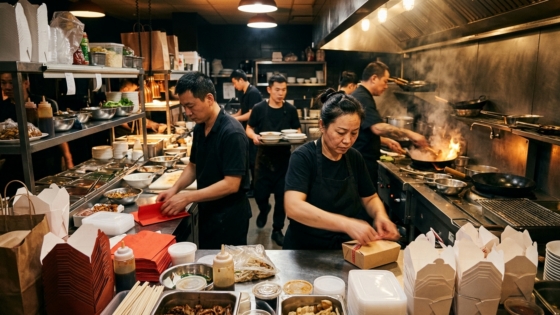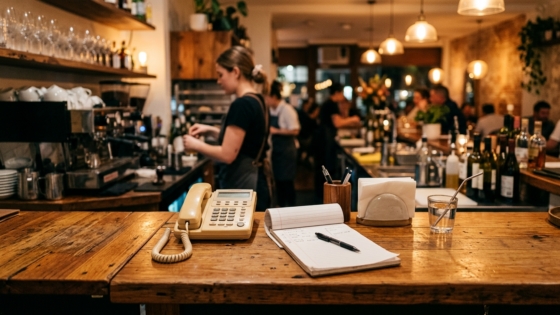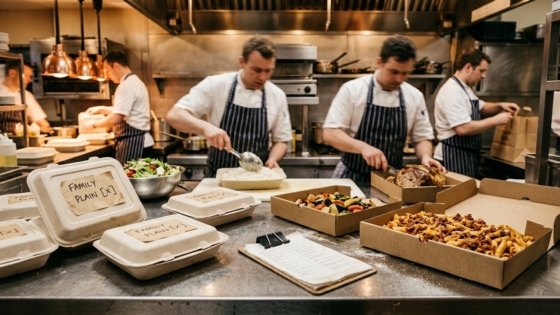
A family of twelve calls to order a Friday night dinner — a combination of individual dishes, two shared platters, one person who needs gluten-free, one shellfish allergy, and they want everything ready for 6:45 PM pickup. Your staff member picks up the phone mid-rush. By the time the call ends, three details have been missed, one quantity is wrong, and the kitchen ticket shows no indication of the shellfish allergy.
Complex orders are not edge cases for most restaurants — they represent some of the highest-value transactions you take in any given week. According to Restaurant Business Online, catering accounted for roughly 11% of the foodservice market, and for operators that commit to it strategically, it can represent 5% to 10% of total restaurant sales — or significantly more in dense office markets. The problem is not the demand. It is the infrastructure for capturing it accurately.
Key Takeaways
- Catering and large group orders carry five distinct layers of complexity — headcount, customization, dietary restrictions, portion estimation, and confirmation — and human phone staff rarely address all five consistently.
- Catering is its own revenue category, not a bigger takeout order, and the phone infrastructure must match its distinct requirements.
- Communication breakdown between phone and kitchen is where most large-order errors occur — not in the kitchen itself.
- AI voice agents can capture all layers of a complex order in a structured format that flows directly to kitchen tickets with zero transcription errors.
- The highest-risk moment in any catering call is the transition from verbal note to kitchen preparation — eliminating that handoff eliminates most mistakes.
Why Catering Calls Break Standard Phone Operations
Restaurant phone operations are optimized for the average call: one or two people, a few items, maybe a modification or two. The physical and cognitive load of that call is manageable. But a catering inquiry — or even a family dinner for eight to twelve people — multiplies every variable simultaneously.
Industry experts are clear on this distinction. Philip Daus, a partner at Simon-Kucher quoted in Restaurant Dive’s analysis of catering operations, put it directly: “Catering is not a bigger takeout order. That’s typically where the pitfall is.” The buyer in a catering scenario is often not the person who will eat the food — it is an office manager, a family organizer, or an event planner who is managing logistics on behalf of a group. Their expectations are different. They need reliability, confirmation, and precision. And they are evaluating your restaurant’s professionalism, not just your food.
This distinction matters because the mental model your staff uses for a regular pickup call is wrong for a catering call. Standard training tells staff to take the order and move on. Catering calls require capturing data across five distinct layers, and missing any one of them creates a downstream failure.
The Five Complexity Layers of Every Catering Call
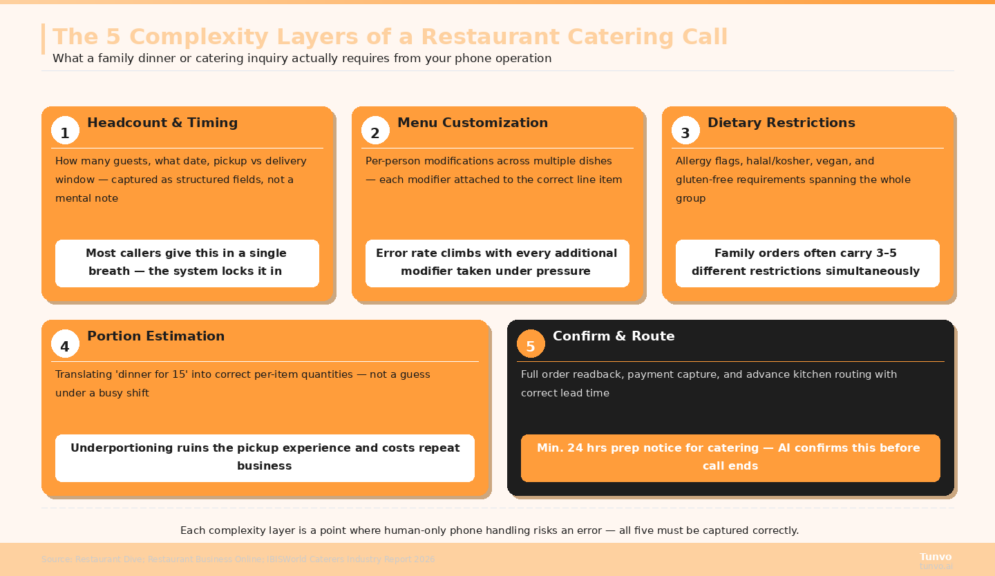

Every catering or large-group call, whether it is a birthday dinner for fifteen or an office lunch for thirty, passes through these five layers:
Layer 1 — Headcount and timing. Most callers give this information quickly and assume it is obvious. Staff often capture it correctly. The error usually comes when timing conflicts with kitchen capacity — when three catering orders are all scheduled for the same pickup window and no one has cross-checked availability against the prep calendar.
Layer 2 — Menu customization. A family ordering General Tso’s chicken for six people does not want all six portions identical. One person wants extra spice. One wants the sauce on the side. One wants white rice instead of fried. Each of these is a separate modifier that must be attached to the correct item on the correct ticket. During a voice call, this is transcribed from memory. The error rate climbs with every additional modifier.
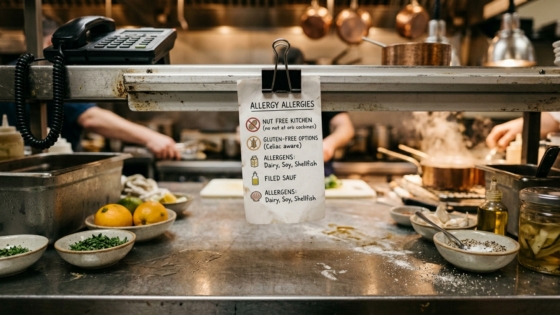
Layer 3 — Dietary restrictions. Unlike individual orders where a single allergy is flagged, group orders often carry three to five different dietary requirements simultaneously: one person is shellfish-free, one is vegan, one cannot eat gluten. Each restriction must be tied to a specific item or portion, not just flagged as a general note. A blanket allergy note on the ticket creates ambiguity in the kitchen about which dishes are affected.
Layer 4 — Portion estimation. “Dinner for twelve” is not a specific order — it is a starting point. Staff with catering experience know how to translate group size into portion quantities for a given cuisine. Staff without that experience guess. Underportioning creates the worst outcome: a family that arrives for pickup and discovers they have food for eight, not twelve, an hour before their dinner party starts.
Layer 5 — Confirmation and routing. Large orders need a longer lead time, advance notice to the kitchen, and a confirmation loop back to the customer. This is the layer most often skipped in a busy shift. The customer hangs up assuming everything is confirmed. The staff member moves to the next call. The kitchen receives the ticket without context about timing requirements.
Where the Real Errors Happen: The Kitchen Handoff
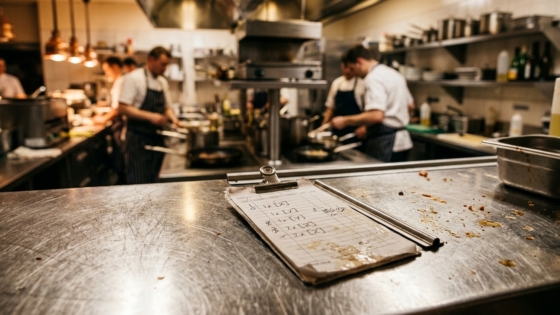
The failure point in most large-order mistakes is not the phone call itself — it is what happens between the call and the kitchen. A verbal order gets transcribed onto a paper notepad. That note is handed to a shift supervisor. The supervisor enters it into the POS manually. Each transcription step introduces the possibility of a dropped modifier, a missed allergy flag, or a timing detail that gets lost.
Research into restaurant catering operations consistently identifies communication breakdowns between front-of-house and back-of-house as the primary driver of large-order failures. The system works when everything goes perfectly. It fails when a single link in the chain breaks — and during a busy dinner rush, the probability of a break somewhere in a multi-step handoff is high.
The practical solution is to eliminate handoffs. When the order is captured digitally at the point of the call — with every modifier, restriction, and timing detail structured into discrete fields — it routes directly to the kitchen ticket without a transcription step. No notes. No manual re-entry. No translation from a staff member’s shorthand to a kitchen instruction.
What AI Voice Agents Do Differently With Complex Orders
An AI voice agent trained on your menu handles catering calls differently from standard phone handling in three specific ways.
First, it works through a structured capture sequence rather than a free-form conversation. When a caller says “we need dinner for fifteen on Saturday at 7 PM,” the system does not just note the number — it captures headcount, date, time, and confirmation of pickup versus delivery as discrete data points. If any is missing, it asks. A human staff member taking the same call may mentally note “fifteen for Saturday” and assume the rest will come up naturally, often missing the delivery question entirely.
Second, the system attaches dietary restrictions and modifications to specific line items rather than adding a free-text note. When a customer says “and we need the noodle dish without peanuts,” the peanut restriction is linked to that specific menu item in the POS ticket — not appended as a general comment at the bottom of the order that the kitchen may or may not see before plating.
Third, the confirmation step is automatic. When the full order is captured, the system reads back the complete order — every item, every modification, every restriction, the timing, and the pickup arrangement — before ending the call. The customer confirms or corrects. That confirmation is logged. If a dispute arises about what was ordered, there is a record.
| Order Element | Human Phone Handling | AI Voice Agent |
|---|---|---|
| Headcount & timing | Captured verbally, transcribed manually | Captured as structured fields, routed to calendar/POS |
| Per-item modifications | Written in shorthand, staff-dependent interpretation | Attached to specific line items in POS ticket |
| Dietary restrictions | Free-text note, kitchen must interpret context | Flagged on affected items; auto-appended to kitchen ticket |
| Portion guidance | Staff experience varies; no consistent check | System can prompt with standard quantity recommendations per headcount |
| Order confirmation | Often skipped during busy periods | Automatic readback before call ends; confirmation logged |
Managing Kitchen Capacity for Large Orders
The most common operational risk in catering is not taking the wrong order — it is accepting too many large orders for the same time window without a mechanism to manage kitchen capacity. A 24-hour lead time policy protects against last-minute chaos, but it does not protect against three catering orders all scheduled for 6 PM on a Friday when your kitchen normally tops out at one.
According to the IBISWorld Caterers industry report, the U.S. catering industry has grown at a compound annual growth rate of 6.7% over the past five years, reaching an estimated $15.7 billion in 2026. The demand for catering continues to rise alongside return-to-office trends — which means the volume pressure on restaurant operations for large orders is increasing, not plateauing.
Managing this at the phone intake level is the most efficient point of intervention. When a catering call comes in and a particular time slot is already at kitchen capacity, the right system does not accept the order and create a problem — it offers alternative pickup windows based on current load. Customers find this transparent and helpful. It also protects the kitchen from the overcommitment that turns a profitable order into a service failure.
Building a Catering-Ready Phone Operation
Restaurants that want to grow their catering revenue need phone infrastructure that matches the complexity of those orders. That means several practical requirements working together: a menu database detailed enough to support per-item modifications, a POS integration that carries order details from intake to kitchen ticket without a transcription step, and a confirmation workflow that creates a record for every large order.
Tunvo’s AI voice agent is built for exactly this scenario. When a catering inquiry comes in, the system walks callers through each layer of the order — headcount, menu selection, modifications, dietary restrictions, and timing — and delivers a structured ticket directly to your kitchen via MenuSifu POS integration. The confirmation readback at the end of the call means every large order is verified before it enters your kitchen workflow. Book a free demo to see how it handles a multi-person catering call end to end.
Common Questions
What is the minimum order size that should use a structured capture process?
Any order with more than four people or more than one dietary restriction warrants a structured approach. Below that threshold, experienced staff handle the complexity naturally. Above it, the number of variables outpaces what most people can hold in working memory during a busy shift without making errors.
How much advance notice should restaurants require for catering orders?
The answer depends on your kitchen setup and prep requirements, but the industry standard for most restaurant-level catering is 24 hours minimum. Anything with more than 20 people or specific packaging requirements benefits from a 48-hour window. The key is to enforce it consistently — and the phone intake point is where that enforcement either happens or breaks down.
Should catering and regular takeout orders be handled through the same phone line?
Operationally, many restaurants run them through the same phone system, but the intake workflow should differ. A catering inquiry that comes in on a regular phone line should be routed to a structured capture process rather than treated as a fast-turnaround order. Some restaurants create a dedicated catering line or a callback workflow for inquiries that require detailed coordination. The goal is to prevent catering calls from being processed under the same mental model as a two-item pickup.
How do I make sure the kitchen has enough lead time when a catering call comes in after hours?
An AI voice agent handles this by accepting catering inquiries 24/7 and routing them into the order queue with a scheduled pickup time. The kitchen receives the ticket at the start of the shift with all details captured. Staff do not need to be on the phone to capture an after-hours catering request — the system logs it completely, and the confirmation readback ensures the customer has agreed to a realistic pickup time. Start a 15-day free trial to see how the after-hours workflow functions in practice.