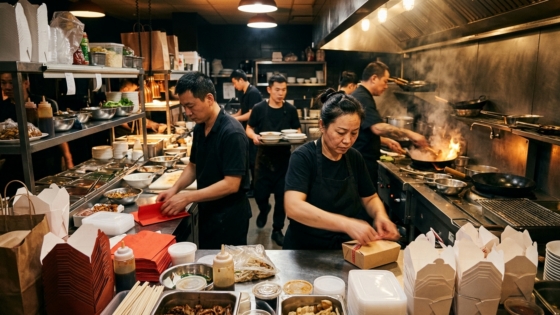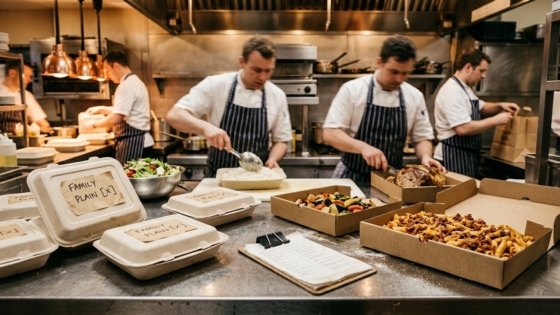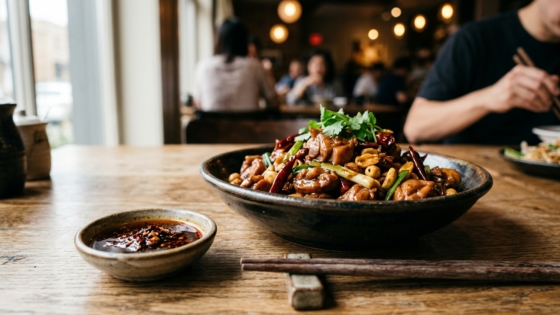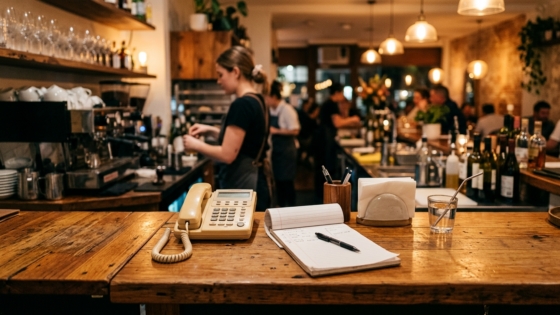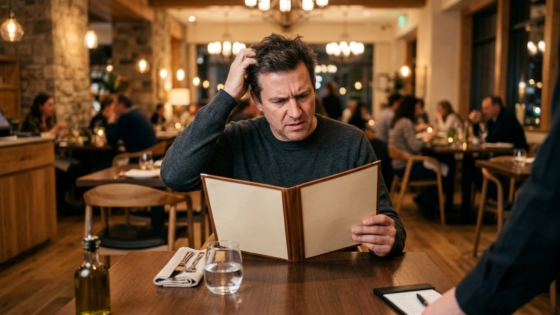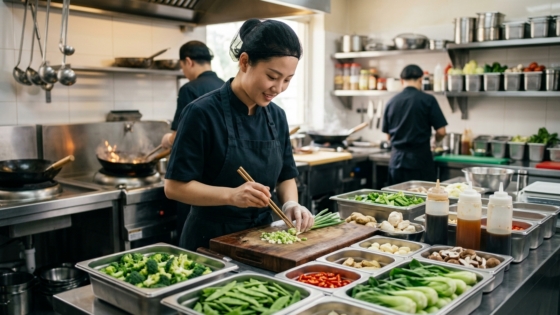
It’s Friday at 6:45 PM. Your dining room is full, the wok station is firing on all burners, and the phone won’t stop ringing. The staff member who picks up speaks perfectly functional English — but the moment a caller with an unfamiliar accent starts rattling off a complicated order, things fall apart. Words get misheard. Items get guessed at. Modifications get missed. And somewhere downstream, a dish comes out wrong.
The accent barrier in restaurant phone ordering is real, and it runs in both directions: staff accents can confuse customers, and customer accents can confuse staff. Neither side is at fault. But the consequences — missed orders, wrong dishes, frustrated customers, and kitchen re-fires — fall entirely on your restaurant to absorb.
The good news is that this is an operational problem, and operational problems have systematic solutions. Here’s how restaurants are tackling it.
Key Takeaways
- Language barriers contribute to a 15% increase in order errors across restaurant operations, according to National Restaurant Association research — accent friction on phone calls is a significant share of that figure.
- Slowing down and confirming back every item immediately is the highest-leverage behavioral change staff can make — and it costs nothing to implement.
- A laminated call script by the phone desk, with phonetic dish descriptions and confirmation phrases, reduces staff anxiety and call time simultaneously.
- AI voice agents eliminate the staff accent variable entirely, handling English phone orders with consistent, neutral speech and 95%+ order accuracy.
 The accent barrier has both human and technological solutions — the right mix depends on your volume and staffing situation.
Why Phone Calls Amplify the Accent Problem
In person, a server with a strong accent still has an enormous communication toolkit at their disposal: gestures, pointing at the menu, expressions, and a shared physical space. Over the phone, all of that disappears. What’s left is voice and vocabulary — and when either side has difficulty decoding the other, the interaction degrades quickly.
Research on communication barriers in restaurants suggests that language and accent differences can contribute to a 15% increase in order errors, with downstream effects on staff efficiency and customer satisfaction. Phone ordering concentrates this risk: the call typically happens during peak hours, with background noise on both ends, under time pressure, with no visual cues available to either party.
The mistake many restaurants make is treating accent friction as a training failure or a hiring problem. It’s neither. It’s an interface design problem — the interface being the phone ordering process itself.
Strategy 1: Slow Down and Confirm Every Item Immediately
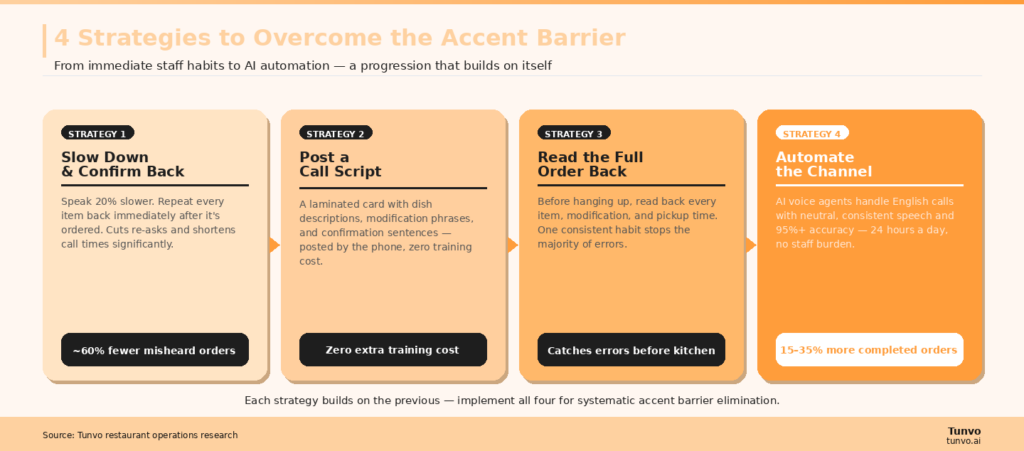
This is the highest-return behavioral change with the lowest implementation cost. Staff who consciously slow their speech by 20% on phone calls — even when the dining room is chaotic around them — are significantly easier for callers to understand, regardless of their native accent.
More importantly, confirming each item as it’s ordered (not just at the end of the call) catches errors in real time. “So that’s the Mapo Tofu — did I get that right?” is a sentence that takes two seconds and prevents a kitchen re-fire. Industry data consistently shows that repeating orders back prevents the large majority of phone ordering mistakes — the challenge is getting tired, busy staff to do it on every single call.
Make this a standard operating procedure, not a suggestion. Include it in shift briefings. Spot-check it on busy nights. Treat a missed confirmation the way you’d treat a missed handwash.
The “Parking Lot” Technique
For complex orders, train staff to use a “parking lot” method: as each item is confirmed, the staff member writes it on a visible notepad or order screen and reads the full list back at the end of the call. “Let me read your whole order back so we get it exactly right” signals professionalism and catches anything that slipped through. Most callers appreciate it — they don’t want wrong food any more than your kitchen does.
Strategy 2: Build a Phone Call Script and Post It by the Phone
Accent barriers compound when staff have to improvise. An unprepared staff member trying to describe what’s in a dish they’re not confident in, in a second language, over a noisy phone line, is going to stumble. Script that situation out of existence.
A laminated one-page call guide posted by the phone desk should include the English descriptors for your ten most commonly ordered dishes (not just the Chinese names), the standard modification phrases customers might use (“on the side,” “well done,” “no [ingredient]”), confirmation sentence templates, and a closing script that confirms pickup time or delivery address.
This doesn’t make phone calls robotic — it makes them reliable. Staff can improvise the warm parts of the conversation. The parts that matter for order accuracy should be scripted.
Sample Confirmation Script Template
| Situation | Scripted Response |
|---|---|
| Customer orders an item | “That’s the [item name] — and would you like rice or noodles with that?” |
| Customer requests a modification | “I’ll note that — [modification] on the [item]. Got it.” |
| Order complete, reading back | “Let me read your whole order: [full list]. Does that sound right?” |
| Closing the call | “That’ll be ready in about [X] minutes. Your name for the order?” |
Strategy 3: Simplify What Goes Over the Phone
Not every item on your menu needs to be available for phone ordering. Some dishes — those with complex modifications, unusual ingredients that require extensive description, or preparation that varies significantly based on verbal customization — are high-risk candidates for phone order errors.
Research on restaurant communication strategy indicates that 70% of customers are more likely to return to a restaurant with clear, consistent communication — even if the food is only average. A streamlined phone menu that covers your bestsellers clearly is better for order accuracy and customer satisfaction than a comprehensive menu that regularly generates confusion.
Consider creating a “phone ordering menu” — a shorter, annotated version of your full menu that staff can reference during calls and that you can text or email to callers who want to browse before calling. The items that stay on the phone menu are those your staff can describe confidently, confirm accurately, and the kitchen can execute consistently.
Strategy 4: Remove the Human Communication Variable Entirely
The most reliable solution to the accent barrier in phone ordering is to remove it from the equation. AI voice agents that handle inbound restaurant calls speak with consistent, clear, accent-neutral English and are designed to understand a wide range of caller accents — including regional American English, non-native accents, and fast speech — because they’re trained on diverse voice data.
Modern voice AI systems are built with multilingual support and accent recognition, allowing them to adapt to a wide range of caller speech patterns even for complex orders. This isn’t the robotic IVR system of ten years ago — it’s conversational AI that can handle modifications, ask clarifying questions, and confirm complete orders before sending them to the kitchen.
For Chinese restaurants specifically, the accent barrier problem is particularly acute because many staff members are more fluent in Mandarin or Cantonese than in English, and many of the restaurant’s English-speaking customers are calling from neighborhoods with significant cultural distance from Chinese cuisine. An AI voice agent bridges that gap without putting the burden on staff who are already managing a full dining room.
Tunvo’s AI voice agent is designed for exactly this use case. Customers calling your restaurant get clear, consistent English voice interaction. Orders go directly to your kitchen via MenuSifu integration. Staff are free to focus on the dining room. Start a 15-day free trial to see how the system handles your specific menu and call volume.
What About the Other Direction — Understanding Customer Accents?
The accent barrier isn’t only about staff accents confusing customers. Staff members with strong English fluency still encounter callers whose accents or speech patterns are difficult to parse — regional American dialects, non-native English speakers ordering in their second language, elderly callers speaking softly, or callers in noisy environments.
The behavioral strategies above (slowing down, scripting confirmations, reading back full orders) help with this too — because they give callers multiple opportunities to correct misunderstandings before the order is placed. Technology also helps: AI voice agents trained on diverse voice data are often better at parsing non-native English accents than human staff who haven’t been specifically trained for it.
The practical implication: don’t try to screen callers or route based on perceived accent. Build your phone ordering system to work reliably across the full range of callers you actually receive.
Frequently Asked Questions
Is it appropriate to ask a caller to repeat themselves if I didn’t understand?
Yes — and doing it correctly is a skill. “I want to make sure I have that right — could you say the item name one more time?” is professional, reassuring, and catches errors. What creates friction is asking the same caller to repeat themselves three or four times, which signals a systemic problem rather than a simple mishear. Script a single clean ask-for-confirmation phrase and use it once; if the item is still unclear, describe what you heard and ask if it’s correct.
Should I hire only English-fluent staff for phone positions?
This restricts your hiring pool unnecessarily and doesn’t address the root problem. The accent barrier affects even fully fluent English speakers when phone conditions are poor. A better approach is to create a phone ordering system — scripts, confirmation protocols, and potentially AI automation — that works reliably regardless of who answers.
How much does an AI voice agent reduce accent-related errors?
By removing staff accent from the equation entirely for phone orders, AI voice systems eliminate one of the two sides of the barrier. Tunvo customers report 95%+ order accuracy on AI-handled calls, compared to significantly higher error rates on staff-handled calls during peak hours. About Tunvo — built by Sobot, Asia-Pacific’s leading customer service platform backed by SoftBank — and how it handles the accent challenge in practice.
Does AI voice technology understand different English accents?
Yes. Modern AI voice agents are trained on diverse voice datasets that include regional American accents, non-native English speakers, elderly voices, and varied speech rates. This is generally better than individual staff members who are exposed to a narrower range of accents during their training. Tunvo’s system is specifically tuned for restaurant ordering vocabulary and the range of modifications and requests common in Chinese restaurant contexts.