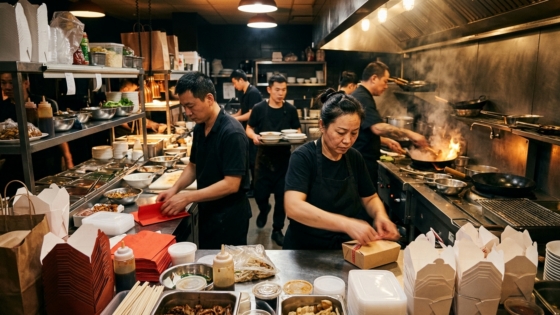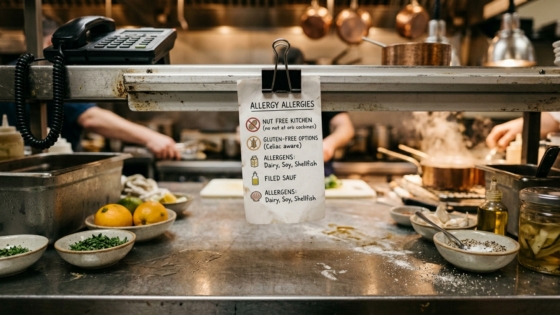
It happens multiple times per shift at almost every Chinese restaurant in New York. A caller places a takeout order and adds, at the end, “and no MSG, please.” The server taking the call is mid-service, writing on a paper ticket while a table flags them down. “No MSG” gets written, or half-written, or skipped. The order goes to the kitchen without the modifier. The guest receives food they specifically asked to be prepared differently. At best, they’re mildly annoyed. At worst — if the request was medically significant — the consequences are serious. This article examines why dietary modification requests fail at the phone stage, what the data shows about the frequency and impact of these failures, and why AI-handled ordering captures these requests more reliably than human staff under pressure.
Key Takeaways
- Food allergy and dietary restriction errors in restaurants are widespread — the CDC’s restaurant food safety research identifies allergen miscommunication as a leading cause of adverse reactions at dining establishments.
- The phone ordering stage is the highest-risk point for dietary modification loss — handwritten transcription under pressure during peak service is structurally error-prone.
- AI voice ordering systems capture dietary modifications as structured data fields, not handwritten notes — eliminating the transcription step that causes most modifier failures.
Why Dietary Modifiers Get Lost at the Phone Stage
The Peak-Hour Attention Problem
A phone order during dinner rush is never taken in a quiet moment. The person answering — whether a dedicated phone worker or a server pulled from the floor — is handling multiple sensory streams simultaneously: the caller’s voice, background restaurant noise, other staff communication, and the visual environment of an active service. Under these conditions, the cognitive load of taking an order already taxes working memory. Add a modifier at the end of the order — “oh, and no MSG, can you do that?” — and the mental slot for that addition is competing with everything else.
Research on working memory and multitasking in high-cognitive-load environments consistently shows that late-arriving information in a sequence is disproportionately vulnerable to loss. In a restaurant context, this is the “last thing the caller said” problem — modifiers stated at the end of an order, or added as an afterthought mid-call, are the ones most likely to be omitted from the written ticket. CDC research on restaurant food safety practices identifies communication breakdowns between front-of-house and kitchen staff as a primary pathway for allergen incidents — and the phone order transcription point is where that breakdown most commonly originates.
The Handwriting and Ticket Legibility Problem
Paper ticket systems — still the standard in many Chinese restaurants — require a server to write modifiers legibly under time pressure, then pass that ticket to a kitchen that may have its own language and abbreviation conventions. “No MSG” written in haste may be abbreviated, illegible, or simply omitted from a ticket where space is limited. A study published in the journal Frontiers in Allergy in 2023 examining food allergy risks in the dining industry found that the failure point in the vast majority of restaurant allergen incidents was communication breakdown — not kitchen error — with handoff between order-taking and preparation identified as the highest-risk moment.
The “I Thought MSG Was Optional” Ambiguity Problem
In Chinese restaurant kitchens, MSG usage is often implicit rather than explicit — a baseline assumption rather than a per-dish decision. When a modifier arrives at the kitchen as “no MSG” on a paper ticket, it may be interpreted differently by different cooks: does it mean no MSG in the sauce? No MSG in the wok? No MSG-containing ingredients like oyster sauce? Without a standardized protocol for what “no MSG” means at the kitchen level, even a correctly transmitted modifier may result in inconsistent execution. This is a systems problem that precedes any technology fix — but it’s a problem that AI ordering systems can surface more clearly, because they capture the modifier in a structured field that can be configured to trigger specific kitchen protocols.
What AI Ordering Does Structurally Differently
Modifiers Become Structured Data, Not Handwritten Notes
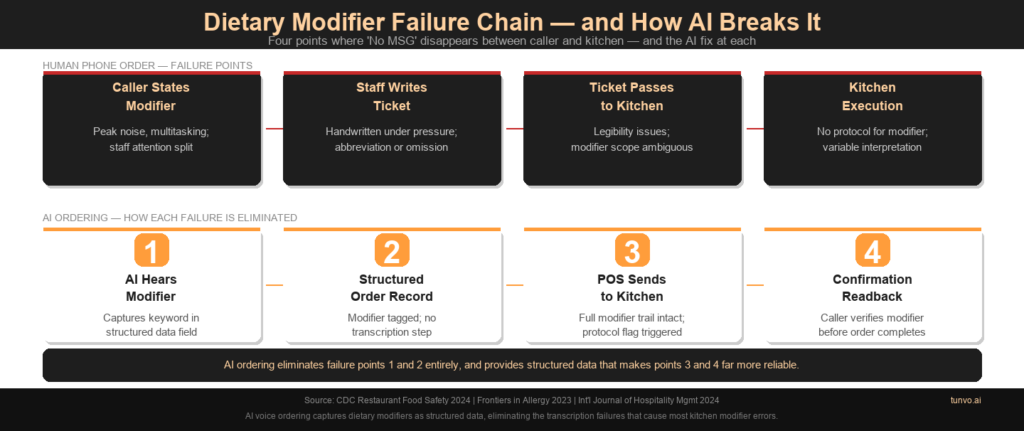
When a caller tells an AI voice ordering system “no MSG, please,” the system doesn’t write it on a paper ticket. It captures the modifier as a tagged field in a structured order object — the same way a web order form captures “extra sauce” or “no onions” as a checkbox selection. That modifier travels through the system with the order, intact, to every downstream step: the kitchen ticket, the POS record, the confirmation readback to the caller, and the re-fire protocol if there’s a question.
This structural difference is fundamental. Handwritten modifier capture requires a human to: (1) hear and correctly parse the modifier under noise, (2) hold it in working memory while writing the order, (3) write it legibly, and (4) ensure it appears on the kitchen-facing ticket. AI capture requires none of these intermediate steps — the caller states the modifier, the system recognizes it, and it’s in the order record. The error rate is dramatically lower not because AI is smarter than a server, but because it eliminates the four points of failure that exist in the human-mediated process.
The Readback Loop Adds a Verification Layer
Well-designed AI ordering systems confirm the full order back to the caller before completing the transaction: “Your order is: one Kung Pao Chicken, one Beef with Broccoli — no MSG on both dishes, one order of steamed rice. Does that sound right?” This readback creates a verification loop that rarely exists in high-volume phone ordering with human staff. A caller who hears their modifier confirmed is both reassured that it was captured and given an opportunity to correct it if not. This is a guest experience improvement that also functions as a quality control step — and it happens consistently, on every order, regardless of service volume.
Dietary Keywords Can Be Configured With Kitchen Protocols
For restaurants that want to go further, AI ordering systems can be configured to map specific dietary keywords to specific kitchen instructions. “No MSG” can trigger a kitchen ticket flag that specifies: “Use no MSG seasoning; substitute low-sodium soy; confirm with prep cook before plating.” “Gluten-free” can trigger a cross-contamination protocol flag. “Severe nut allergy” can trigger an escalation to a human staff member for confirmation before accepting the order. This level of systematic dietary modifier management is not practical with handwritten ticket systems, and it substantially reduces both the incidence and the severity of dietary modification failures. Tunvo’s AI voice agent captures dietary modifiers at the ordering stage and routes them directly to your POS with full modifier data intact.
The Scope of the Problem: What the Research Shows
How Common Are Food Allergy Reactions at Restaurants?
The CDC’s January 2026 data brief on allergic conditions in US adults confirms that food allergies affect a significant and growing proportion of the population. Separately, a 2024 study published in the International Journal of Hospitality Management reviewing two decades of evidence on dining out with food allergies found that restaurants remain the leading site of severe allergic reactions — with communication failures between guests and staff identified as the most preventable contributing factor.
For operators, the stakes are clear: a dietary modification error that causes a guest to become ill is not just a reviews problem. It is a liability exposure, a repeat-business loss, and in severe allergy cases, a medical emergency. The operational investment in systems that reduce modifier failure rates has a direct impact on this risk profile.
The “No MSG” Case in Chinese Restaurant Contexts
MSG sensitivity — whether medically documented or preference-based — is one of the most common dietary modification requests in Chinese restaurant ordering. For Chinese restaurant operators, this creates a specific operational challenge: MSG is often embedded in multiple components of a dish (sauce bases, premade ingredients, cooking oil preparations), meaning “no MSG” requires kitchen-level changes to the preparation process, not just a single ingredient omission. A modifier that arrives as a paper ticket note “no MSG” without specificity creates ambiguity at every kitchen station. A modifier that arrives as a structured flag with a configured protocol creates consistency — and consistency is what protects both the guest and the restaurant.
| Modifier Type | Human Phone Risk | AI System Advantage |
|---|---|---|
| No MSG | Lost in noise or omitted under pressure; kitchen ambiguity on scope | Captured as tagged field; configurable kitchen protocol triggered |
| Gluten-free request | Transcription error; no cross-contamination protocol triggered | Structured flag with prep protocol; consistent every order |
| Nut/shellfish allergy | High-stakes; human may not escalate for kitchen confirmation | Configurable to escalate to human; documented in order record |
| Less spicy / no chili | Vague without protocol; variable interpretation by kitchen | Confirmation readback; specific modifier sent to kitchen |
| Vegan / no meat stock | Often missed for dishes with hidden meat-based sauces | Full modifier trail in POS record; kitchen notified on ticket |
Common Questions
Can AI ordering systems understand unusual dietary requests that aren’t standard menu modifiers?
Modern AI voice ordering systems handle a wide range of dietary modification language — including informal phrasing like “I can’t have MSG,” “I’m avoiding gluten,” or “nothing spicy at all, please.” Where the request falls outside the trained vocabulary, well-designed systems prompt the caller for clarification or offer a human escalation. The key configuration question is how the operator maps common dietary requests to specific kitchen instructions — a one-time setup that pays dividends on every subsequent order. Book a demo to see how Tunvo’s menu training handles your specific dietary modifier vocabulary.
What if a caller has a severe allergy and the AI gets it wrong?
Severe allergy cases — where an error carries genuine medical risk — represent the category where AI ordering systems should be designed to escalate rather than resolve. The right configuration for a potentially life-threatening allergy request is: AI captures the modifier, flags it as high-severity, and routes the caller to a human staff member for explicit confirmation before accepting the order. This is not a failure of AI — it’s a design feature of a responsibly configured system. Operators should verify during implementation that their AI ordering system has a configurable escalation path for allergy severity levels. See how Tunvo approaches responsible AI ordering design for restaurant environments.
Do customers trust AI to get their dietary requests right?
Trust follows performance. Callers who experience an AI system that correctly captures their “no MSG” request, confirms it in the readback, and delivers a dish that reflects it will quickly develop higher confidence in the AI than in the human who took the order last time and got it wrong. The readback confirmation loop is particularly effective here: hearing “your order includes no MSG on both dishes” before completing the order gives guests tangible evidence that the modifier was captured. According to Food Safety Magazine’s 2025 analysis of allergen prevention practices, the single most effective intervention at the order-intake stage is consistent verbal confirmation of dietary modifiers — exactly what AI ordering delivers on every call.