For many staff at Chinese restaurants, the moment a phone call comes in from a caller who clearly doesn’t know the menu — and isn’t sure how to describe what they want — is a moment of low-grade dread. Not because the caller is difficult, but because the staff member knows that what follows is likely to be a slow, effortful negotiation that probably ends with something getting written down wrong.
This doesn’t have to be the situation. Taking orders from non-Chinese-speaking customers is a communication challenge that has been thoroughly solved — not by hiring bilingual staff or rewriting your entire menu, but by putting a systematic phone ordering protocol in place. Here’s the one that works.
Key Takeaways
- A consistent 5-step call flow reduces staff anxiety, shortens call times, and dramatically cuts kitchen errors — without requiring any additional staffing.
- Guiding callers through categories (“noodles, rice dishes, or dumplings?”) works better than waiting for them to navigate your menu on their own.
- Five-word dish descriptions — protein, cook method, sauce — communicate more effectively than reading dish names aloud over the phone.
- AI voice agents can handle this entire interaction automatically, freeing staff to focus on the dining room during peak hours.
Why This Is Harder Than It Needs to Be
Most of the friction in non-Chinese-speaker phone orders comes from a single underlying problem: the restaurant’s phone ordering process was never explicitly designed. Staff improvise. Each call is different. When a staff member who’s more comfortable in Mandarin than English gets a call from a first-time customer who’s never eaten Chinese food, the outcome depends entirely on that day’s luck.
70% of customers are more likely to return to a restaurant with consistently clear communication — even if the food is only average. Consistency is the operative word. A designed phone ordering process produces consistent outcomes. An improvised one doesn’t.
The good news: designing the process takes about an hour and costs nothing except a laminated sheet of paper and a training conversation with your team.
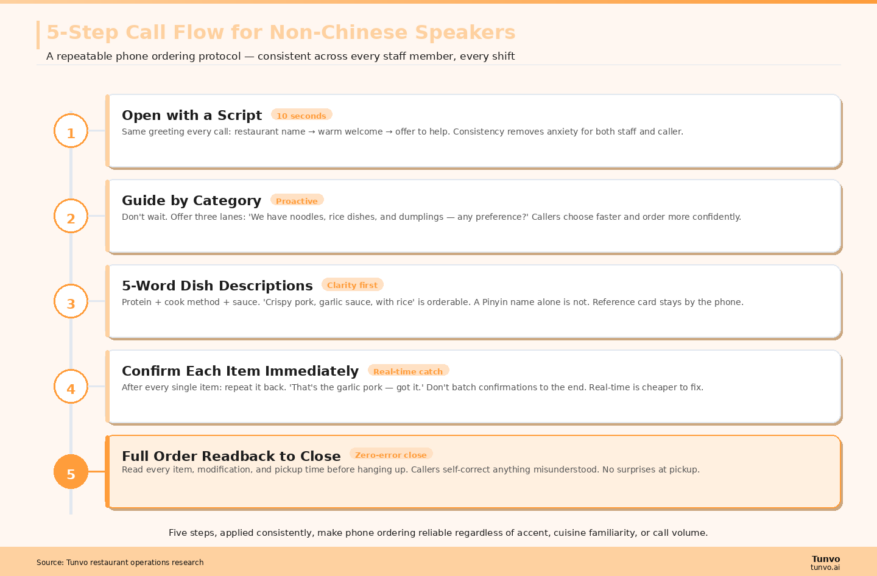
Step 1: Open Every Call the Same Way
Consistency starts at the first word. Every call should open with the same scripted greeting: the restaurant’s name, a warm welcome, and an offer to help. Something like “Thank you for calling [Restaurant Name], this is [name], how can I help you?” takes four seconds and sets a professional, calm tone that reduces anxiety for both the caller and the staff member.
Staff who improvise their opening often skip their own name, say the restaurant name unclearly, or start with “Hello?” — which is ambiguous, unprofessional, and gives the caller nothing to anchor to. The scripted opening matters because it signals to the caller that they’re in good hands, which makes the rest of the conversation easier.
What Not to Say
Avoid openings that are too informal (“Yeah?”), too terse (“Orders?”), or too fast for a caller to parse. Callers who can’t understand the first thing you say will spend the rest of the call anxious about whether they’re being understood — and that anxiety shows up as repeated asks for confirmation, slower ordering, and more modifications as they second-guess themselves.
Step 2: Guide, Don’t Wait
After the opening, most staff members wait for the caller to tell them what they want. This is a mistake when the caller is unfamiliar with Chinese cuisine, because they may not know where to start. They’re holding a menu (or looking at a website), feeling mildly overwhelmed, and hoping for help.
The better approach is to be the guide. After the greeting, offer three category choices: “We have great noodle dishes, rice plates, and dumplings — do any of those sound good?” Most callers will immediately pick a lane, and from there the conversation becomes much simpler. You’re not leaving them in an open field; you’re giving them a path.
This is the same principle that hospitality researchers describe as reducing decision fatigue in ordering — simplifying the choice architecture makes callers more confident and reduces order time.
Step 3: Describe Dishes in Five Words
This is the technique that unlocks the hardest part of the call: helping a caller who doesn’t know your menu understand what your dishes actually are. The principle is to use five words or fewer, covering the key dimensions a caller cares about: what protein, how it’s cooked, and what sauce or accompaniment it comes with.
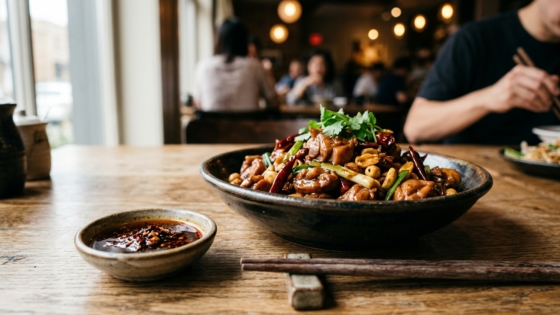
“Mapo Tofu” means nothing to a first-time caller. “Soft tofu in spicy sauce” means something. “Char Siu” is opaque; “roasted BBQ pork, sweet glaze” is not. “Shrimp with lobster sauce” (an American Chinese standard) is actually self-explanatory — most items can be described that way once you develop the habit.
Build a reference card of your twenty most popular dishes with their five-word descriptions. Post it by the phone. Staff will use it until the descriptions are memorized, and then continue using it for new staff who join.
Five-Word Description Examples
| Menu Name | Five-Word Phone Description |
|---|---|
| Mapo Tofu | Soft tofu in spicy sauce |
| Dan Dan Noodles | Noodles, peanut sauce, minced pork |
| Char Siu Bao | Steamed buns, BBQ pork filling |
| Kung Pao Chicken | Chicken, peanuts, spicy, with rice |
| Wonton Soup | Pork dumplings in clear broth |
Step 4: Confirm Each Item Immediately
After each dish is ordered, confirm it before moving on. Not at the end of the call — immediately. “That’s the soft tofu in spicy sauce — got it. And rice or noodles with that?” takes five seconds and prevents the item from being misheard.
Real-time item confirmation is consistently identified as the most effective way to prevent order errors in restaurants — because it catches mistakes at the point where they’re cheapest and easiest to correct, rather than at the point where the wrong food is in front of a customer.
Train staff to treat the confirmation as part of the rhythm of the call, not as a sign that they didn’t hear correctly. “Let me make sure I have that right” is professional, not apologetic.
Step 5: Read the Full Order Back Before Closing
Before ending the call, read back the complete order: every item, every modification, the quantity, and the pickup time or delivery address. “Let me read your whole order back so we get it exactly right” signals professionalism and gives the caller one final chance to catch anything that went sideways.
This is especially important for non-Chinese-speaker callers because they may have been uncertain throughout the ordering process about whether they were understood correctly. The full readback gives them certainty — and certainty converts first-time callers into repeat customers.
When Human Staff Shouldn’t Be the Solution
The five-step protocol works well and is worth implementing immediately. But for restaurants with high phone volume or limited English-fluent staff, it has practical limits — during a Friday dinner rush, a ten-minute phone call from a first-time caller is a significant operational cost.
This is exactly the situation AI voice ordering was built for. Tunvo’s AI voice agent handles the entire five-step flow automatically: it opens calls consistently, guides callers through the menu, describes dishes in plain language, confirms each item in real time, and reads back the complete order before closing. The call goes directly to the kitchen via MenuSifu integration, with no staff involvement required. Staff who would otherwise spend 10–15 minutes on a difficult phone call spend that time on the dining room instead.
Restaurants in the New York area using Tunvo report a 15–35% increase in phone order volume — in part because the ordering experience is reliable enough that customers actually complete the call rather than giving up. Book a free demo to see how it handles your specific menu.
Frequently Asked Questions
How do I handle a caller who gets frustrated mid-call?
Stay calm and stay on script. “I want to make sure I get your order exactly right — let’s go through it together” de-escalates almost any frustration because it signals attentiveness and care. If the caller is genuinely agitated, apologize briefly and offer to transfer them to a manager if needed — but most callers who are frustrated at the start of a call become satisfied if the rest of the call goes smoothly.
What if a caller wants something we don’t have?
Have a scripted answer ready: “We don’t have that on our menu, but I can suggest something similar — [description].” Offering an alternative keeps the caller on the call and demonstrates hospitality. A caller who hangs up because you couldn’t suggest anything is a missed order.
How long does it take to train staff on this protocol?
One 20-minute training session covers the five steps. A laminated reference card handles dish descriptions. Role-playing two or three mock calls makes the protocol feel natural before it’s used live. Total investment: under an hour per staff member, with a return that shows up on the very next shift.
Is there a way to handle this without adding any staff burden at all?
Yes. Tunvo’s AI voice agent handles inbound phone orders entirely automatically, with no staff involvement for standard orders. About Tunvo — Tunvo is built by Sobot, Asia-Pacific’s leading customer service platform backed by SoftBank — and how the system handles the full range of non-Chinese-speaker ordering scenarios.