The pitch sounds almost too good: deploy an AI phone system, eliminate your phone-answering headaches overnight, and never miss a call again. For a restaurant owner fielding 40 calls during a Friday dinner rush while a server is already on hold with a supplier, the appeal is obvious. But “can AI replace your front desk?” is the wrong question. The better question is: which front desk functions should AI handle, which should stay human, and what does the evidence actually show when operators make this switch? This article gives you the full picture — including where AI falls short and what the real-world performance data looks like.
Key Takeaways
- 89% of U.S. independent restaurant operators said they feel positive about AI technology according to TouchBistro’s 2025 State of Restaurants Report — but adoption and results are still uneven.
- AI phone agents excel at the high-volume, high-repetition tasks — inbound ordering, FAQ answering, reservation intake — and genuinely underperform on emotionally complex or situationally novel interactions.
- The practical model for most restaurants isn’t AI vs. human front desk — it’s AI + human, where the AI handles the mechanical layer and humans handle the relational layer.
The Case For: What AI Does Better Than a Human Front Desk
It Never Goes Off-Shift, Never Gets Flustered, Never Misses a Call
The fundamental advantage of an AI phone system is availability. A human front desk — whether a dedicated receptionist or a server pulling double duty — has a finite capacity. During a busy service, calls go to voicemail. After closing, calls go unanswered. An AI voice agent answers every call, on the first ring, at 11 PM on a Tuesday and at 7:30 PM on a Saturday with equal consistency. Industry research consistently finds that 20–43% of restaurant calls during peak hours go unanswered, representing direct, measurable revenue loss. That number drops to near zero with a well-implemented AI phone layer.
According to a February 2026 National Restaurant Association report cited by Restaurant Dive, over 25% of restaurant operators now use AI in some capacity — and the fastest-growing category is phone and customer communication automation. The operators who report the clearest ROI are consistently those who use AI for inbound call handling rather than in-dining floor operations, where human judgment matters more.
It Handles the High-Volume Repetitive Layer That Burns Out Humans
The majority of front desk interactions at a restaurant are structurally identical: “What are your hours?” “Can I place a takeout order?” “Do you have vegetarian options?” “Can I modify my order?” These are not tasks that require human warmth or judgment — they require accuracy and availability. An AI system trained on your menu and FAQ database handles these interactions without fatigue, without error variation, and without the performance degradation that affects human staff after hour four of a busy service.
This is where the operator math gets compelling. A human front desk employee handling 40 calls per shift at $15/hour fully loaded is costing roughly $60 per shift in direct labor just for phone coverage — before accounting for the floor time lost when a server answers the phone mid-table. An AI phone system running 24/7 at a monthly subscription cost eliminates both the labor line and the service interruption, simultaneously. See how Tunvo’s pricing compares to a dedicated phone position for a restaurant at your volume.
It Produces Consistent Order Accuracy
Human phone-order accuracy is limited by environmental noise, accent comprehension, multitasking under pressure, and handwriting legibility. Kitchen mistakes that trace back to miscommunicated phone orders are a documented source of food waste, comped meals, and negative reviews. AI systems designed for restaurant ordering — trained on specific menu items, modifiers, and common customization patterns — eliminate the transcription step entirely. Orders go from voice to POS without intermediate human entry, which is where most transcription errors are introduced. According to Tunvo, its AI voice agent delivers 95%+ order accuracy across tested restaurant environments, eliminating a significant category of kitchen ticket errors.
The Case Against: Where AI Still Falls Short
Emotionally Complex Interactions Still Need a Human
A guest calling to complain about a previous visit, a VIP who wants to arrange a surprise anniversary dinner with specific seating and a custom cake arrangement, a caller managing a severe allergy situation that requires confirmation from kitchen staff — these are not tasks where AI performs reliably or appropriately. Even Taco Bell, after processing over 2 million AI-handled orders, acknowledged in August 2025 that certain customer interactions still belong in human hands. The lesson from large-scale AI ordering deployments is consistent: for predictable, patterned interactions, AI is superior. For novel, emotional, or high-stakes interactions, humans remain essential.
The practical design implication: any well-implemented AI phone system should include a clear escalation path — a way for callers to reach a human for situations the AI cannot resolve. Systems that force every interaction through an AI funnel with no human fallback generate frustration and negative reviews at exactly the interactions that matter most.
Accent and Dialect Variability Remains a Real Challenge
AI voice recognition systems have improved dramatically, but performance still varies across accent types, speaking speeds, background noise levels, and regional dialect variations. For restaurants serving diverse communities — particularly Chinese restaurants in New York where callers may speak Cantonese, Mandarin, Fujianese, or accented English — the system’s language model needs to be trained specifically for these patterns. A generic AI phone system deployed without dialect-specific training will produce more errors, not fewer, for the exact caller population that matters most to the restaurant. This is a configuration and training investment that operators should evaluate honestly before deployment.
The “Cold” Interaction Problem for Relationship-Driven Guests
Some restaurant guests — particularly regulars at family-style or independent restaurants — have relationships with specific staff members. They call and ask for someone by name. They expect to be recognized. They derive satisfaction from the personal element of the interaction. For these guests, an AI phone system is a perceptible downgrade in experience, and some percentage will express this in reviews or simply order less frequently.
This is not an argument against AI phone systems — it’s an argument for thoughtful implementation. Operators who communicate the change proactively (“you can still reach us directly for anything special — just press zero”), who ensure the AI experience is genuinely high quality, and who preserve human availability for complex requests tend to retain relationship-driven guests more successfully than those who deploy AI without communication or fallback design.
The Real-World Performance Picture: What Operators Report
Where AI Delivers Consistent ROI
The clearest ROI cases from AI phone adoption cluster around three operator profiles: high-volume takeout restaurants (particularly Chinese, pizza, and other delivery-heavy concepts) where phone orders constitute a significant share of revenue; restaurants with understaffed or undertrained phone coverage; and multi-location operators who cannot afford a dedicated front desk at every site. In these scenarios, the call answer rate improvement (from 60–70% to near 100%), the order accuracy improvement, and the labor cost reduction combine to deliver payback periods measured in months, not years.
Where Results Are More Mixed
Fine dining operators, event-heavy restaurants that receive complex group booking inquiries, and restaurants with a strong regulars culture have reported more mixed results with pure AI front desk replacement. The common thread is that these operations have a higher proportion of calls that don’t fit the predictable pattern — which is exactly where AI struggles. For these operators, the better configuration is AI for inbound ordering and FAQ handling, with a human channel preserved for reservations and relationship interactions. Learn how Tunvo approaches this hybrid model for restaurant operators with mixed call profiles.
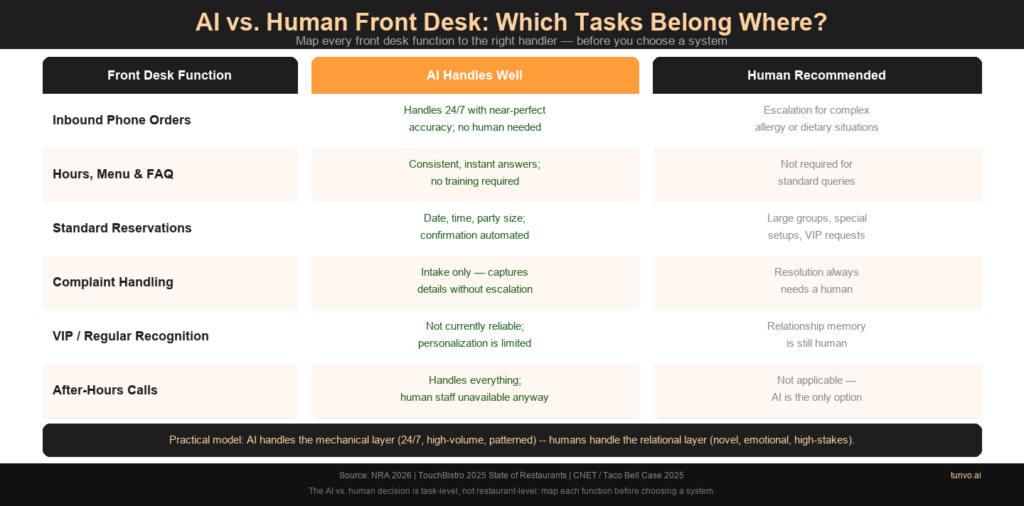
The Practical Decision Framework
| Front Desk Function | AI Handles Well | Human Recommended |
|---|---|---|
| Inbound phone orders | Yes — especially high volume | Escalation for allergy/complex orders |
| Hours, menu, location FAQ | Yes — consistently | Not required |
| Standard reservations | Yes — date, time, party size | Special requests, large groups |
| Complaint handling | Intake only — not resolution | Yes — resolution requires human |
| VIP / regular recognition | Not currently reliable | Yes — relationship memory |
| After-hours / overnight calls | Yes — humans unavailable anyway | Not required |
Common Questions
Will guests complain if they realize they’re talking to an AI?
Reaction varies by guest type and interaction quality. TouchBistro’s 2025 State of Restaurants Report found that 89% of independent operators feel positive about AI — suggesting that operator anxiety about guest pushback may be overstated. Guests who experience an AI that answers promptly, gets their order right, and resolves their question efficiently tend to be satisfied regardless of whether the voice is human. Guests who experience a slow, error-prone, or frustrating AI interaction will react negatively — so the quality of the implementation matters more than the presence of AI itself.
Do I need to tell customers I’m using AI?
This depends on your jurisdiction. Several US states have disclosure requirements for AI interactions in commercial contexts — California’s BIPA-adjacent guidelines and emerging state-level AI transparency laws are worth reviewing with a legal advisor. Beyond compliance, proactive disclosure (“You’ve reached the Tunvo AI ordering assistant for [Restaurant Name]”) tends to generate less friction than callers who discover they’re speaking with AI mid-conversation. Transparency is both good ethics and better UX design. Review Tunvo’s privacy policy and disclosure standards to understand how compliant AI call handling works in practice.
What happens when AI can’t answer a question?
The answer depends entirely on how the system is designed. A well-configured AI phone agent recognizes the boundaries of its training — questions outside its knowledge base, complex requests, or caller distress signals — and offers a clear escalation path: hold for a staff member, receive a callback, or leave a detailed message. Systems that attempt to answer everything regardless of confidence generate misinformation and frustrated callers. Evaluating the escalation design of any AI phone system is as important as evaluating its ordering accuracy. Book a demo with Tunvo to see how its escalation logic works and whether it fits your restaurant’s specific call profile.
Is 2025 the right time to make this investment, or should I wait?
The technology has matured significantly. According to Restaurant Technology News, 69% of restaurants are now adopting AI in some form as of early 2026. Operators who waited for the technology to mature are now entering a market where the systems are genuinely production-ready for high-volume phone ordering. The cost of waiting — in missed calls and labor costs — is real. The cost of early adoption before the technology was ready was also real. The current window represents a reasonable balance of technology maturity and competitive advantage for operators who move decisively.