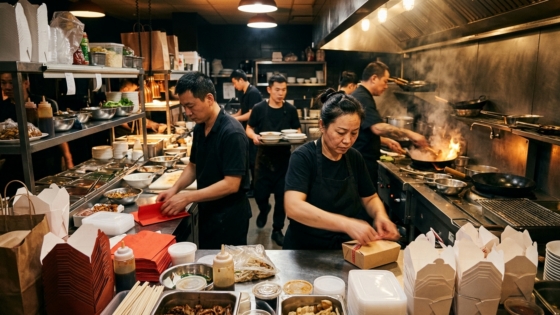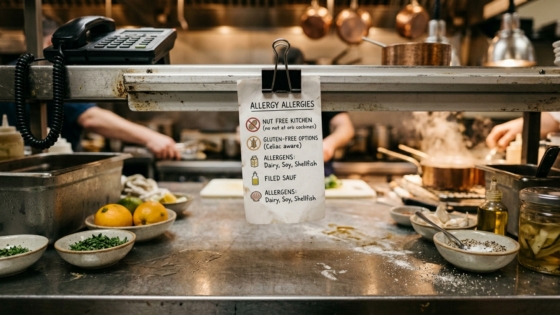
A caller places their order and adds: “Can I get the sauce on the side?” The staff member says yes, hangs up, and writes the order ticket. The kitchen sees the ticket and makes the dish normally. The customer picks up their food, opens the bag, and the sauce is on the noodles, not in a separate container.
This isn’t a deliberate failure. It’s a communication chain with a gap in it — the modification phrase was heard, confirmed, and then lost between the phone and the kitchen because the meaning wasn’t fully shared. This happens dozens of times a day in restaurants that serve English-speaking customers without a standardized modification vocabulary.
The good news: these gaps are entirely fixable. Most customers use the same six or seven modification phrases, and once your staff and kitchen understand what each one specifically means, the error rate on modifications drops to near zero.
Key Takeaways
- “On the side” means a separate container for any sauce, dressing, or topping — not reduced, not mixed in. This is the most commonly misunderstood modification.
- “No [ingredient]” means complete omission, not reduction — and for allergen requests, it requires kitchen confirmation of cross-contact risk.
- Heat level requests (“mild,” “medium,” “spicy”) need an explicit internal translation to your kitchen’s chili scale to be actionable.
- Standardizing modification handling with a printed ticket format and kitchen protocol is more reliable than staff memory alone.
Why Modifications Generate Disproportionate Errors
Standard orders — a dish, a side, a drink — have a clear, complete vocabulary on both sides of the call. Modifications introduce ambiguity because they’re defined differently by different callers and understood differently by different staff members.
“Extra sauce” to one caller means a generous pour; to another, it means double the normal portion in a separate container. “Mild” at one restaurant means no chili at all; at another, it means one chili pepper instead of three. These definitions live in different mental models, and when a busy call goes from phone to ticket to kitchen without those models being aligned, something gets wrong.
Research on restaurant communication shows that language differences and ambiguous requests contribute significantly to the 15% order error rate attributable to communication gaps — and modifications are among the most common sources of that ambiguity.
The Six Modification Phrases Your Staff Must Know Cold
1. “Sauce on the Side”
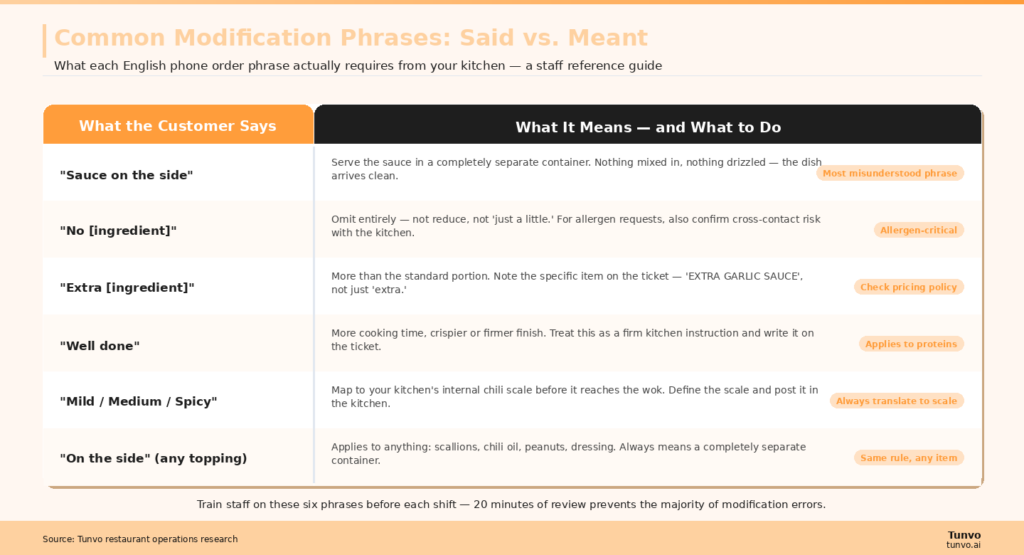
This is the most common and most frequently mishandled modification phrase in English-language restaurant ordering. When a customer says “sauce on the side,” they mean: serve the sauce in a completely separate container. Not mixed in, not lightly applied, not drizzled over — not on the dish at all. The dish should arrive clean, with the sauce in a small container alongside it.
The confusion happens because in many Chinese cooking contexts, sauce is integral to the dish and not conceptually separable. But for customers who are managing sodium, allergies, portion control, or simply personal preference, “on the side” is a firm instruction. Train staff to write it explicitly on the order ticket: “SAUCE: SEPARATE CONTAINER.”
The same phrase applies to any topping or condiment: “dressing on the side,” “chili oil on the side,” “scallions on the side.” The pattern is always the same — the item should not touch the main dish.
2. “No [Ingredient]”
This means omit the ingredient entirely — not reduce it, not put it on the side, not “just a little.” For standard preferences (no onions, no mushrooms), this is typically an aesthetic choice. But “no [ingredient]” is also the phrase customers use when they have an allergy or intolerance, which means the stakes are potentially much higher.
Train staff to ask a follow-up question for “no” requests: “Is that a preference or an allergy?” If it’s an allergy, the kitchen needs to know explicitly — because cross-contact from shared cooking surfaces and utensils can affect even dishes where the allergen wasn’t included. Industry data indicates that nearly half of food allergy-related hospitalization incidents occur in restaurants, making allergen modification the highest-stakes communication in phone ordering.
3. “Extra [Ingredient]”
“Extra” means more than the standard portion. “Extra sauce,” “extra vegetables,” “extra rice” — these are additions, not substitutions. The operational question this generates is: does “extra” come at an extra cost? Many restaurants charge for extra protein (extra shrimp, extra chicken) but not for extra sauce or extra vegetables. Having a clear policy — and having staff know it — prevents awkward price conversations after the modification has been confirmed.
On the order ticket, “extra” should be written explicitly with the specific item: “EXTRA GARLIC SAUCE” not just “extra.” Kitchen staff who see “extra” without knowing what item is being amplified have to guess.
4. “Well Done”
“Well done” is primarily a meat doneness request — steak, chicken, pork — but English-speaking customers also use it more loosely to mean “cooked more” or “crispier” when applied to other items like pan-fried dumplings, crispy dishes, or anything that has a spectrum from soft to crisp. In the context of Chinese restaurant phone ordering, you’ll most often hear it for proteins.
For safety as well as customer satisfaction, “well done” should be treated as a specific instruction to the kitchen — not a suggestion. Write it on the ticket. The customer who asked for it is a customer who will notice if it’s not done.
5. Heat Level: “Mild,” “Medium,” “Spicy”
Heat level requests are common for Chinese dishes, but “mild,” “medium,” and “spicy” are relative terms that mean different things to different people — and completely different things depending on what restaurant or cuisine they’ve ordered from before. The only way to make these actionable for your kitchen is to define them in your internal terminology.
Create a simple internal scale: “Mild = no added chili; Medium = 1 dried chili per portion; Spicy = 3+ dried chilies.” Post the scale in the kitchen and reference it on order tickets. When staff confirm a heat level request with a caller, they should communicate in customer language (“mild/medium/spicy”) and translate to kitchen language on the ticket.
6. “Substitute” or “Instead Of”
Substitution requests — “can I get tofu instead of chicken?” or “can I have brown rice instead of white?” — are the most complex modification type because they require knowing both what the customer wants removed and what they want added, and whether the kitchen can actually do it. Some substitutions are standard; others require checking with the kitchen.
Train staff to confirm substitutions in two steps: confirm what’s being removed (“so you’d like it without chicken”), then confirm what’s being added (“and with tofu instead”). Writing it as two separate notes on the ticket makes it easier for the kitchen to process correctly.
Making Modifications Stick: From Phone to Kitchen
The most common point of failure for modifications isn’t the phone call — it’s the handoff from the order ticket to the kitchen. Staff who take modifications verbally and then write something abbreviated or unclear on the ticket create errors that no amount of phone training can prevent.
Establish a ticket format that treats modifications as first-class information, not afterthoughts. Every modification should be in a consistent location on the ticket (not buried in the notes field), written in full (not abbreviated), and confirmed by kitchen staff before cooking begins. If you use a POS system, configure modification fields that kitchen staff actually see on the kitchen display.
Tunvo’s AI voice agent handles this problem structurally: modifications captured during the AI call go directly into the order data sent to your kitchen via MenuSifu integration — there’s no transcription step, no abbreviation, and no memory lapse between confirmation and ticket. The kitchen sees exactly what the customer specified. View Tunvo pricing plans to see how the system handles modification capture at scale.
Training Your Team on Modification Vocabulary
Building a one-page modification reference — with each phrase, its precise meaning, and the ticket notation to use — takes about thirty minutes. Reviewing it with staff takes another twenty. Role-playing three or four call scenarios involving modifications makes the protocol natural before it’s applied live.
The reference should live on a laminated card next to the phone ordering station, alongside your five-word dish descriptions. Together, these two documents cover the majority of English phone ordering scenarios your team will encounter.
Review the reference quarterly. Add any new modification phrases that are coming up regularly. Update the heat level scale if your menu changes. The document should reflect what’s actually happening on your calls, not just what you anticipated when you first wrote it.
Frequently Asked Questions
What does “on the side” mean if a customer asks for it for something other than sauce?
“On the side” always means a separate container, regardless of what item it’s applied to. “Scallions on the side,” “chili oil on the side,” “peanuts on the side” — all of these mean the item should be packaged separately from the main dish. When in doubt, separate.
How should I handle a modification request that our kitchen can’t accommodate?
Be honest and immediate: “I want to make sure we can do that correctly — let me check with the kitchen.” Hold for thirty seconds, confirm, and come back with either a yes or a specific alternative. Customers who are told “no” upfront — with an explanation and an alternative — are much less frustrated than customers who are told “yes” and then receive food that doesn’t match what they requested.
Is there a way to prevent modifications from getting lost between the phone and kitchen entirely?
Yes. Integrated AI voice ordering systems capture modifications in the order data and transmit them directly to the kitchen display — eliminating the human transcription step where most modification errors occur. About Tunvo — built by Sobot, Asia-Pacific’s leading customer service platform backed by SoftBank — and how it handles modification data in practice.
Should I charge for modifications?
The industry norm is to charge for added protein and extra premium ingredients, and not to charge for omissions or basic substitutions. Set a clear policy, communicate it on your menu and phone ordering process, and apply it consistently. Inconsistent modification pricing is a common source of customer complaints that are difficult to resolve after the order is placed.