In today’s increasingly competitive restaurant landscape, cost-cutting alone is no longer the answer—revenue growth is the true lever that moves the bottom line.
Many restaurant owners have adopted voice bots only to treat them as “tools to reduce front-desk staff.” And yes, they save on labor. But revenue stays flat. The issue isn’t that the bots “don’t work.” It’s a strategic blind spot: treating a system that could directly impact revenue as just another line item on the expense sheet.
The reality is different. When managed with a focus on three key metrics—Phone Order Share, Repeat Caller Rate, and Revenue Per Call—voice AI can transform from a cost center into a profit engine, delivering measurable, scalable, and sustainable revenue growth.
Many restaurant owners share the same frustration:
“The bot answers the calls. We get plenty of inquiries. So why aren’t sales moving?”
The root cause is that most restaurants are still stuck at the basic goal of “answering calls and not missing orders.” What actually drives revenue is a shift in focus to three specific outcomes:
- Which calls come with clear purchase intent but fail to convert?
- Which orders could have been upsold but weren’t?
- Which repeat customers showed intent to order again but weren’t effectively retained?
These three questions map directly to three core metrics.
Metric #1: Phone Order Share — Turning Inquiries into Transactions
Phone Order Share measures the percentage of total restaurant orders that come through the phone channel (handled by both bot and human staff).
In day-to-day operations, the phone is often an underleveraged channel. Many customers don’t call to “browse”—they call when they’re already close to a purchase decision:
-
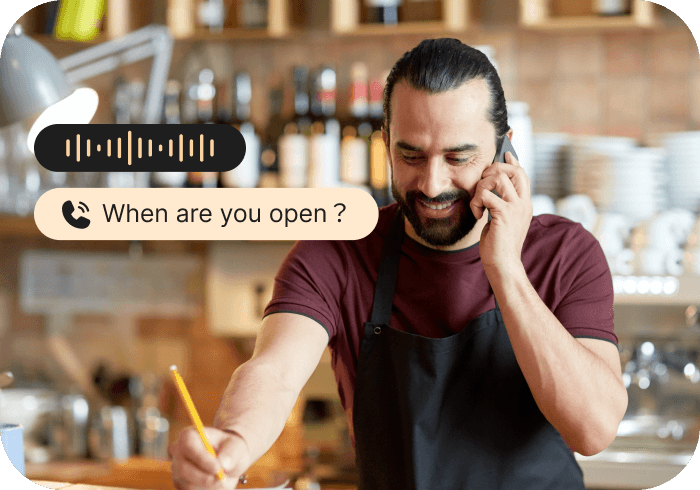
Asking about hours? They’re likely deciding where to eat tonight.
-
Asking about signature dishes? They probably already have a meal in mind.
-
Asking about reservations? They’ve basically chosen your spot.
If these calls end with answers instead of orders, you’re essentially handing high-intent customers to competitors.
Voice AI’s real value lies in its ability to capture and amplify this intent consistently and at scale. Industry data shows that AI-powered phone systems are generating additional revenue of $3,000 to $18,000 per month per location—up to 25 times the cost of the AI host itself (Restaurant Business Online).
One Chinese restaurant chain redesigned its bot scripts around “high-frequency inquiry scenarios” and saw phone order share jump from 8% to 22%, adding an average of $30,000+ per location in monthly revenue (Slang Labs).
They didn’t overcomplicate it—just two tweaks:
-
Post-menu-inquiry prompting: “That’s one of our signature dishes. We also have a combo meal that saves about 20% compared to ordering à la carte. Would you like me to place the order for you over the phone?”
-
Post-hours-or-address prompting: “It can get busy tonight—would you like me to reserve a table for you?”
The goal here isn’t to “push sales.” It’s to close the loop when intent is already there.
Operationally, restaurants can mine call data to identify which inquiry types convert best, prioritize script optimization for those scenarios, and ensure the bot stays synced with POS, inventory, and reservation systems—nothing kills a sale like being unable to fulfill it.
Metric #2: Repeat Caller Rate — The Most Stable, Low-Cost Revenue Driver
Repeat Caller Rate measures the percentage of total inbound calls from customers who have ordered before—either for reservations or direct orders.
Restaurant economics are clear:
-
Acquiring a new customer costs 5 to 7 times more than retaining an existing one (Toast)
-
Repeat customers consistently show higher average check values, order efficiency, and visit frequency
But many restaurants treat new and returning callers exactly the same. When a regular calls again and has to repeat everything from scratch, it chips away at loyalty.
This is where voice AI shines—it remembers. By recognizing caller ID, order history, and preferences, the bot can switch to “regular mode” automatically:
“Welcome back, Ms. Chen. Your usual table by the window for four? And the same spice level for your order?”
It’s not flashy—but it feels personal.
A neighborhood American-style diner introduced customer preference tagging and repeat caller recognition, pushing repeat caller rate from 15% to 35% .
They also added lightweight retention nudges: Returning caller? The bot offers: “As a thank you, we’ve added a complimentary dessert to your reservation today.”
No coupons. No complex campaigns. Just a simple gesture—and repeat rates climbed.
From a business standpoint, every 10-point increase in repeat caller rate typically means:
-
Lower pressure on new-customer acquisition spend
-
More stable daily sales
-
More predictable cash flow
Metric #3: Revenue Per Call — The “Profitability” Meter of Your Phone Channel
Revenue Per Call measures the average revenue generated per answered call.
Many restaurants overlook this metric—but it’s often what separates average performers from top-tier ones.
With similar call volumes, some restaurants generate 20–30% more revenue from the same number of calls (Slang Labs). The difference isn’t call volume—it’s systematic upselling.
Human upsells are hit-or-miss, especially during rushes. Voice AI, however, can:
-
Upsell every single time
-
Use data-driven recommendations instead of guesswork
Examples:
-
Customer orders a main → suggest a high-margin, frequently paired side
-
Family reservation → recommend a family combo
-
Business booking → offer premium add-ons or private rooms
A fast-casual chain analyzed their high-margin, high-pairing-rate items, built them into the bot’s script, and saw revenue per call climb 28%, adding roughly $20,000 per location per month.
Research indicates that AI systems maintain consistent accuracy rates even during peak hours, while human hosts experience a 23% drop in order precision during rush periods. This consistency translates directly to customer satisfaction and repeat business.
This isn’t about pushing the most expensive item. It’s about matching the right option to the right moment. When the suggestion fits the context, customers actually appreciate it.
The Flywheel: How the Three Metrics Work Together
These three metrics don’t operate in silos—they form a growth loop:
-
Phone Order Share → Captures more customers already in buying mode
-
Revenue Per Call → Increases the value of each transaction
-
Repeat Caller Rate → Turns one-time buyers into long-term patrons
Key Metrics That Turn Voice AI Into a Restaurant Revenue Engine
Restaurants that successfully turn voice AI into a revenue engine usually optimize three core metrics: answer rate, conversion rate, and average order value.
| What It Measures | How Voice AI Improves It | Revenue Impact | |
|---|---|---|---|
| Answer Rate | The percentage of incoming calls answered by the restaurant. | AI voice agents answer every call instantly, even during peak hours or after closing. | Captures orders and reservations that would otherwise be lost. |
| Conversion Rate | The percentage of calls that turn into confirmed orders or reservations. | AI guides callers through menu options, confirms details, and reduces friction in the ordering process. | More calls turn into paying customers. |
| Average Order Value (AOV) | The average amount customers spend per order. | AI can suggest add-ons, combos, and popular dishes during phone orders. | Increases revenue from each call. |
One hotpot chain applied this framework to its phone channel:
- Phone Order Share: 10% → 25%
- Revenue Per Call: +20%
- Repeat Caller Rate: 30%
In three months, phone channel revenue doubled.
The difference wasn’t a “smarter bot.” It was a shift in mindset—from “answering calls” to “monetizing every ring.”
Industry-wide data confirms this potential. Donatos Pizza, after rolling out Revmo’s voice AI across 174 locations, achieved a 71% order conversion rate (up from a prior benchmark of 58%), handled over 301,000 calls, and reallocated nearly 4,841 labor hours in a single month—all while maintaining 99.9% order accuracy (Restaurant Business Online).
Conclusion: Voice AI’s Real Value Is in Revenue, Not Just Savings
If you treat voice AI as a “labor-saving tool,” its ceiling is fixed.
But when you run it like a revenue channel, it becomes:
-
A system that captures high-intent demand
-
A tool that consistently lifts average check size
-
An engine that retains customers over time
The shift from “How much did I save?” to “How much more did I earn?” is what makes voice AI a worthwhile investment for restaurants.
By continuously optimizing around Phone Order Share, Repeat Caller Rate, and Revenue Per Call, voice AI stops being “just an answering machine”—and becomes a true growth engine for your restaurant.
FAQs
1. What is a voice AI agent for restaurants?
A voice AI agent for restaurants is an AI-powered system that automatically answers phone calls, takes orders, manages reservations, and handles common customer inquiries. Unlike traditional IVR phone menus, modern voice AI uses natural language processing to understand conversational speech and respond in real time.
For restaurants, this means every call can be answered instantly—even during busy service hours or after closing time. Studies show that restaurants miss up to 30–43% of incoming calls during peak hours, leading to lost reservations and takeout orders. Implementing voice AI ensures that no potential revenue opportunity is missed.
2. How can voice AI increase restaurant revenue?
Voice AI can directly increase restaurant revenue in several ways:
-
Capture missed calls – AI answers every call instantly, preventing lost orders or reservations.
-
Increase average order value – AI can suggest add-ons or upgrades during phone orders.
-
Boost reservations – Faster call handling means more confirmed bookings.
-
Enable 24/7 ordering – Restaurants can accept orders even outside business hours.
Industry data shows that restaurants using voice AI can see 12–30% more phone orders and a 12–25% increase in average order value through consistent upselling and improved call handling.
3. Why do restaurants lose revenue from missed phone calls?
Phone calls remain a critical ordering channel for many restaurants. However, during lunch and dinner rushes, staff often cannot answer every call while serving guests.
Research shows that:
-
43% of restaurant calls go unanswered during peak hours
-
Restaurants may lose $27,000–$180,000 per year due to missed calls
-
Many customers will not call a second time if their first call isn’t answered
By automatically answering calls, AI voice assistants help restaurants recover this hidden revenue and improve customer experience at the same time.
4. Can AI voice agents integrate with restaurant POS systems?
Yes. Most modern restaurant voice AI solutions integrate directly with POS systems such as Toast, Square, Aloha, or Clover. This integration allows the AI system to:
-
Send phone orders directly into the POS
-
Check menu availability in real time
-
Sync order details with kitchen workflows
-
Provide accurate order confirmations
POS integration helps reduce manual entry errors and speeds up order processing, allowing staff to focus on preparing food and serving guests.
5. Will voice AI replace restaurant staff?
No. In most cases, voice AI complements restaurant staff rather than replacing them.
The AI handles repetitive tasks such as answering phone calls, taking basic orders, or confirming reservations. This frees employees to focus on higher-value work, including:
-
Guest service inside the restaurant
-
Handling complex customer requests
-
Managing large group bookings or special events
Many restaurants report that AI reduces staff stress and improves service quality because employees spend less time juggling phone calls during busy shifts.
6. How accurate is AI voice ordering for restaurants?
Modern AI voice ordering systems for restaurants have become significantly more accurate thanks to advances in natural language processing and large language models.
Unlike traditional automated phone menus, AI voice agents can understand conversational speech, accents, and multi-item orders. They can also confirm details such as pickup time, special requests, and order modifications during the conversation.
According to industry research, advanced voice AI systems can achieve order accuracy rates above 90–95%, especially when integrated with restaurant menus and POS systems. Continuous learning from real interactions also helps the AI improve over time.
7. How much does a restaurant voice AI system cost?
The cost of a restaurant voice AI solution varies depending on features, call volume, and POS integrations. Most providers use a subscription or usage-based pricing model.
Typical pricing structures include:
-
Monthly SaaS subscriptions
-
Per-call or per-minute usage pricing
-
Custom enterprise pricing for multi-location restaurants
For many restaurants, the investment is often offset quickly by the additional revenue captured from previously missed calls, more reservations, and increased takeout orders. Even recovering a small percentage of missed calls can generate thousands of dollars in additional monthly revenue.
8. Is voice AI better than online ordering for restaurants?
Voice AI and online ordering systems serve different but complementary roles in restaurant operations.
Online ordering works well for customers who prefer browsing menus digitally. However, many customers still prefer calling restaurants directly when they want to:
-
Ask questions about the menu
-
Customize their order
-
Make reservations
-
Confirm wait times
Voice AI ensures that these calls are answered instantly, while online ordering handles digital transactions. Together, they create a more complete omnichannel ordering experience for restaurants.