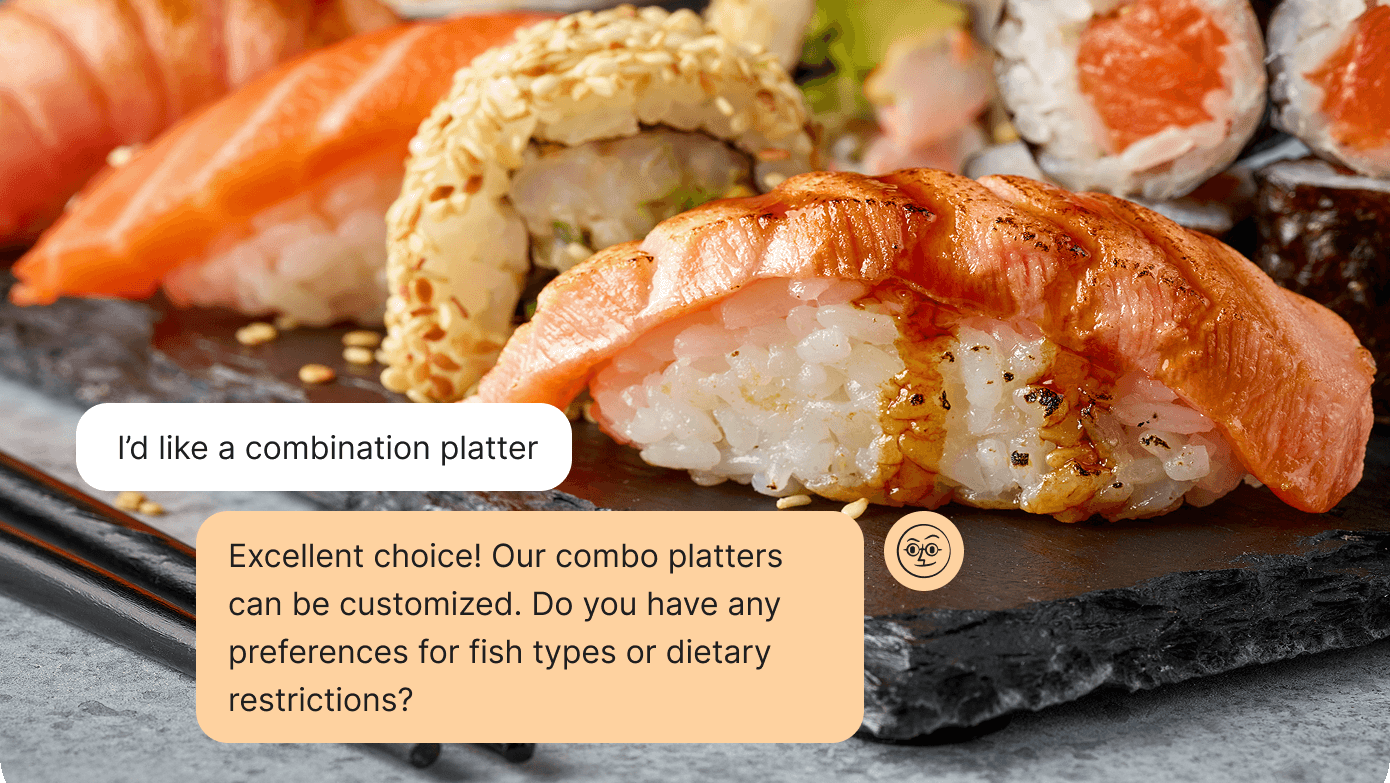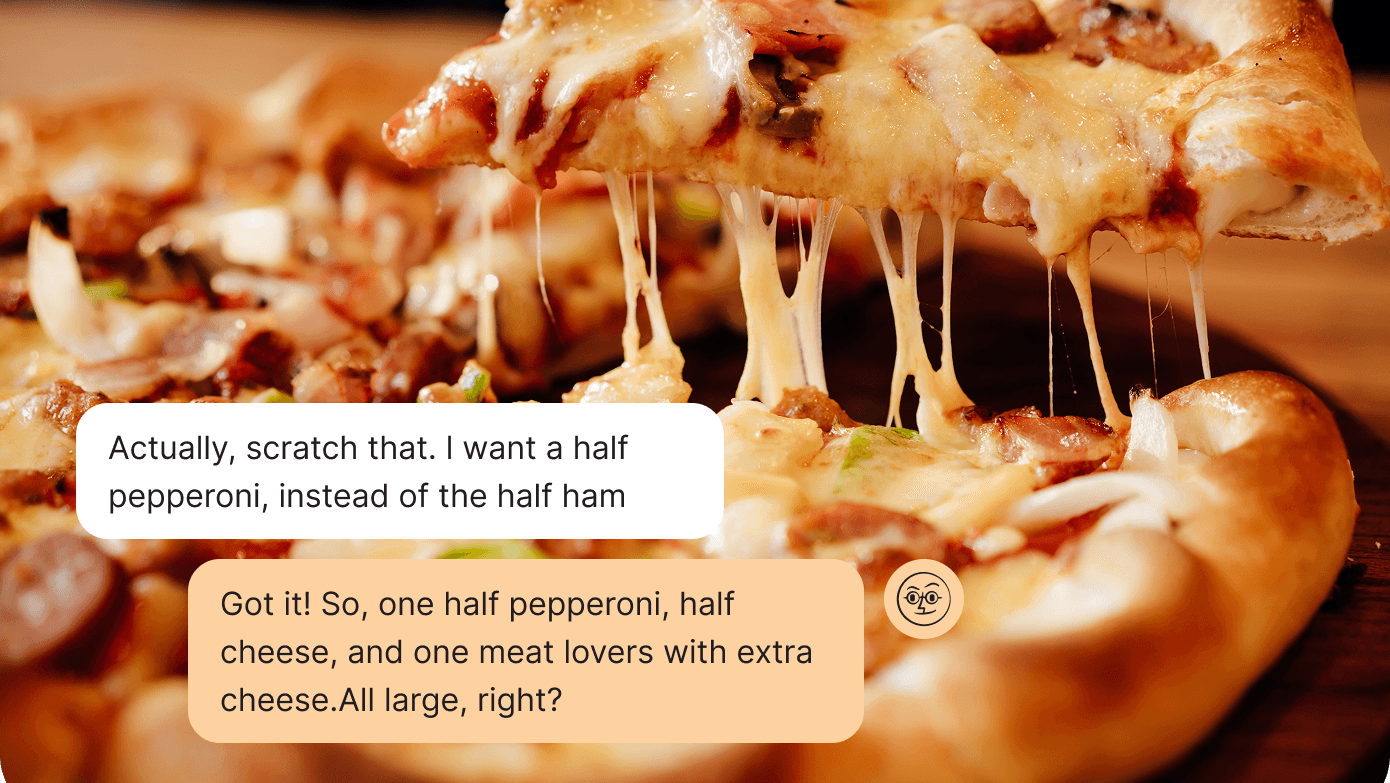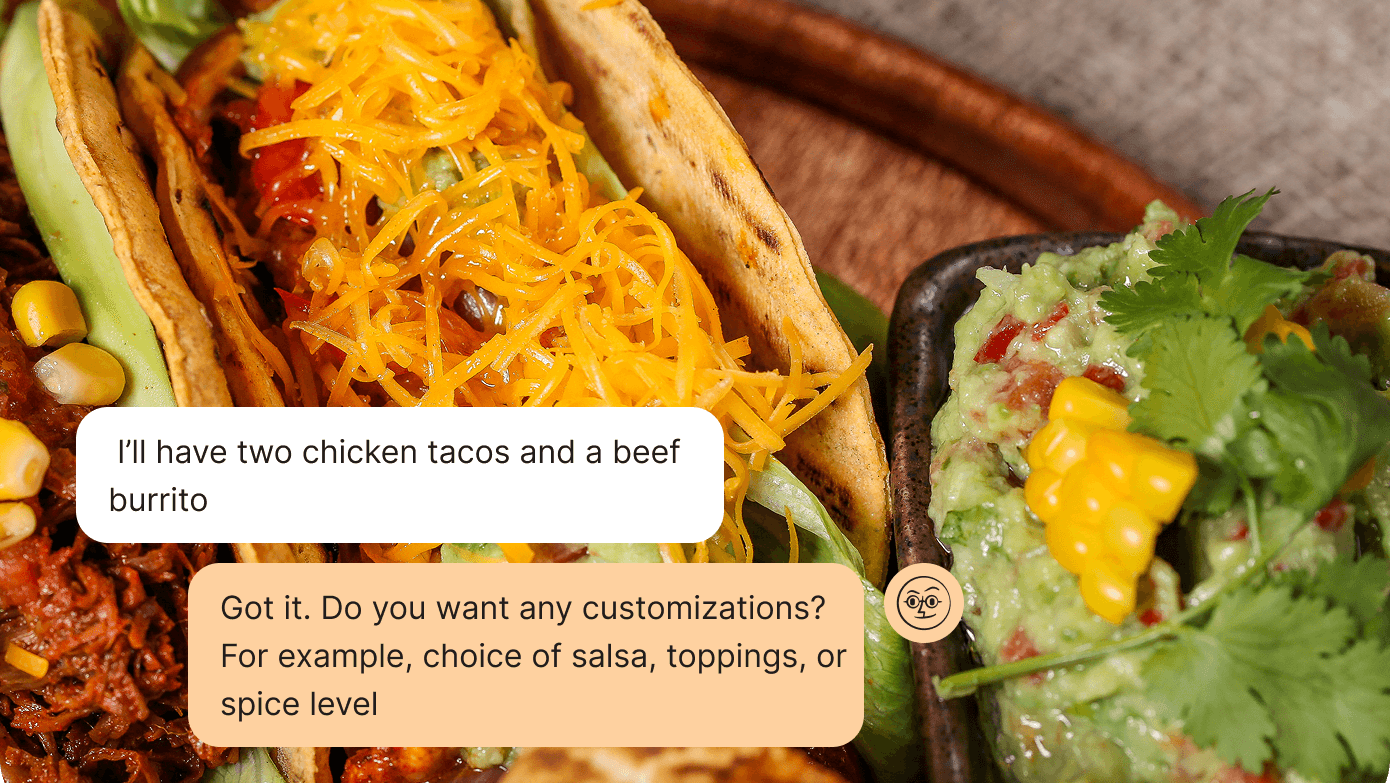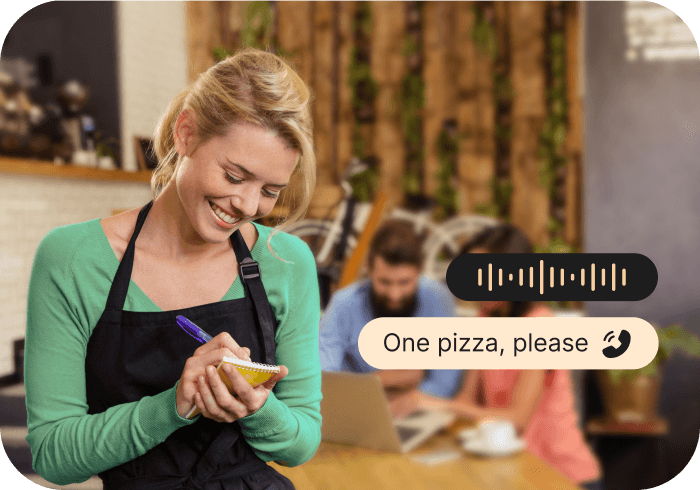
For restaurants, the true value of a voice bot starts with “understanding”. Only by accurately capturing customers’ requests—whether reservations, orders, or general inquiries—and extracting key details such as party size, time, menu items, and preferences, can the bot effectively replace human staff for basic service. Misunderstandings can lead to lost orders, frustrated customers, and negative reviews.
Modern voice bots, especially those powered by large language models (LLMs), no longer require the traditional “speech-to-text” step. They can directly interpret spoken input, identifying intent and key information from the audio itself. This approach allows the system to handle complex, scattered requests during peak hours—something traditional systems struggle with.
Whether using a classic ASR+intent extraction setup or an end-to-end LLM solution, the goal remains the same: implement three foundational capabilities that form the backbone of reliable restaurant voice services.
| ❶ | Voice Comprehension: Turning Speech Into Actionable Understanding |
| ❷ | Intent Recognition: Identifying What the Customer Wants |
| ❸ | Key Information Extraction: Capturing Critical Service Details |
Technology ❶: Voice Comprehension — Turning Speech Into Actionable Understanding
Voice comprehension enables the bot to interpret spoken language and extract actionable information, directly from audio. For restaurant applications, this means accurately recognizing:
- Menu items, drinks, and specials
- Dietary preferences and modifications
- Local language nuances or accents
Common Challenges
- Complex or specialty menu items: Dishes like “Peking Duck” or “Xiao Long Bao” may be misheard by generic speech systems.
- Varied accents and speech patterns: Customers may mix languages or use strong regional accents.
- Noisy environments: Background sounds from kitchens or dining areas can degrade recognition.
Practical Solutions
- Custom restaurant vocabulary: Feed the bot your menu, drinks, and key service terms into its training data.
- Accent and language adaptation: Collect sample recordings from your primary customer base to improve recognition.
- Noise-optimized audio handling: Use noise-canceling solutions and include friendly prompts like, “For the clearest experience, please speak from a quiet area.”
Example
An American restaurant initially used a generic speech recognition engine. “Xiao Long Bao” was often misheard as “small long bow,” leading to 15% order errors. After training with custom menu items and phrases, recognition accuracy exceeded 95%, dramatically improving customer satisfaction.
Technology ❷: Intent Recognition — Identifying What the Customer Wants
Once the bot understands the spoken words, intent recognition determines the core request: reservation, ordering, information inquiry, or feedback. Accuracy is key—misinterpreting intent causes frustration and errors.
Common Challenges
- Indirect requests: Customers might say, “I want to bring my family tonight; we’ll need a table,” instead of directly asking for a reservation.
- Multiple simultaneous requests: One sentence might include a reservation and a menu question.
- Similar intents with different outcomes: “Change reservation time” vs. “Cancel reservation” require precise differentiation.
Practical Solutions
- Define core intents: Identify common customer needs and categorize them clearly into primary and secondary intents.
- Guided prompts for clarification: When requests are vague, the bot can ask naturally: “Would you like me to reserve a table or provide menu details first?”
- Train to distinguish similar intents: Use keywords and phrasing examples to avoid misclassification.
Example
A mid-size chain initially confused “reservation” with “hours inquiry.” After building an intent library and refining guiding prompts, accuracy improved from 82% to 96%, ensuring customer needs were met promptly.
Technology ❸: Key Information Extraction — Capturing Critical Service Details
After identifying intent, the bot must extract all essential details to fulfill the request.
- Reservation: party size, date/time, seating preference, contact info
- Order: menu items, quantity, taste preferences, dining method (dine-in/takeout)
Accuracy here is vital; missed or incorrect details directly lead to service errors.
Common Challenges
- Scattered information: Customers rarely provide details in a fixed order.
- Vague descriptions: Terms like “around 7 PM” or “about four people” need conversion to actionable data.
- Potential conflicts: For example, one guest says “we’ll arrive at 5 PM, my friend at 6 PM,” creating ambiguity.
Practical Solutions
- Create structured templates: Define which details must be collected for each intent.
- Guided completion prompts: Prompt for missing information naturally, e.g., “Could you confirm the exact time and your contact number for the reservation?”
- Clarify potential conflicts: Ask confirmation questions, e.g., “So the table is reserved for 5 PM arrival, and your friend will join at 6 PM—correct?”
Example
A hot pot chain improved order accuracy by 90% by integrating templates and a pre-confirmation step for reservations and orders, ensuring dietary and preference details were never missed.
Integrating the Three Technologies: Building a Reliable Service Loop
Voice comprehension → intent recognition → key information extraction forms a foundational service loop:
- Voice comprehension captures what the customer says.
- Intent recognition identifies the goal of the interaction.
- Key information extraction gathers actionable details for execution.
The goal is practical application, not extreme technical performance. If the system reliably captures menu items, distinguishes reservations from orders, and collects all necessary details, it can handle 80% of basic service needs. Advanced features like multi-turn dialogue and context memory can be layered on this foundation.
Comprehensive Analysis of Three Core Technologies for Restaurant Voice Bots
| ❶ Voice Comprehension | ❷ Intent Recognition | ❸ Key Information Extraction | |
|---|---|---|---|
| Core Definition | Accurately converting speech signals into processable text or semantic representations, specifically optimized for restaurant-specific vocabulary | Determining the customer’s true purpose and intent category from their spoken words | Extracting structured data fields needed to execute the task from the conversation |
| Technical Foundation | Acoustic model + language model + restaurant-specific lexicon; or end-to-end LLM direct audio understanding | NLU-based classification models; or LLM prompt engineering for intent classification | Rule-based template matching + entity recognition; or LLM context extraction |
| Core Value for Restaurants | Accurately capturing dish names, ingredients, and special requests to prevent order errors and misheard preferences | Quickly routing different needs (reservation vs. ordering vs. inquiry), reducing transfers and wait times | Ensuring critical details like reservation time/party size, order quantities, and preferences are never missed |
| Primary Challenges | Specialty dish names, multilingual mixing, kitchen noise, accent variations | Vague expressions, multiple intents in one sentence, distinguishing similar intents | Disorganized information order, vague time expressions, conflicting information |
| Implementation Complexity | ★★★☆☆
Requires menu data training |
★★★★☆
Requires extensive conversation sample labeling |
★★★☆☆
Requires field template definition |
| Typical Cost Impact | Higher initial training cost, but long-term benefit after one-time training | Higher ongoing optimization cost, requires continuous intent library updates | Moderate, primarily depends on rule design and template maintenance |
| Key Success Factors | Completeness and update frequency of menu lexicon | Richness and labeling quality of real conversation samples | Completeness of field templates and confirmation mechanism design |
| System Integration | Requires POS integration for real-time menu and inventory updates | Requires CRM integration to recognize VIPs and repeat customers | Requires direct write-back to POS/reservation systems for automatic execution |
| User Experience Impact | Directly determines whether customers feel “understood” | Determines whether the interaction flow feels smooth and natural | Determines whether service outcomes are accurate and error-free |
| Performance Metrics (KPIs) | Word error rate, dish recognition accuracy | Intent classification accuracy, coverage rate | Field capture rate, completion rate |
| Industry Best Practices | Update menu lexicon monthly; record real customer voices to optimize models | Update intent library seasonally or for promotions; design friendly clarification prompts | Auto-summarize at conversation end; proactively ask for clarification when information is vague |
| Future Evolution | Zero-shot learning for new menu items; stronger recognition in noisy environments | Simultaneous multi-intent processing; emotion and urgency recognition | Cross-conversation memory; predictive information completion |
Conclusion: The Key to Successful Implementation Is Restaurant-Specific Adaptation
The technology itself is only as good as its fit to the restaurant. By customizing menu vocabulary, defining core intents, and establishing key information templates, even restaurants without in-house technical teams can deploy effective voice bots.
When a voice bot reliably understands spoken requests and accurately collects all required details, it can replace human staff for reservations, ordering, and inquiries—saving labor, improving efficiency, and enhancing customer satisfaction. This foundational implementation is the starting point for competitive advantage in restaurant operations.
FAQs
❶ Why doesn’t voice recognition always need to convert speech to text first?
Traditionally, speech is converted to text (ASR) before intent and key information are extracted. Modern large models and some end-to-end voice AI, however, can interpret intent and extract details directly from audio. This reduces latency and minimizes errors caused by accents, regional speech, or uncommon menu items.
❷ How can I ensure the voice bot understands a restaurant’s unique menu items?
The most effective approach is to customize a restaurant-specific vocabulary: include all menu items, drinks, combos, and common service terms like “window seat,” “takeout,” or “extra spicy.” Training with voice samples and background noise conditions significantly improves accuracy and reduces order errors or customer complaints.
❸ Why are multi-turn conversations and context memory important for restaurant phone service?
Customers often request multiple things in one call: a reservation, ordering food, or asking about parking and hours. Without context memory, a bot may repeat questions or miss information, frustrating the customer. Context memory allows the bot to follow the conversation naturally, improving fluency and satisfaction.
❹ How can a bot handle multiple intents in one request?
Intent recognition can separate a statement into distinct requests, e.g., “I want to reserve a table + check today’s specials.” The bot confirms the primary intent (reservation) first, then addresses secondary intents (menu info), ensuring every request is handled correctly.
❺ During peak hours, how does a voice bot minimize errors and omissions?
The key is leveraging the three foundational technologies:
- Voice comprehension to capture menu items, party size, and preferences accurately;
- Intent recognition to distinguish reservations, orders, inquiries, or complaints;
- Key information extraction to ensure details like time, party size, dishes, and preferences are complete.
Adding a confirmation step for customers further reduces mistakes during busy periods.
❻ Will using a voice bot make customers feel the service lacks a “human touch”?
Not if implemented thoughtfully. With natural language prompts, context memory, multi-turn conversation, and personalized details (like remembering returning customers’ seating or preferences), bots can deliver a warm, human-like experience while improving consistency and speed.
❼ What happens if the network fails or a request is too complex?
Modern systems implement a graceful fallback: the bot transfers the call to a human agent while passing along all collected key information, avoiding repeated explanations and maintaining service continuity.
❽ Besides saving labor, what other benefits does a voice bot bring?
Beyond labor savings, bots improve order accuracy, reduce missed requests, shorten wait times, and record customer preferences. Over time, these advantages boost satisfaction, repeat business, and reputation. In short, bots are more than a “phone-answering tool”—they’re a lever for service quality and operational efficiency.
About Tunvo AI
Tunvo is an AI voice agent for restaurants.
It answers every call, takes orders straight into your POS, and helps restaurants boost revenue by capturing every inbound opportunity. So your teams can focus on delivering exceptional guest experiences.