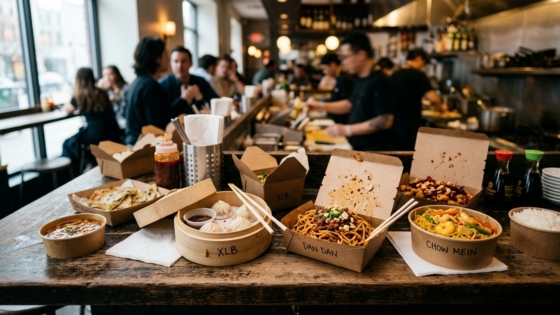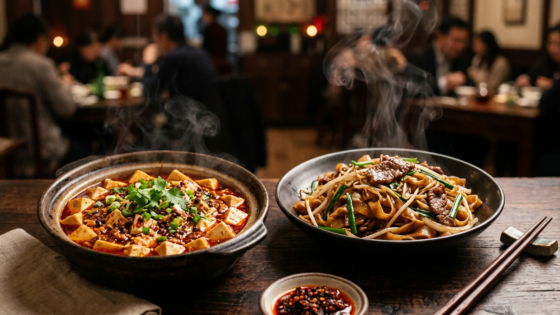
Walk through any Chinatown and you’ll notice something: menus that list “Braised Pork with Tofu” alongside menus that describe “melt-in-your-mouth slow-braised pork belly, lacquered in a rich soy reduction, served over silken tofu in a clay pot.” Both dishes might be identical. One gets ordered constantly. The other gets passed over. The difference is entirely in how they’re described.
For Chinese restaurants in New York and across North America, the challenge is real. Many dishes have names that are entirely meaningful to a Chinese-speaking customer but opaque to an English-speaking one — and even bilingual descriptions often stop at ingredients without ever telling the customer what the dish will actually taste and feel like. This guide is about changing that.
Key Takeaways
- Descriptive, sensory-rich menu language can increase sales on individual items by up to 27%, according to Cornell University research.
- The goal of a menu description is to create a craving — not just to list what’s in the dish.
- Chinese dishes often have evocative preparation methods and flavor profiles that translate beautifully into English — most menus just don’t take advantage of them.
- Short is better. Two vivid sentences outperform six generic ones.
Why Chinese Restaurant Menus Often Undersell Their Dishes
There are a few structural reasons Chinese restaurant menus tend to be description-light in English:
First, many operators originally built their menus for a Chinese-speaking customer base and never fully translated the intent of each dish — just the literal name and ingredients. Second, the sheer size of many Chinese menus (often 80–120 items) makes writing full descriptions for every dish feel overwhelming. Third, there’s a cultural norm in Chinese dining of letting the food speak for itself, without marketing language — a value that doesn’t always translate to English-language menus competing in a busy urban market.
The result is menus where “Mapo Tofu” appears without context for someone who’s never had it, where “Dry Pot Cauliflower” sounds like a cooking mistake, and where “Fish Fragrant Eggplant” raises more questions than it answers. These are genuinely delicious dishes that deserve better introductions.
The Science Behind Appetizing Language
This isn’t just intuition. A Cornell University study found that renaming basic menu items with more descriptive language increased sales by 28% and made diners willing to pay 12% more. A separate study by Dr. Brian Wansink, also from Cornell, showed that using descriptive words for menu labels increased sales by as much as 27%.
Why does this work? Sensory language activates the brain’s anticipation response. When a customer reads “crispy” they unconsciously hear the crunch. “Silken” triggers a tactile memory. “Smoky” brings up a scent association that triggers appetite. The menu description isn’t just informing the customer — it’s starting the eating experience before the food arrives.
The Building Blocks of a Strong Dish Description
Every good menu description contains some combination of four elements:
- Preparation method — how the dish is cooked (“wok-tossed over high heat,” “slow-braised for hours,” “flash-fried”)
- Texture — what it feels like (“crispy edges,” “silken,” “fall-off-the-bone tender”)
- Flavor profile — what it tastes like (“bold, numbing Sichuan spice,” “savory-sweet glaze,” “bright with ginger and scallion”)
- A closing image or context — one final detail that makes it feel complete (“served bubbling in a clay pot,” “finished with a drizzle of aged black vinegar”)
You don’t need all four in every description — sometimes two elements combine better than four. The goal is to give the customer a complete sensory preview in one or two sentences.
RestaurantTimes recommends keeping descriptions concise: avoid overwhelming customers with text, and avoid generic filler words like “delicious” or “tasty” that carry no actual information. Every word should earn its place.
Before and After: Real Chinese Dish Descriptions
Here are examples of how the same dishes read before and after applying sensory description principles. The “before” versions are representative of what appears on many menus today. The “after” versions take about 30 seconds more to write.
| Dish | Before (Generic) | After (Sensory) |
|---|---|---|
| Mapo Tofu | Soft tofu with spicy ground pork sauce | Silken tofu in a bold, numbingly spicy Sichuan sauce with ground pork — served bubbling in a clay pot, bright with doubanjiang and fragrant with Sichuan peppercorn. |
| Char Siu Pork | BBQ pork with honey glaze | Slow-roasted pork shoulder lacquered in a honey-hoisin glaze, caramelized at the edges, tender through the center — a Cantonese classic that’s been on our menu since day one. |
| Fish Fragrant Eggplant | Eggplant with garlic sauce (no fish) | Wok-seared eggplant in a savory-sweet-tangy Sichuan sauce of garlic, ginger, scallion, and chili — no fish, but full of the bright, layered flavors the name promises. |
| Beef Tendon with Scallion | Braised beef tendon, scallion | Slow-braised beef tendon, collagen-rich and melt-tender, served chilled with crisp scallion, sesame oil, and a light soy dressing — a dim sum staple that rewards the adventurous eater. |
| Steamed Egg Custard | Steamed egg with soy sauce | Cloud-soft steamed egg custard, silky and barely set, finished with a drizzle of light soy and sesame oil — the definition of comfort food in one gentle bowl. |
Notice what the “after” descriptions do: they address the customer’s hesitations directly. “Fish Fragrant Eggplant” might confuse or concern a non-Chinese customer — the description clarifies what it actually tastes like. “Beef Tendon” might sound intimidating — the description frames it as a reward for the curious. This kind of anticipation management is part of what good menu writing does.
Language That Works: A Word Bank for Chinese Dishes
Below is a practical reference for the types of sensory language that work well with common Chinese cooking techniques and flavor profiles.
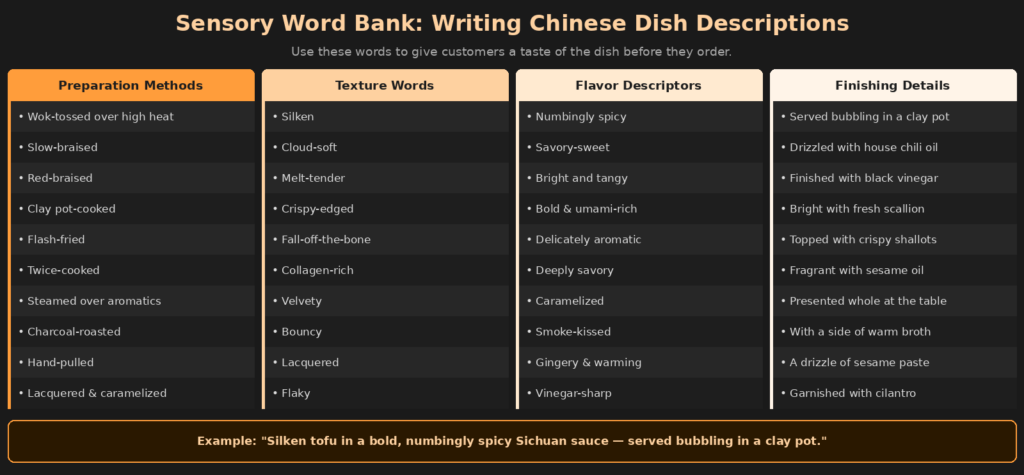
Preparation Methods (evoke skill and care)
Wok-tossed over high heat · slow-braised · clay pot-cooked · flash-fried · red-braised · steamed over aromatics · twice-cooked · charcoal-roasted · hand-pulled · stone-ground
Texture Words (make customers feel the dish)
Silken · cloud-soft · melt-tender · fall-off-the-bone · crispy-edged · collagen-rich · bouncy · lacquered · flaky · velvety · charred on the outside
Flavor Descriptors (communicate taste before the first bite)
Numbingly spicy · savory-sweet · bright and tangy · bold and umami-rich · delicately aromatic · deeply savory · caramelized · smoke-kissed · gingery and warming · vinegar-sharp
Finishing Details (the image that closes the description)
Served bubbling in a clay pot · finished with aged black vinegar · drizzled with house chili oil · topped with crispy shallots · bright with fresh scallion and sesame · presented whole at the table
Handling Dishes That Need Extra Context
Some Chinese dishes have names or ingredients that may create hesitation in a non-Chinese diner. Rather than avoiding these dishes or keeping descriptions minimal, lean into the explanation — it signals confidence and often creates intrigue.
Dishes with Off-Putting Names in Translation
Dishes like “Fish Fragrant Eggplant,” “Husband and Wife Beef,” or “Red-Braised Pig Trotters” can read oddly in literal translation. ChowNow recommends leading with the star ingredient or preparation technique rather than the name alone. A description that opens with “Tender braised pig trotters, gelatinous and fall-apart soft…” tells the customer what they’re getting before they decide how to feel about the name.
Unfamiliar Ingredients
Ingredients like wood ear mushrooms, century eggs, doubanjiang, or bamboo shoots may need a one-phrase explanation that normalizes them. “Crunchy, earthy wood ear mushroom” is enough context for someone who hasn’t encountered it before to decide whether they’re interested. UpMenu notes that mentioning ingredient origins and unique qualities increases perceived value — and for Chinese restaurants, authentic ingredient names with a brief description signal quality rather than obscurity.
Bilingual Menus: Getting the Balance Right
Many Chinese restaurants serve a mixed English and Chinese-speaking customer base. A bilingual menu is often the right choice, but the two languages don’t have to say the same things in the same way. Chinese customers often know the dish from experience and need less descriptive context. English-speaking customers often need more sensory orientation.
A practical approach: write the Chinese description in the traditional, minimal style. Write the English description using the sensory-rich approach outlined in this guide. Both audiences get a menu that speaks to them — and your kitchen stays the same.
For phone orders, the same principle applies. When customers call in — whether in Mandarin or English — the conversation should feel natural and the dish should be described appetizingly. Tunvo’s AI voice agent handles calls in both languages, and the ordering conversation can be configured to match how you describe your dishes. See the Tunvo About page for more on how the system is configured for Chinese restaurants specifically.
Frequently Asked Questions
How long should a menu description be?
For most dishes, one to two sentences is ideal — roughly 20 to 40 words. This is enough to create appetite and provide key context without overwhelming the reader. Longer descriptions work well for signature or complex dishes. Very simple dishes like a plain rice or tea don’t need descriptions at all.
Should I describe every dish on the menu?
Prioritize your high-margin items and any dishes that may be unfamiliar to non-Chinese customers. If a full description for every item feels daunting, start with your top sellers and your highest-margin dishes — where the return on the writing effort is highest — and work outward from there.
What words should I avoid?
Avoid generic filler words like “delicious,” “tasty,” “amazing,” and “yummy” — they carry no real information and readers skim past them. Also avoid exaggeration that doesn’t match the dish. If a mild dish is described as “intensely spicy,” the mismatch creates disappointment and erodes trust. Every description should be honest and specific.
Your menu descriptions are working hard — your phone system should too. Tunvo AI answers every call in English and Mandarin, takes orders accurately, and connects directly with your MenuSifu POS. Start your free trial or see a live demo.