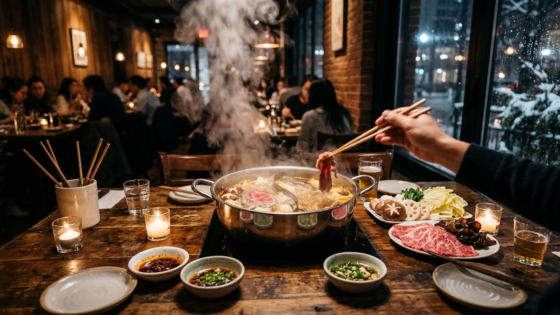
When the temperature drops in New York, something changes about how people think about food. They’re not looking for a quick bite anymore. They want warmth. They want something that fills the table and fills the room with steam. They want hot pot.
For Chinese restaurant owners, this is not just a menu moment — it’s a marketing opportunity. Winter is the season when your core menu items become emotionally resonant comfort food for a much wider audience than usual. The question isn’t whether to promote soups and hot pot in winter. It’s how to do it in a way that builds real revenue and brings customers back through February.
In conversations with restaurant owners across New York, I’ve seen which winter approaches actually move the needle. This guide covers them.
Key Takeaways
- Cold weather naturally increases demand for warm dishes — don’t wait for customers to discover your hot pot; actively promote it.
- Hot pot is a high-value group dining experience, which means each reservation is worth significantly more than a solo cover.
- Limited-time winter specials create urgency and give you fresh marketing content across social, email, and SMS.
- Delivery-friendly soup options extend your winter revenue beyond your dining room walls.
Why Winter Is Actually a Revenue Opportunity for the Right Restaurants
January and February are widely considered the hardest months for restaurants. Post-holiday spending drops, the weather keeps people home, and there are no major dining occasions to anchor foot traffic. But this framing misses something important: not all restaurants suffer equally in winter.
Restaurants that serve warm, communal, hearty dishes — ramen, pho, soup dumplings, hot pot — are uniquely positioned to be exactly what customers want in January and February. According to Paytronix’s winter marketing research, citing a National Restaurant Association survey, soups and stews rank among the most sought-after comfort foods during colder months. Hot beverages and hot meals are the category that sees the largest spike in demand when temperatures fall.
The challenge isn’t demand — it’s visibility. You have to make sure the people who are craving exactly what you serve actually think of you when that craving hits.
Building a Winter Marketing Strategy Around Hot Pot and Soup
Lead with warmth, not just food
The most effective winter restaurant marketing isn’t product advertising — it’s emotional. Restaurant marketing specialists consistently emphasize that winter social content performs best when it leads with the feeling: a steaming bowl of broth, condensation on the windows, the sound of a bubbling pot. The caption “When it’s 12°F outside, nothing hits like our house-made lamb hot pot” outperforms “Now serving hot pot!” every single time.
For Chinese restaurants, this is an area of genuine competitive advantage. Hot pot is a multisensory experience — the broth, the dipping sauces, the communal table. That translates beautifully to video content. A 15-second Instagram Reel of a bubbling dual-broth pot can generate more bookings than a week of static posts.
Create a winter-specific menu or offer
A limited-time winter menu serves several marketing functions at once: it gives you something new to announce, creates urgency (it’s only here until March), and signals to regular customers that something worth coming back for is happening. Grubhub’s winter promotion guide recommends building your seasonal offerings around comfort and warmth, with the specific advice to tie menu launches to campaign windows — “Winter Comfort Menu through February 28” rather than an open-ended daily special.
For hot pot specifically, consider structuring your winter offer as a set menu: a fixed price that includes the soup base choice, a selection of proteins, vegetables, and noodles, plus one drink. This simplifies ordering, increases average check size, and makes the dining experience feel curated rather than à la carte.
Target groups and corporate bookings
Hot pot is inherently a group dining format. A table of 6 ordering a hot pot set menu is worth three or four times the revenue of a couple ordering individual dishes. Winter is prime season for corporate team dinners, friend group gatherings, and family meals — all of which are natural hot pot occasions.
Marketing specialists focused on hot pot restaurants recommend building a separate group booking pitch: a minimum party size, a streamlined set menu for groups, and a direct booking contact (phone or email) that makes the reservation process feel personal rather than transactional. A restaurant that can book private hot pot dinners for groups of 8–12 during January and February can fill an otherwise quiet Tuesday night with high-margin revenue.
Use email and SMS to reach customers when they’re cold
The best time to promote hot pot is when the customer is standing outside in 28-degree weather wondering where to eat. That’s a mobile moment — they’re on their phone. Paytronix’s research on winter marketing highlights geo-targeted SMS campaigns as particularly effective in winter, with messages like “Cold outside? Our pork bone broth is ready — call us and your order goes straight to the kitchen.” The immediacy of SMS matches the immediacy of the cold-weather craving.
For restaurants using a loyalty program or CRM, a “Comfort Food of the Week” series works well in January and February — each week featuring a different soup or hot pot variation with a brief description and a special price for the week only.
Make delivery work for hot pot
Hot pot for delivery sounds logistically challenging — and it can be if you approach it as a delivery version of your dine-in experience. The smarter approach is building hot pot kits: pre-portioned broths in sealed containers, pre-sliced proteins, fresh vegetables, and cooking instructions. Hot pot restaurant marketing guides recommend framing these as “hot pot at home” kits — a premium delivery product that captures customers who want the experience but can’t come in.
The phone order is critical here. Customers ordering a complex hot pot kit will call — they have questions about portion sizes, spice levels, and add-ons. That phone call is a high-value interaction that should never go to voicemail. Tunvo’s AI voice agent can handle exactly this type of call: fielding questions about the hot pot kit options, confirming customizations, and sending the order directly to your MenuSifu POS — so your team focuses on preparation, not phone management.
A Winter Marketing Calendar for Soup and Hot Pot Restaurants
| Month | Campaign Focus | Key Promotion Ideas |
|---|---|---|
| November | Holiday group bookings | Corporate hot pot dinner packages; early booking incentives for December |
| December | Holiday celebrations | Holiday prix fixe with hot pot; gift cards; “12 Days of Soup” social campaign |
| January | Comfort food + New Year wellness | Lighter soup options for health-conscious diners; weekday hot pot specials |
| February | Valentine’s + Lunar New Year | Couples hot pot set menu; Lunar New Year family feast packages |
| March | Transition to spring | “Last of winter” hot pot promotion; introduce spring menu previews |
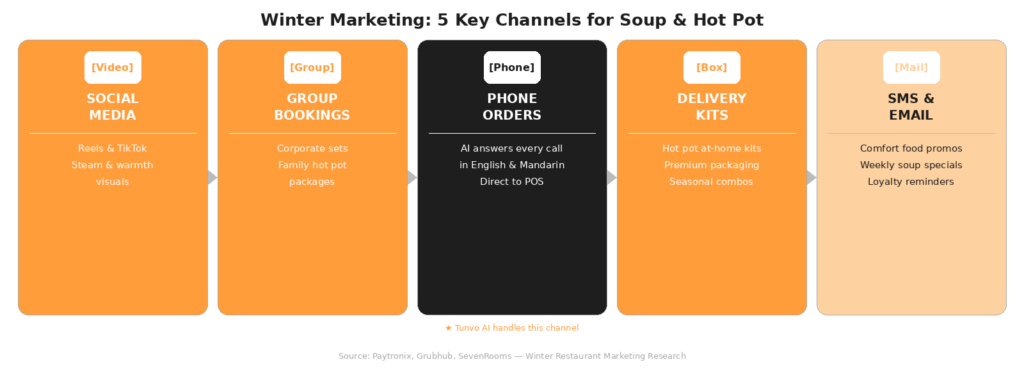 Winter marketing works across multiple channels — each one reinforcing the warmth and community of hot pot dining.
The Lunar New Year Opportunity
For Chinese restaurants, January and February hold a marketing asset that most non-Chinese competitors simply can’t touch: Lunar New Year. In 2026, Lunar New Year falls on January 29th. This is one of the biggest dining occasions of the year for Chinese-American families, and it anchors a full week of elevated traffic.
SevenRooms’ winter restaurant marketing guide recommends promoting reservations for major holiday occasions at least three to four weeks in advance, using social media countdowns, email campaigns, and direct customer outreach. For Lunar New Year, the promotion window should start in January 1st — families are already planning their celebrations.
A family hot pot feast for Lunar New Year — with traditional broth options, auspicious garnishes, and a curated protein selection — is both a natural product fit and a high-average-check opportunity. Promoting it as a pre-bookable, limited-availability experience (only 15 tables available for the big night) creates the urgency that drives advance reservations.
Don’t Let the Phone Bottleneck Ruin Your Winter Push
Here’s a pattern I see repeatedly: a restaurant does everything right in winter marketing. Good social content, SMS blasts, a compelling hot pot promotion. Traffic picks up. And then customers call — and can’t get through.
Winter is busy. Your team is handling packed tables, complex hot pot setups, and a dining room full of large groups. The phone rings during peak hours and nobody can get to it. WebstaurantStore’s holiday marketing guide specifically notes that restaurants need to “capitalize on the surge in dining activity” during winter — but that only happens if every inbound inquiry actually gets answered.
This is the exact problem Tunvo was designed to solve. The AI answers every call — in English and Mandarin — handles hot pot reservations, takes delivery orders, and answers common questions about your winter menu specials. Your team never has to choose between the customer at the table and the customer on the phone.
Frequently Asked Questions
When should restaurants start promoting their winter hot pot menu?
Start promoting in late October or early November, before customers have settled into their winter dining habits. Early promotion captures the first-mover advantage — customers who book your hot pot dinner in early December are less likely to be comparison shopping than those you try to reach in January. A six-week lead time also gives you time to build anticipation through social content before your formal launch.
How do you market hot pot delivery without losing the experience?
Position delivery hot pot as a “hot pot kit” rather than a takeout version of the restaurant experience. Include the broth base in sealed containers with reheating instructions, pre-sliced proteins, and a simple instruction card. Price it as a premium product — not cheap takeout — and market it as “restaurant-quality hot pot at home.” The experience is different from dine-in, but it can be genuinely good if it’s positioned correctly.
What social media content works best for soup and hot pot in winter?
Video content consistently outperforms static images for hot pot promotion. Short-form videos (15–30 seconds on Instagram Reels or TikTok) showing the broth being poured, ingredients being added, and steam rising from the table are highly shareable and drive strong engagement. Pair these with captions that lean into the emotional warmth angle — cold temperatures, comfort food, gathering with family — rather than simple product descriptions.
Is it worth offering a loyalty discount specifically for winter?
Yes, especially for hot pot — because hot pot is a group activity, and a loyalty discount gives the person organizing the group dinner a financial reason to choose your restaurant over a competitor. A “Winter Hotpot Club” loyalty punch card (dine three times in January-February and your fourth visit is 20% off) rewards repeat behavior and gives you a marketing hook across all your channels.
Your winter marketing only works if every customer who calls actually gets through. Tunvo’s AI voice agent answers every call in English and Mandarin, handles reservations and orders, and connects directly with your MenuSifu POS.