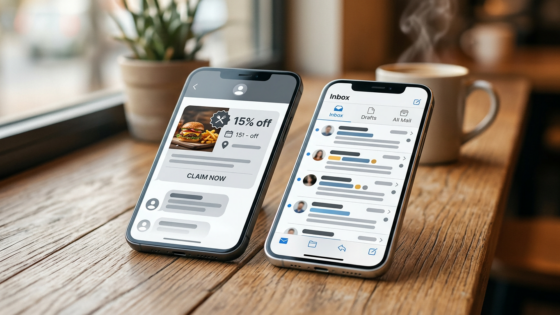
You put together a lunch special, write a subject line, build the email, and hit send. A few days later, you check the stats: 28% open rate, 1% click-through. Of every 100 customers on your list, one person actually clicked. The special ran and went.
Now picture this instead: you send a text at 11:15 am — “Lunch special today only: half-price beef noodle soup. Show this text at pickup.” Within three minutes, 95 of those 100 customers have read it. A dozen respond or walk in before noon.
That gap — between email and SMS — isn’t marginal. It’s structural. And for independent restaurants that depend on repeat customers and time-sensitive promotions, understanding why it exists (and how to use both channels strategically) is one of the highest-leverage marketing decisions you can make.
Key Takeaways
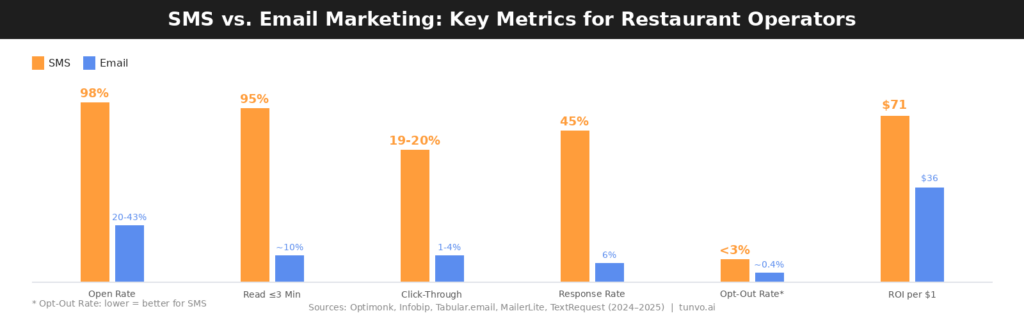
- SMS open rates average 98%, compared to 20–43% for email — the difference is not gradual, it’s categorical.
- Restaurant and café emails have some of the lowest click-through rates of any industry, averaging just 1.06%.
- SMS works best for time-sensitive offers; email works best for longer-form content and announcements.
- Using both channels together — SMS + email — consistently outperforms using either alone.
- The best time to build your SMS list is at the phone order moment — when a customer calls to place an order.
The Core Numbers: How SMS and Email Compare
Start with the headline data, because it sets the context for every decision that follows.
Open Rates
SMS open rates average 98%, compared to email open rates that typically range between 20% and 43% depending on the platform and industry. The gap isn’t a matter of optimization — it reflects a fundamental difference in how people relate to their inboxes versus their text messages.
Email inboxes are filtered, skimmed, and routinely ignored. Most people have hundreds of unread promotional emails sitting in folders they’ll never open. Text messages arrive in the same inbox as messages from friends and family — they’re seen, and they’re seen immediately. 95% of SMS messages are read within three minutes of being delivered. No other marketing channel comes close to that speed.
Click-Through and Response Rates
The open rate gap is dramatic. But the engagement gap downstream is even wider. SMS click-through rates average 19–20%, while email click-through rates linger between 0.77% and 4.36% — that’s roughly a 5–10x difference.
For restaurants specifically, the numbers are worse. MailerLite’s 2025 industry benchmarks show that restaurants and cafés have one of the lowest click-through-to-open rates of any sector — just 3.28%. That means even among the customers who open your restaurant’s email, barely 3 in 100 click on anything. Restaurant emails also have the second-highest unsubscribe rate in the dataset.
Why? Because restaurant promotional emails often lack urgency. “Come visit us this month” doesn’t create an impulse. A text at lunchtime does.
Response Rate and ROI
SMS response rates sit at 45%, compared to 6% for email — meaning nearly half of customers who receive a text promotion will actively respond in some way, whether that’s replying, calling, or walking in.
The ROI comparison is close but favors SMS for time-sensitive use cases. SMS delivers an estimated $71 return for every dollar spent, versus $36 for email. Email still delivers a strong ROI — but for a restaurant running a same-day promotion, the speed advantage of SMS compounds the return significantly.
Why the Gap Exists: The Psychology Behind the Numbers
Understanding why SMS performs so differently isn’t just interesting — it helps you use it correctly.
Proximity and Urgency
The phone is with people constantly. Americans check their phones an average of over 100 times a day. A text message doesn’t sit in a queue waiting to be sorted — it interrupts. That interruption is exactly what a time-sensitive restaurant promotion needs. “Half-price dumplings today, 5-7pm” is a message that means nothing tomorrow. It needs to be seen now, and SMS guarantees it will be.
No Algorithm, No Filter
Email marketing has a spam problem. Approximately 3% of SMS messages are considered spam, compared to nearly 85% of emails. Even legitimate marketing emails face spam filters, promotions tabs, and inbox sorting. A text message goes directly to the customer. There’s no filter to defeat and no algorithm controlling distribution.
The Permission Difference
When a customer gives you their phone number and opts in to SMS, it’s a more intentional act than giving an email address. Email opt-ins happen constantly — you hand over your email to get a discount, download a PDF, or book a reservation, and then forget you signed up. SMS opt-in feels more personal. That higher intentionality translates directly into higher engagement.
What Email Does Better
This isn’t an argument that restaurants should abandon email. Email has real advantages that SMS can’t match.
Length and Richness
An email can carry images, menus, links, videos, and full promotional copy. A text message maxes out at 160 characters. If you’re announcing a new menu, introducing a catering service, or sharing your restaurant’s story, email gives you the canvas to do it properly.
Cost Per Message
Sending 1,000 emails costs fractions of a cent. Sending 1,000 texts costs real money — typically $0.01–$0.05 per message depending on your platform. At high volume, that difference matters. Email is better for regular newsletters where you’re communicating information that doesn’t need to arrive in the next three minutes.
Discoverability and Search
Customers can search their email inbox. A promotion you sent three weeks ago might get found when someone is cleaning out their inbox on a Sunday night and suddenly remembers your restaurant. Texts disappear into scroll history and are rarely revisited.
The Comparison: When to Use Each Channel
| Use Case | Best Channel | Why |
|---|---|---|
| Daily or weekly lunch special | SMS | Read before lunch hour; drives immediate action |
| Flash sale / same-day promotion | SMS | Speed is the point; email delay kills the offer |
| Loyalty reward notification | SMS | Personal, direct; customer expects it |
| Monthly newsletter | Space for photos, menus, stories | |
| New menu announcement | Rich content; visual presentation matters | |
| Seasonal event or holiday promotion | Both | Email teases the event; SMS reminder day-of |
| Win-back campaign (lapsed customers) | SMS first, then email | SMS gets seen; email provides the detail |
| Catering or large-order inquiry | High-consideration decision; needs full information |
The Synergy Play: Using SMS and Email Together
The most effective restaurant marketers don’t choose between SMS and email — they use them in sequence. Research shows that following up an email campaign with an SMS increases the email’s open rate by 20–30%. The text creates urgency; the email provides depth.
A Practical Two-Channel Sequence for a Holiday Promotion
- 7 days before: Send an email with full details — the special menu, dates, reservation instructions, photos.
- 3 days before: Send a text reminder: “Chinese New Year special menu is almost sold out — reserve your table now.” Link to reservation page.
- Day of: Send a text: “Tonight only — our New Year menu starts at 5pm. Call now to reserve: [number].”
The email does the storytelling. The texts do the driving. Each channel is doing exactly what it does best.
Using SMS to Revive Dormant Email Subscribers
If you have an email list where a significant portion of subscribers haven’t opened anything in 90 days, a well-timed text message can reactivate them. SMS conversion rates average 21–40% depending on the industry and message relevance — high enough that even a small re-engagement campaign can generate meaningful returns on a segment you’d otherwise write off.
Building Your SMS List: Where the Phone Comes In
The question isn’t whether SMS outperforms email — the data on that is settled. The real question is: how do you build an SMS subscriber list in a restaurant context without it feeling intrusive?
The Three Best Capture Moments
For most independent takeout restaurants, phone numbers are most naturally collected at three moments:
- At pickup: A short script from staff — “Want to join our loyalty program? We’ll text you when you’re close to a free dish.” Easy yes, no friction.
- During a phone order: Every customer who calls already has a phone. Asking “Can I confirm your number for our loyalty program?” at the end of the order feels natural, not like marketing.
- On packaging: A QR code on your takeout bag or receipt: “Text REWARDS to [number] for 10% off your next order.” Customers scan it at home, already happy with their food.
The phone order moment is particularly powerful. A customer who calls to place an order is already engaged — they’ve chosen you. Capturing their number right then, at peak intent, has a much higher conversion rate than asking cold at the counter. This is one reason why Tunvo’s AI voice agent asks for and confirms a caller’s phone number on every call — ensuring loyalty enrollment happens consistently during the order flow, even during a Friday rush when staff are juggling ten things at once.
What SMS Marketing Actually Costs for a Small Restaurant
One common hesitation among independent restaurant owners is cost. Here’s the real math.
A basic SMS marketing platform (SimpleTexting, EZTexting, or similar) starts at roughly $25–$30/month for up to 500 messages. At a 45% response rate, 500 texts generates approximately 225 customer responses — whether that’s calls, pickups, or order placements. If even 50 of those result in an average $35 order, that’s $1,750 in revenue from a $30 marketing spend. That’s a return no email campaign at 1% click-through will match for time-sensitive promotions.
The cost per message is low — but the opt-in list is the asset. Every customer phone number you capture has compounding value over time: every future promotion, every loyalty notification, every re-engagement campaign becomes cheaper per conversion as your list grows.
Frequently Asked Questions
Do restaurant customers actually want to receive SMS promotions?
Yes — with conditions. 72% of consumers made a purchase after receiving a brand text message, and 79% are more likely to buy when subscribed to SMS updates. The caveats are that messages must be relevant, infrequent enough to not feel spammy (1–3 per week is the outside limit), and easy to opt out of. Customers who opted in willingly and receive offers tied to their actual behavior respond very well.
Is SMS better than email for every restaurant promotion?
No. SMS wins for time-sensitive, short-form promotions where immediate action is the goal. Email wins for rich content, detailed announcements, and anything where the reader needs information before making a decision. The most effective restaurant marketers use both channels in sequence rather than choosing one.
What’s the best time to send restaurant SMS promotions?
For lunch promotions, 11:00–11:30 am consistently outperforms other windows. For dinner specials, 3:30–5:00 pm hits customers before they’ve made dinner plans. Weekend brunch promotions perform well sent Saturday morning between 9:00–10:00 am. Avoid sending before 8 am or after 9 pm — those windows generate the highest opt-out rates.
How many texts per month is too many for a restaurant subscriber list?
The standard guidance is 4–6 texts per month for a restaurant — roughly once a week or slightly more. Beyond that, opt-out rates climb sharply. Every text on your list should have a clear reason to exist: a specific offer, a loyalty update, or an urgent announcement. A text that says “Just wanted to remind you we’re open!” is the kind of message that loses subscribers.
Can SMS replace email entirely for a small restaurant?
It can handle most time-sensitive marketing functions, but email handles things SMS can’t — rich content, menus with photos, detailed seasonal announcements. For restaurants with limited marketing bandwidth, starting with SMS and adding email later is the sensible order. SMS has lower setup friction, higher immediate ROI, and is easier for staff to manage. Once your SMS list is generating consistent returns, adding email as a secondary channel for longer-form content is the natural next step.
The best time to capture a customer’s phone number is the moment they call your restaurant. Tunvo’s AI voice agent handles every phone call — and ensures loyalty enrollment and number capture happen on every order, without your staff having to remember to ask. See how it works and what it costs, or book a demo to see it live.