Most restaurant owners think about missed calls purely in terms of lost orders. They run the math: five missed calls a day, average order of $40, and suddenly you’re looking at a six-figure revenue gap over a year. That math is painful enough. But there’s a second cost that almost nobody talks about — and it’s one I’ve been watching closely since we started building Tunvo’s voice AI system. Missed calls don’t just lose you orders in real time. They quietly erode the Google ranking that determines how many customers find you in the first place.
Key Takeaways
- Google treats phone responsiveness as a signal of business quality and ranks active, responsive businesses higher.
- Unanswered calls during peak hours create a pattern of low engagement that the local algorithm picks up over time.
- Every interaction a customer has with your Google Business Profile — including clicking to call — affects your local visibility.
- The restaurants that answer every call don’t just earn more revenue; they earn better placement on Google Maps.
How Google Decides Which Restaurants to Show You
Before we get into the phone call connection, it’s worth understanding how Google Maps rankings actually work. Google’s local algorithm uses three core signals when deciding which restaurants appear in the coveted “local pack” — those top three results shown on Google Maps when someone searches “Chinese restaurant near me.”
Those three signals are relevance (does your profile match the search?), distance (how physically close are you to the searcher?), and prominence (how well-known and trusted is your business based on the signals Google can observe). You can’t control distance. You can influence relevance through your profile. But prominence — which is where most of the competitive differentiation happens — is driven in large part by engagement: how often customers interact with your listing, and what those interactions look like.
Engagement Signals: What Google Is Actually Watching
According to BrightLocal’s research on local ranking factors, behavioral signals — click-through rates, mobile clicks to call, direction requests — are among the most reliable indicators of a business’s relevance and quality. They’re hard to fake because they represent actual human decisions. When someone searches for your restaurant and clicks the phone number to call, that’s a positive signal. When they call and get no answer, they leave. And that’s where things start to break down.
Google doesn’t directly know whether your phone rang and went unanswered. But it observes the downstream effects: a customer who calls and gets no answer doesn’t spend more time on your profile. They don’t click for directions. They don’t request your menu. They bounce — and visit a competitor’s listing instead. From Google’s perspective, your listing produced a poor customer outcome. Over hundreds of calls and dozens of peak-hour rushes, that pattern accumulates.
The Peak Hour Problem
The timing of missed calls matters as much as the volume. During a Friday dinner rush, your kitchen is loud, your staff are moving fast, and the phone is the last thing anyone wants to deal with. That’s also when your Google Maps listing is generating its highest call volume — hungry people within a mile of your restaurant, deciding between you and three competitors. The calls that go unanswered at 6:30 PM on a Friday are precisely the calls most likely to produce a negative engagement signal and a lost customer who orders from someone else.
| Scenario | Google Signal Impact | Revenue Impact |
|---|---|---|
| Call answered, order placed | ✅ Positive engagement | ✅ Revenue captured |
| Call answered, no order (wrong number, question) | ✅ Positive engagement | — Neutral revenue |
| Call missed, customer calls competitor | ❌ Lost engagement signal | ❌ Revenue lost |
| Call missed, customer leaves 1-star review | ❌ Negative review signal | ❌ Revenue + future customers lost |
| After-hours call, voicemail, no callback | ❌ No engagement captured | ❌ Revenue lost |
The Missed Call → Bad Review Pipeline
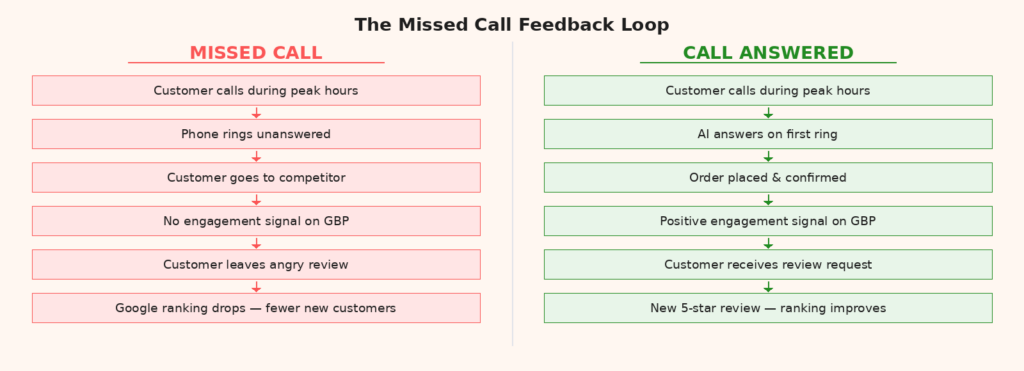
There’s a downstream effect that’s even more damaging than the immediate engagement loss. A customer who calls your restaurant three times on a Friday night and gets no answer is not a neutral event for your reputation. That customer is frustrated — they were hungry, they chose you, and you let them down before they even tasted the food. A meaningful share of those customers will leave a negative review, not about the food, but about being unable to reach you. That review stays on your profile for years.
When we were designing Tunvo’s call-handling architecture, we analyzed patterns from seed restaurant deployments in New York. The most common trigger for negative reviews that mentioned “couldn’t reach anyone” or “phone always busy” came from peak-hour missed calls — not from bad food, not from slow service, but from an unanswered phone. The food could be excellent, but the review still said 1 star.
What the Local Search Data Is Telling Us in 2026
Recent research from Search Engine Land shows a striking pattern: many businesses are seeing their Google Maps rankings hold steady while their actual incoming call volume drops. The reason is structural — Google’s AI-generated local results are replacing traditional map pack listings in some search formats, and those AI results don’t always include a click-to-call button. This makes it even more important that when Google does show your click-to-call option, you answer. The calls you receive from Google Maps are increasingly self-selected, high-intent customers — people who specifically chose to call you over using a delivery app. Missing those calls is a compounding loss.
Review Recency Is Part of the Same System
There’s a related dynamic worth understanding. Local SEO case studies consistently show that when review velocity drops, rankings can follow. Missed calls don’t just lose you a sale — they often lose you a potential reviewer. A satisfied phone-order customer who speaks to a human, places their order smoothly, and receives their food on time is exactly the kind of customer who will respond positively to a review request. A customer who couldn’t get through won’t leave you a review at all — or will leave the wrong kind.
How Consistent Call Answering Improves Your Ranking Over Time
The fix isn’t complicated in concept, even if it’s hard in practice. Every call that gets answered is a positive data point: engagement, customer retained, potential review earned. Do that consistently — 100% of calls answered, during peak hours and after closing — and the ranking effects accumulate over months.
The challenge is that consistent call answering requires either enough staff to handle peak-hour volume (expensive and unreliable) or a system that doesn’t have staffing constraints. This is precisely the problem Tunvo’s AI voice agent was designed to solve: every call gets answered on the first ring, in English or Mandarin, whether it’s a $15 lunch order at noon or a reservation inquiry at 11 PM.
The Compounding Benefit of 100% Pickup Rate
Think about what changes when every call gets answered. The customer who would have frustrated-searched elsewhere instead places an order. The potential negative review never gets written. The engagement signal on your Google listing is positive. The customer, satisfied with the experience, responds to a follow-up review request. Over 60 days, this compounds: more engagement, better review velocity, improved local ranking, more customers finding you. Research on GBP optimization shows that restaurants seeing consistent interaction growth can achieve meaningful ranking improvements within six months.
The restaurants we work with in New York that have deployed Tunvo’s AI voice agent don’t just report higher revenue — they report fewer negative reviews mentioning phone issues, and they’re starting to see the ranking improvement that comes with that cleaner engagement signal.
Frequently Asked Questions
Does Google directly penalize restaurants for missed calls?
Google doesn’t issue a direct “missed call penalty,” but the downstream effects — lower engagement, higher bounce rates after a click-to-call, and potential negative reviews — collectively suppress your prominence score over time. Google’s own Local Services Ads documentation confirms that missed calls can negatively affect responsiveness ratings, which influence placement. The indirect effects on organic Google Maps ranking follow similar logic.
What’s the best way to eliminate missed calls during peak hours?
The most reliable solution is to decouple call-answering from your floor staff entirely. Whether that means a dedicated phone handler, call forwarding, or an AI voice agent, the goal is the same: remove the peak-hour conflict between serving tables and answering phones. An AI solution that handles ordering end-to-end is particularly effective because it doesn’t just answer — it completes the transaction, which is the positive engagement signal that matters most.
Does answering after-hours calls help my Google ranking?
Yes — and the after-hours window is often the most underutilized. Customers who call at 10 PM to ask about tomorrow’s specials or place an advance order are high-intent. If they reach a message or silence, they find somewhere else. Tunvo’s 24/7 coverage was built specifically for this gap: the calls that happen outside business hours but still represent revenue opportunities.
Every missed call is a missed opportunity — for revenue, for a review, and for your Google ranking. Tunvo answers every call, in English and Mandarin, and sends orders straight to your MenuSifu POS. Get started in 30 minutes.