
New York’s tipping rules are some of the most detailed in the country. The state separates tipped workers into different categories, sets different cash wages and tip credit amounts for each category, and enforces compliance with criminal penalties in serious cases. Wage theft — including improper tip handling — became eligible for criminal prosecution in New York as of 2023. Fines can reach 200% of unpaid wages plus interest and civil penalties. For a restaurant owner trying to run a tight operation, this isn’t a compliance detail to leave to guesswork. This guide covers the 2026 rules in plain language: what you can and can’t do with tips, how the tip credit works in practice, and where the most common mistakes happen.
Note: This article provides general information about New York tipping laws for restaurant operators. It is not legal advice. For questions specific to your operation, consult a licensed employment attorney familiar with the New York Hospitality Industry Wage Order.
Key Takeaways
- Tips belong to employees, not employers. An employer cannot keep any portion of tips except in the context of a lawful tip pool.
- The tip credit is available only for “food service workers” and “service employees” as defined by the Hospitality Wage Order — kitchen staff do not qualify.
- The 80/20 rule limits when tip credits can be applied: if an employee spends more than 20% of a shift on non-tipped work, the employer cannot take the tip credit for that day.
- Service charges are treated as tips by default under New York law unless the customer is clearly notified otherwise in writing.
- Daily records of employee tips are required under NY Labor Law Section 196-d and are subject to NYDOL inspection.
Who Counts as a “Tipped Employee” in New York?
Three Categories That Matter for Restaurants
New York’s Hospitality Industry Wage Order defines worker categories precisely, and the tip credit rates are different for each category. Getting the category wrong is one of the most common compliance errors.
A food service worker is an employee primarily engaged in serving food or beverages to customers — wait staff, bartenders, bussing personnel, captains — who regularly receives tips. Delivery workers are explicitly excluded from this definition. A service employee is a broader tipped category covering other positions that customarily receive tips, such as door staff or coat check. A non-service employee is any other employee — cooks, dishwashers, prep staff — who does not qualify for a tip credit and must receive the full base minimum wage.
The distinction matters because the tip credit amount differs significantly between food service workers and service employees. Employers must give careful attention to the applicable wage order to ensure they are taking the appropriate credit for each occupation.
The 2026 Tip Credit Rates
NYC and Downstate vs. Upstate
| Worker Category | Location | Cash Wage | Tip Credit | Min Wage |
|---|---|---|---|---|
| Food service worker | NYC, LI, Westchester | $11.35 | $5.65 | $17.00 |
| Food service worker | Remainder of NY | $10.70 | $5.30 | $16.00 |
| Service employee | NYC, LI, Westchester | $14.15 | $2.85 | $17.00 |
| Service employee | Remainder of NY | $13.30 | $2.70 | $16.00 |
The rule in every case: the employee’s cash wage plus actual tips received must equal at least the full minimum wage for every hour worked. If tips fall short for any shift, the employer must make up the difference. This requires tracking actual tip amounts per employee per shift — not estimating or averaging across weeks.
Four Conditions Required to Claim the Tip Credit
You Must Meet All Four — Not Just Most
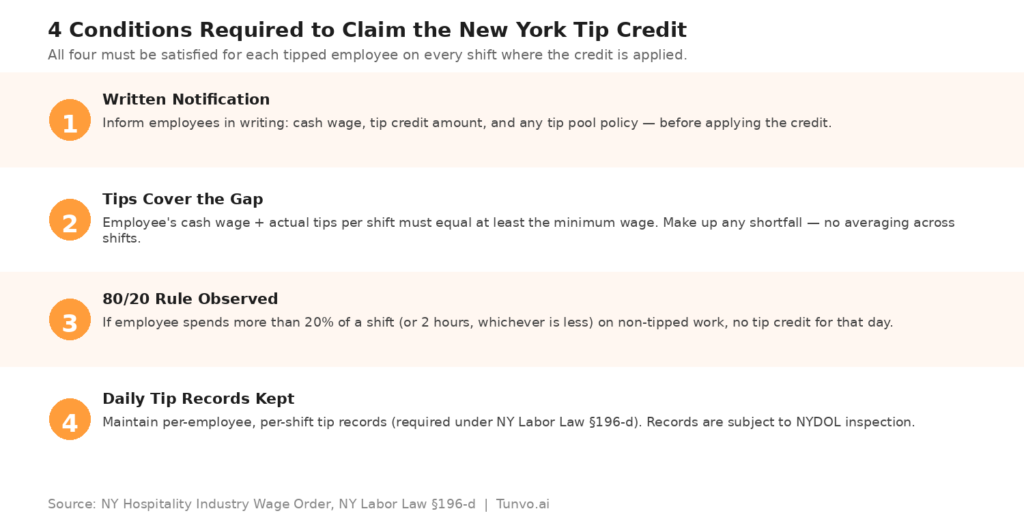
New York’s Hospitality Wage Order sets strict conditions. For an employer to claim a tip credit, the employee must receive enough tips and must have been notified of the tip credit as required. In practice, the four conditions are:
1. Written notification. You must notify employees clearly and in writing that you are using the tip credit, including the cash wage amount, the tip credit amount, and whether there is a tip pooling policy. This notice should be given before the tip credit is first applied.
2. Tips must actually make up the difference. If they don’t on any given shift, you pay the gap. There is no period averaging. Each shift stands alone.
3. The 80/20 rule. If an employee spends more than two hours, or 20% of their shift (whichever is less), doing non-tipped work, the employer may not take the tip credit for any hours worked that day. Side work like rolling silverware or restocking the service station is fine; the line is crossed when an employee spends too much time on tasks entirely removed from service (e.g., kitchen prep). This rule requires some judgment and is a common audit trigger.
4. Daily tip records maintained. Under NY Labor Law Section 196-d, employers are required to maintain daily records of the tips employees receive, and those records are subject to NYDOL inspection. Wage statements must separately show the tip and wage components of pay.
Tip Pooling and Tip Sharing in New York
Who Can Participate — and Who Cannot
New York allows both tip sharing and tip pooling, but the rules are specific about who may participate. Only employees who regularly interact with customers — servers, bartenders, bussers — may be included in an employer-mandated tip pool. Kitchen staff who do not interact with customers cannot be included in a mandatory tip pool. This is a firm line in New York.
Tip sharing is different from tip pooling. Tip sharing is when directly tipped employees voluntarily share their tips with other workers who provided direct service. Managers and supervisors cannot receive tips from a pool — their inclusion would invalidate the pool and potentially trigger back-pay claims.
For tip pool calculations, the employer may only factor in the actual tips the employee received from the pool — not the amount they contributed. If an employee contributed $100 to the pool but only received $80 back, the tip credit calculation uses the $80 figure.
Service Charges: The Common Misunderstanding
A Service Charge Is Presumed to Be a Tip
This one catches restaurant owners off guard regularly. Under the Hospitality Wage Order, there is a legal presumption that any charge not for food and drink is a tip. If your restaurant adds an automatic 18% gratuity to tables of 6+, or a mandatory service charge to banquet packages, that charge is presumed to be a gratuity and must be distributed to the employees who served that table or event.
To treat a mandatory service charge as a business revenue item rather than a gratuity, the employer bears the burden of demonstrating by clear and convincing evidence that the notification was sufficient to ensure a reasonable customer would understand the charge was not a tip. This typically requires a clear written statement in contracts, menus, and agreements — not just a small-print note. The default, without clear notification, is that the service charge belongs to staff.
Credit Card Processing Fees on Tips
You Can Deduct Them — With Conditions
New York allows employers to deduct a pro-rated credit card processing fee from tips paid by credit card. As of January 2025, employers are required to provide employees with detailed monthly statements outlining all deductions from tips received, including credit card fees. The deduction must reflect only the actual processing cost attributed to that tip — you cannot deduct a flat percentage that’s higher than your actual merchant fee. And the net tip, after the fee deduction, must still be paid to the employee no later than the next regularly scheduled payday.
Federal Tax Changes: Tips Are Now Tax-Deductible for Employees
What the One Big Beautiful Bill Act Means for Your Staff
Under the One Big Beautiful Bill Act signed into law on July 4, 2025, tips and overtime pay are no longer subject to federal income tax starting with the 2025 tax year. Employees in traditionally tipped roles can deduct up to $25,000 in tip income annually from their federal taxes, with the provision in effect through December 31, 2028. Tips are still subject to Social Security and Medicare taxes. This change affects employee tax filing but does not change your payroll obligations as an employer — you still owe employer FICA on wages, and tip reporting requirements remain in place.
Frequently Asked Questions
Can my restaurant keep a portion of employee tips?
No. Tips belong to employees. Under NY Labor Law, employers cannot take any portion of employee tips except in the context of a lawful tip pool. Withholding tips without a valid legal basis is wage theft and is subject to back pay, civil penalties up to 200% of unpaid wages, and potentially criminal prosecution.
Can my head cook participate in a tip pool?
No, under a mandatory employer-run tip pool. Kitchen staff who do not regularly interact with customers cannot be included in a mandatory tip pool. Servers and other directly tipped employees can voluntarily agree among themselves to share tips with anyone, but the employer cannot mandate kitchen inclusion in the pool.
What is the 80/20 rule in New York?
The 80/20 rule states that if a tipped employee spends more than 20% of their shift (or more than 2 hours, whichever is less) doing non-tipped work, the employer cannot take the tip credit for any hours worked that day. The entire shift reverts to the full minimum wage at the employer’s expense.
Does a mandatory service charge on a banquet belong to the servers?
By default, yes — New York law presumes any charge not for food and drink is a tip and must be distributed to employees. To treat it as restaurant revenue, you must provide clear written notification to customers that the service charge is not a gratuity. The burden of proof is on the employer.
Are tips tax-free in New York for employees in 2026?
Tips are exempt from federal income tax (up to $25,000/year) through 2028 under the One Big Beautiful Bill Act. However, tips are still subject to Social Security and Medicare (FICA) taxes, and state income tax obligations in New York remain unchanged. Employees should consult a tax professional for their individual situation.
Managing tip compliance well requires clean records, clear employee notifications, and tight shift-by-shift tracking. That operational discipline becomes harder when your team is stretched thin — juggling phone orders, table service, and back-of-house tasks at the same time. Freeing your staff from the phones is one of the simplest ways to reduce that pressure.
Tunvo’s AI voice agent answers every inbound call, takes orders directly into your POS, and keeps your team focused on the floor. Learn how it works, or start a 15-day free trial — no commitment, set up in 30 minutes.