If you’re a Chinese restaurant owner comparing phone ordering solutions, you’ve probably run across both Tunvo and Tarro. On the surface they seem to solve the same problem: your phone rings, an order gets taken, it goes to your kitchen. But the way they do that — and what that means for your restaurant day-to-day — is fundamentally different. This isn’t a minor feature comparison. It’s two different philosophies about what “AI phone ordering” actually means.
I want to be upfront: I’m Tunvo’s VP of Product, so I have a perspective here. What I’ll try to do is give you an honest breakdown of the actual architectural and operational differences, so you can make the decision that’s right for your restaurant, not just the one that sounds best in a demo.
Key Takeaways
- Tarro uses a human + AI hybrid model — human agents (historically based in the Philippines) answer calls with AI assistance. Humans are still the primary handler.
- Tunvo is a pure LLM-driven AI voice agent — no human operators in the order-taking loop. The AI handles the call from start to finish.
- The cost structure is different — Tarro’s pricing reflects the cost of human labor; Tunvo’s reflects software and compute.
- The technology foundation is different — Tarro built its model on traditional call center infrastructure; Tunvo is built on real-time LLM voice technology from the ground up.
- Neither is universally “better” — the right choice depends on your volume, your tolerance for technology, and what you value in a vendor.
What Tarro Actually Is
Tarro has been helping Chinese restaurants handle phone orders since roughly 2015, and they’ve built a significant business doing it — according to Sacra research, they reached around 3,500 restaurants and an estimated $85M revenue run rate by end of 2024. That success is real and worth respecting.
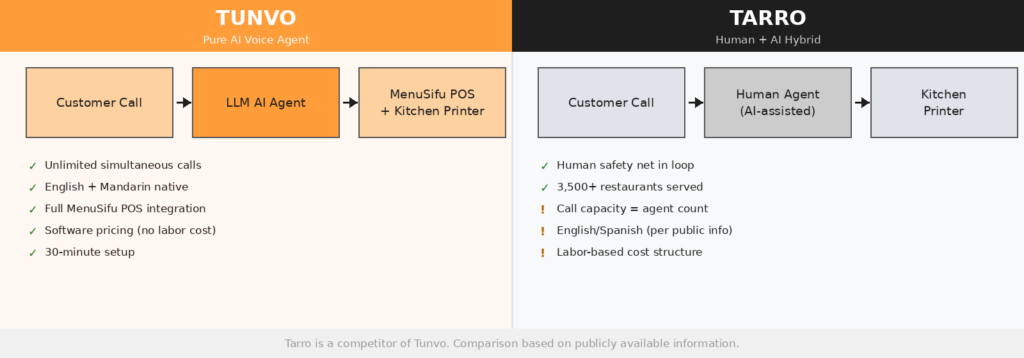
The model Tarro built is what the industry calls a “human + AI” hybrid: when your customer calls, a trained human agent — located in a remote call center — answers and takes the order, with AI software running in the background to assist with accuracy and speed. The human agent is the primary point of contact. AI helps them, but the human is handling the call.
This model has clear strengths. Human agents can handle unexpected situations gracefully — a confused customer, an unusual order, a complaint. They can improvise. They can de-escalate. And when the AI is uncertain, a human agent provides the fallback that keeps the order from going wrong.
The limitation is structural: you’re paying for human labor, even if it’s lower-cost offshore labor. And a human call center — no matter how well staffed — cannot be in three places at once. When your phones are ringing off the hook on a Friday night, the system’s capacity is bounded by how many agents are available.
What Tunvo Actually Is
Tunvo is a pure AI voice agent. There are no human operators involved in the order-taking process. When a customer calls, a large language model — the same class of AI technology that powers modern AI assistants — handles the conversation from start to finish, in real time.
This isn’t an IVR (interactive voice response) system with menu buttons and rigid prompts. It’s not a keyword-matching bot that falls apart when someone says “can I get the kung pao but with less sauce and maybe some extra vegetables instead of peanuts.” It’s a conversational AI that understands natural language, handles modifications, and responds with the same flexibility a trained human order-taker would.
Tunvo was built by Sobot — Asia-Pacific’s leading customer service AI platform with over a decade of AI development experience, backed by SoftBank — specifically for the North American restaurant market. That foundation matters: Sobot has built production-grade voice AI for millions of customer interactions, and Tunvo is that expertise applied to restaurant phone ordering.
The Technology Difference: Why It Matters
Traditional voice AI systems — including many built in the 2015-2022 era — use a three-step pipeline: speech recognition converts the customer’s words to text, an NLP (natural language processing) model interprets the text, and a text-to-speech system generates the response. Each handoff between these systems adds delay, and each system has its own error rate that compounds through the chain.
Modern AI voice architecture research from Deepgram describes the problem clearly: “Traditional voice AI moves through three separate engines. ASR turns speech into text, an NLP model drafts a reply, and TTS speaks it back. That handoff chain adds cumulative delays and loses prosody, tone, and speaker identity.”
Tunvo’s approach uses real-time LLM technology — a tighter integration where a single large language model handles comprehension and response generation with natural conversational flow, rather than a fragmented pipeline. The result is an AI that sounds less robotic, handles unexpected phrasing more gracefully, and processes bilingual conversations (English and Mandarin) without needing separate language-specific models.
As independent research on voice agent architecture notes, real-time LLM-based approaches are best suited for “AI concierges, live assistants in fast-paced environments” — which describes restaurant phone ordering during a dinner rush precisely.
Side-by-Side Comparison
| Feature | Tunvo | Tarro |
|---|---|---|
| Core model | Pure AI voice agent (LLM-driven) | Human agents + AI assistance |
| Who answers the call | AI only | Human agent (AI-assisted) |
| Languages | English + Mandarin | English + Spanish (per public materials) |
| Simultaneous calls | Unlimited (software) | Limited by agent capacity |
| POS Integration | MenuSifu (deep integration) | Printer-based output |
| Setup time | ~30 minutes | Custom (agent training required) |
| Cost structure | Software-based pricing | Labor-based (human agent cost) |
| Mandarin support | ✅ Native | ⚠️ English/Spanish (per public materials) |
| Human fallback | Optional (route to staff) | Built-in (human is primary handler) |
| Parent company | Sobot (10yr AI, SoftBank-backed) | Independent (founded 2012) |
The Language Question
For Chinese restaurants specifically, the language support difference is significant. Tunvo’s AI handles both English and Mandarin natively — meaning it understands a customer who switches mid-sentence, a common pattern in Chinese-American restaurant phone calls. The AI doesn’t route the call to a different system or struggle with code-switching. It handles it in a single, continuous conversation.
Tarro’s publicly available materials describe their agents as fluent in English and Spanish. For a Chinese restaurant whose customer base includes Mandarin speakers — and whose owners often prefer to communicate in Chinese — this is a meaningful gap. If your restaurant serves a bilingual Chinese-English community in New York, that gap shows up in real calls.
The Scale Question: Simultaneous Calls
This is where the architectural difference becomes most concrete. Tarro’s system, built on a human agent model, handles calls one at a time per agent. When your restaurant is getting four calls simultaneously during the 6pm rush, you need four agents available. If only two are available, two customers wait or hang up.
Tunvo’s AI system scales to simultaneous calls without constraint. The number of calls your AI can handle at any given moment isn’t limited by staffing — it’s a software resource question, not a human one. During peak hours, when phone orders drive the highest share of takeout revenue, this is a meaningful operational advantage.
The MenuSifu Integration Advantage
Tarro sends order information to a printer — a receipt-style output that someone at your restaurant reads and enters into your POS manually, or that fires directly to a kitchen printer. This works, but it doesn’t integrate into your POS data layer.
Tunvo’s deep integration with MenuSifu — the leading POS system for Chinese restaurants in North America — means phone orders become full POS orders, not just printer tickets. Order data flows into your reporting, inventory management, and customer history. A phone order taken by Tunvo looks identical to an in-person order in your MenuSifu dashboard. That data doesn’t disappear into a stack of paper tickets.
When Tarro’s Model Makes Sense
Tarro built a real business by solving a real problem, and their model has genuine advantages in specific scenarios. If your restaurant handles a high volume of unusual, off-menu requests — the kind of customization that genuinely benefits from human judgment — a human fallback in the loop is reassuring. If your staff is not comfortable with technology and you want a partner who manages every detail, Tarro’s managed-service model provides that.
Tarro has also built out delivery and SMS marketing services beyond phone ordering. If you’re looking for a single vendor to manage phone ordering, delivery, and marketing all at once, their broader platform may be more relevant than a comparison on AI capability alone.
When Tunvo Makes More Sense
Tunvo is the stronger fit when: your customer base includes significant Mandarin speakers; you’re already running MenuSifu and want orders fully integrated into your POS data; you want to scale to unlimited simultaneous calls without worrying about staffing constraints; or you want AI-first economics — software pricing rather than paying for human labor at a margin.
Tunvo’s pricing model is built for the software era of this industry, not the offshore labor era. If you believe AI is where phone ordering is heading — and the technology trajectory strongly suggests it is — then building your operation on a pure AI foundation rather than a hybrid one positions you better for the next several years.
According to Tunvo, customers achieve 95%+ order accuracy, 20%+ lower labor costs, and 13%+ higher order revenue. Those figures are directionally consistent with what the industry sees from removing the human bottleneck in call handling — and with research showing digital ordering systems reduce errors by up to 30% compared to manual processes.
The Honest Summary
Tarro is a proven, established business with a hybrid model that trades some efficiency for a human safety net. It’s a solid choice for restaurant owners who want reliability and human backup built into the system. The trade-off is cost structure (human labor priced in), limited Mandarin support, and call capacity constraints at peak hours.
Tunvo is a pure AI system built on modern LLM technology, with native Mandarin support, unlimited concurrent call handling, and deep POS integration with MenuSifu. The trade-off is that it’s newer, still in its early rollout phase in New York, and asks you to trust that AI can handle what humans have traditionally done.
We think the AI trajectory is clear — and we’d rather be the option that’s built for where this industry is going than the one optimized for where it’s been.
Frequently Asked Questions
Does Tunvo have any human backup if the AI can’t handle a call?
Yes. Tunvo can be configured to transfer calls to your staff when needed — for example, if a customer specifically requests to speak to a person, or in situations the AI identifies as outside its scope. The difference from Tarro’s model is that this is the exception, not the default. The AI handles the overwhelming majority of calls independently.
Tarro claims 99.5% accuracy — how does that compare to Tunvo?
Tunvo reports 95%+ order accuracy, attributable to the AI’s end-to-end understanding of conversational ordering. Tarro’s 99.5% figure reflects their human + AI model, where human agents provide the accuracy safety net. Direct statistical comparison is difficult because the models differ — one is fully AI-assessed, one has human review built in. What matters practically is whether the orders that reach your kitchen are correct, regardless of what’s generating them.
Can I use Tunvo if I don’t have MenuSifu?
Yes. Tunvo supports direct printer integration for restaurants without a MenuSifu POS. However, the full POS integration — with order data flowing into your reporting and management tools — is only available with MenuSifu. If you’re evaluating your POS at the same time as your phone ordering solution, our team can walk you through the full setup, including the MenuSifu ecosystem.
Is Tarro available in New York?
Yes, Tarro operates nationally. Tunvo is currently focused on New York as its primary market for 2026, with expansion to broader North America planned subsequently. If you’re a New York Chinese restaurant, this is the market Tunvo has built specifically for.
Every missed call is a missed opportunity. Tunvo’s pure AI model answers every call simultaneously, in English and Mandarin, and sends orders straight to your MenuSifu POS.
See the difference for yourself. Book a Demo or Start Your 15-Day Free Trial.