You spent real money setting up MenuSifu. Your kitchen tickets print in the right language. Your staff knows the system. Orders from DoorDash and Uber Eats flow in automatically. So why is the phone still the most chaotic part of your restaurant?
If you’re a MenuSifu user, you’ve already done the hard part — you’ve built a reliable technology backbone for your restaurant. But there’s a gap that MenuSifu doesn’t close on its own: the inbound phone call. Someone calls to place a takeout order, make a reservation, or ask about a dish. Your POS is waiting to receive that order. The problem is that someone has to pick up the phone and bridge those two worlds — and during the dinner rush, that person is usually the one who should be doing something else.
Voice AI was built to close exactly this gap. And when it’s purpose-built to connect with MenuSifu, it doesn’t just answer the phone — it takes the order, handles the modifiers, and sends it straight into your POS as a clean, formatted ticket. No re-entry. No mistakes from the third time someone shouted “extra spicy” over the noise.
This guide covers everything a MenuSifu restaurant owner needs to know about voice AI: how it works with your existing system, what it can and can’t handle, how to evaluate your options, and what results you can realistically expect.
Key Takeaways
- MenuSifu POS users can add voice AI without replacing any hardware or software — the integration works alongside your existing setup.
- Voice AI answers every call and routes orders directly into MenuSifu, eliminating manual re-entry and the errors that come with it.
- The technology has matured significantly — modern LLM-based systems handle complex modifiers, bilingual customers, and peak-hour call surges that would overwhelm any human staff member.
- The revenue math is compelling: industry data shows that restaurants miss up to 43% of phone calls during peak hours, each one a lost order.
- Setup for a MenuSifu-integrated voice AI can take as little as 30 minutes — your menu is already in the system.
Why Phone Orders Still Matter for MenuSifu Restaurants
The Myth That “Everyone Orders Online Now”
It’s easy to assume that third-party platforms and QR codes have made phone orders obsolete. They haven’t — especially not for independent Chinese restaurants, which represent the largest segment of MenuSifu’s customer base. Phone ordering in the United States has a 120-year history, and the habits run deep. Regular customers call directly because they know the restaurant, want to customize their order beyond what an app allows, and often get better service. They’re also avoiding the 25–30% commissions that third-party platforms charge, which means every phone order that converts is meaningfully more profitable for you.
There’s also a demographic reality. Many of your most loyal customers — particularly older Chinese-American diners and customers who live nearby — prefer calling. A customer who phones in is a customer who is already decided. They’ve made their choice. The only variable is whether you answer.
The Peak-Hour Problem That MenuSifu Alone Can’t Solve
MenuSifu handles everything that happens after an order is placed. The KDS routes tickets to the right station. Reports track your top dishes. Inventory updates in real time. But when the phone rings at 6:45 PM on a Friday and your entire front-of-house team is managing tables, online deliveries, and walk-ins simultaneously, MenuSifu can’t pick up the phone for you.
Industry research shows that 43% of restaurant phone calls go unanswered during peak hours. Each missed call doesn’t just mean a lost order — it typically means a lost customer. Research indicates that 60% of callers won’t try again if no one picks up the first time. They simply call the next restaurant on their list. For a restaurant averaging five missed calls a night at $40 per order, that’s $73,000 in annual revenue that evaporates silently.
Why MenuSifu Restaurants Are Particularly Well-Positioned for Voice AI
Here’s what most voice AI conversations miss: the integration is only as good as the POS it connects to. A voice AI that sends orders to a printer, or requires manual transfer into your POS, creates a new set of problems. But for MenuSifu users, the integration exists at the system level. Your menu, modifiers, pricing, and kitchen routing are already configured. A voice AI that plugs into MenuSifu can use all of that data — it knows your categories, your modifiers, your combos — and it sends orders in as native tickets, not transcribed notes.
That distinction matters enormously in practice. It’s the difference between an AI that replaces your phone and one that extends your POS to answer the phone.
How Voice AI Works Inside a MenuSifu System
The Technical Architecture (Without the Jargon)
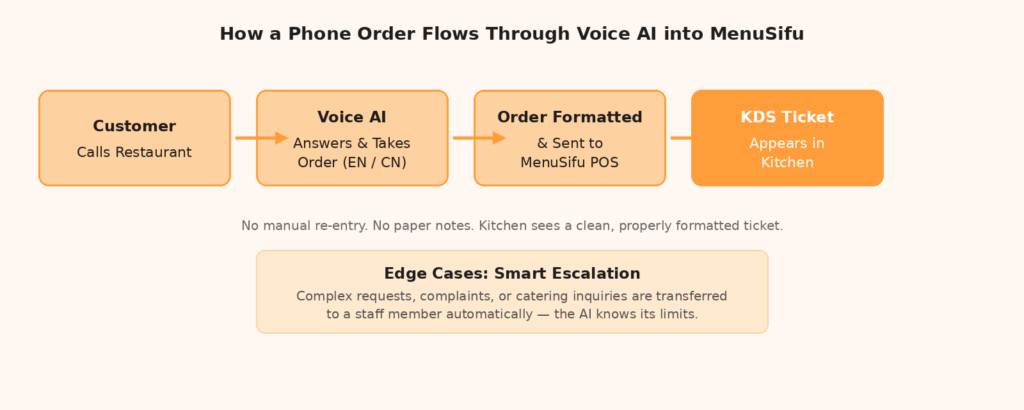
When a customer dials your restaurant number, the call routes to the voice AI system instead of a physical phone. The AI answers, greets the caller in their language (English, Mandarin, Cantonese — depending on configuration), and begins a natural conversation about their order.
Modern voice AI systems built on large language models (LLMs) don’t follow a rigid script. They understand open-ended requests the way a trained employee would. “I’ll have the number 12 but no scallions, and can I get the dumpling soup instead of the hot and sour?” That kind of request — with a substitution, a removal, and an implicit understanding of what “instead of” means in context — is exactly what LLM-based AI handles well, and what older speech-recognition systems struggled with.
Once the order is complete, the system formats it as a structured ticket and sends it directly into MenuSifu. The order appears in your KDS exactly as it would if a staff member had entered it manually — with the right items, the right modifiers, and the right printer routing. Your kitchen team doesn’t need to know the call was handled by AI.
Menu Sync: How the AI Knows What You Serve
This is where the MenuSifu integration becomes particularly valuable. Rather than requiring manual menu entry into a separate system, a well-integrated voice AI pulls its menu knowledge from your existing MenuSifu data. Item names, modifier groups, pricing, availability — all of it lives in MenuSifu already.
When you update a price, add a seasonal special, or mark an item 86’d, that change can propagate to the voice AI automatically. The AI never quotes an outdated price or takes an order for something you stopped serving last month. This kind of real-time sync is only possible because MenuSifu exposes structured menu data — and it’s one of the reasons MenuSifu restaurants have an advantage when deploying voice AI over restaurants running older or more closed POS systems.
What Happens When the AI Reaches Its Limits
No AI handles every situation perfectly. A customer who wants to discuss a complex catering order, or who calls with a complaint that requires manager attention, shouldn’t stay in an automated flow. Well-designed voice AI systems include smart escalation: when the conversation moves outside the AI’s confident handling range, it gracefully transfers the call to a staff member or takes a message. The key is that routine orders — which represent the large majority of phone volume — are handled fully automatically, freeing your staff for the situations where human judgment actually matters.
What Voice AI Can Handle on a MenuSifu Menu
Standard Orders: The Easy Part
The majority of phone calls to a Chinese takeout restaurant are straightforward. “I’d like the General Tso’s chicken with fried rice and a wonton soup.” Modern voice AI handles these calls with high accuracy. The LLM has ingested your full MenuSifu menu, understands category names, dish numbers, and common aliases (customers calling it “the orange chicken” when your menu says “Tangerine Beef”). It confirms the order back to the customer before finalizing, catching mistakes before they reach the kitchen.
Modifiers: Where Older AI Failed and LLMs Succeed
Chinese restaurant menus are modifier-intensive in ways that trip up simpler AI systems. “No MSG.” “Less oil.” “Extra spicy — actually, make it medium.” “Half-order of fried rice instead of white rice.” “No peanuts, my wife is allergic.” These aren’t edge cases — they’re standard requests at most Chinese restaurants, and handling them correctly matters both for customer satisfaction and, in the case of allergens, for safety.
This is where the generation of voice AI matters enormously. Earlier systems built on ASR (automatic speech recognition) plus scripted NLP could handle simple modifications like “no onions.” They failed on anything that required understanding context, sequence, or nuance. LLM-based systems — the technology underlying modern voice AI platforms — approach modifier handling differently. They understand that “hold the sauce” means something different depending on whether the customer ordered a dumpling dish or a stir-fry. They can ask a clarifying question when the request is ambiguous, just as a good employee would.
When Tunvo pulls modifier groups directly from MenuSifu, the AI also knows which modifiers are valid for which items. A customer asking to make their soup “extra spicy” will get a valid response, because the AI knows whether your MenuSifu menu includes that modifier for that item. Requests for modifiers that don’t exist trigger a graceful clarification rather than a nonsense order in the kitchen.
Bilingual Calls: A Specific Advantage for Chinese Restaurants
A significant portion of Chinese restaurant phone volume comes from Mandarin or Cantonese-speaking customers who are more comfortable ordering in their first language. Managing this with human staff means either hiring bilingual employees (increasingly difficult and expensive) or losing those customers to a language barrier. Voice AI that supports Chinese-English bilingual conversations removes that barrier entirely. The AI switches language mid-call if needed, handles dish names in Chinese, and responds naturally — without putting the caller on hold while someone who speaks Mandarin finishes taking another table’s order.
What Voice AI Isn’t Built to Handle
Voice AI is not a general customer service agent. It excels at structured transactions: take the order, confirm the details, route the ticket. It’s less suited for open-ended conversations about dietary restrictions across an entire menu (“just tell me everything that’s vegan”), complex catering negotiations, or situations where a customer is upset and needs empathy and problem-solving. These situations need a human, and good voice AI knows to route them accordingly rather than attempting an answer that might make things worse.
Evaluating Voice AI Options as a MenuSifu Restaurant
The Integration Question You Have to Ask First
Many voice AI vendors will tell you they “integrate with any POS.” What that often means in practice is that they send a structured order summary to an email address or a printer — and someone on your team re-enters it into the POS. That’s not an integration; that’s a transcription service. Before evaluating any feature set, ask directly: does the order appear as a native ticket in MenuSifu, with the correct modifiers and kitchen routing? If the answer involves any manual step, the operational benefit is significantly reduced.
Tunvo’s integration with MenuSifu is direct. Orders go into the POS as properly formatted tickets, exactly as they would from any other ordering channel. This matters most during peak hours, when a re-entry step isn’t just inconvenient — it’s impossible to execute consistently.
Key Evaluation Criteria
| Criterion | Why It Matters for MenuSifu Users | What to Ask |
|---|---|---|
| Native MenuSifu integration | No re-entry, no errors, no extra labor | Does the order appear as a ticket in my KDS? |
| Bilingual support | Chinese restaurant callers use Mandarin / Cantonese | Can the AI handle full Chinese-language calls? |
| Modifier depth | Chinese menus have layered customization | Can I test a complex order with multiple modifications? |
| Menu sync method | Your menu changes — AI must keep up | How do menu updates in MenuSifu reflect in the AI? |
| Setup time | You don’t have weeks to spare for onboarding | How long from signup to first live call? |
| Human escalation | Edge cases need a real person | What triggers a transfer, and how does it work? |
Pricing Models to Watch Out For
Voice AI pricing varies widely. Some platforms charge per call, which sounds reasonable but can become expensive if your volume is high. Others charge a flat monthly fee with a call cap, meaning your busiest nights — when you need the AI most — might hit a limit. The most restaurant-friendly model is a flat monthly subscription with unlimited calls, because your phone volume during peak hours is precisely when the value is highest, and you shouldn’t be penalized for it.
The ROI Case for MenuSifu Restaurant Owners
Calculating Your Missed-Call Revenue Gap
The math on voice AI ROI is unusually transparent, which is rare for restaurant technology. Start with a conservative estimate of your missed calls: if your restaurant receives 50 calls a day during a four-hour peak window and staff can realistically answer 70% of them, you’re missing roughly 15 calls. If 60% of those would have converted to orders, and your average phone order is $35, you’re losing $315 a night — or over $110,000 a year. That estimate is deliberately conservative. HungerRush’s analysis found that a typical restaurant loses over $27,000 annually just from unanswered calls, and that figure rises sharply for restaurants with high phone volume.
Voice AI doesn’t just recover lost calls. It also captures revenue that leaks in other ways: orders taken incorrectly because of noise or rushed staff, customers who hang up after being put on hold, and late-night calls that come in after closing when no one is monitoring the phone.
Labor Efficiency: What Changes When the Phone Answers Itself
The labor benefit is harder to quantify but often more meaningful to owners than the revenue side. Every minute a front-of-house employee spends on the phone is a minute they’re not serving a table, running food, or managing the flow of the dining room. In a two- or three-person front-of-house operation — which describes most independent Chinese restaurants — this trade-off is constant. Voice AI doesn’t make your staff redundant; it makes their time proportional to your highest-value activities.
Tunvo’s data shows that restaurants using voice AI report up to 40% savings in labor costs related to phone management, and 13%+ higher order revenue from capturing calls that previously went unanswered or were handled incorrectly.
The Payback Period
For most MenuSifu restaurants, voice AI pays for itself within the first month — sometimes within the first week. A subscription cost of a few hundred dollars per month against thousands in recovered revenue is a compelling equation. The more important question isn’t whether the ROI is positive (it nearly always is), but whether you’re comfortable with the transition and trust the system enough to let it handle live customer calls. That’s why a free trial period, and the ability to test the system yourself before going live, matters so much in the evaluation process.
Tunvo offers a 15-day free trial precisely for this reason — so you can call your own number, test your menu, and hear how the AI handles your specific dishes before committing. Start your free trial or book a demo to see the MenuSifu integration in action.
Frequently Asked Questions
Do I need to change anything about my MenuSifu setup to use voice AI?
No significant changes are required. Tunvo connects to your existing MenuSifu account and pulls your menu data from the system you already use. You don’t need to re-enter your menu, reconfigure your KDS, or change how your kitchen receives orders. The integration works alongside your current setup — it adds a new input channel (phone calls) to the same MenuSifu system that already handles your other orders.
What happens if a customer calls during our closed hours?
The voice AI can handle after-hours calls in several ways, depending on your preference. It can inform callers of your hours and take a message, quote your next available ordering window, or (if you offer pre-ordering) accept orders for a future pickup or delivery slot. This means calls that previously went to voicemail — and were rarely acted on — become captured leads. After-hours is often when your most motivated customers call, and recovering those conversations has real revenue value.
Can the AI handle calls in both English and Mandarin on the same line?
Yes. Tunvo’s voice AI supports Chinese-English bilingual calls on a single phone number. The AI detects the customer’s language preference early in the conversation and responds accordingly. If a caller switches between languages mid-call — which is common in mixed-language households — the AI adapts. This eliminates the need to maintain separate phone lines or staff your phone specifically with bilingual employees during peak hours.
How does the AI handle items that are sold out or temporarily unavailable?
When an item is marked unavailable in MenuSifu — either manually or through your inventory management settings — that status is reflected in the voice AI’s menu knowledge. If a customer orders a sold-out item, the AI will inform them and suggest alternatives from the same category. It will not take an order for something that can’t be fulfilled. This is one of the specific advantages of a system that reads directly from your MenuSifu menu data rather than operating from a static menu uploaded at setup.
What percentage of calls will the AI handle fully without human involvement?
For a typical Chinese takeout restaurant, the vast majority of calls — straightforward orders, reservation inquiries, hours and location questions — can be handled end-to-end by the AI. Restaurants using Tunvo report that 95% or more of routine order calls complete without needing staff intervention. Complex situations, catering inquiries, or callers who specifically request a human are escalated immediately. The goal isn’t 100% automation — it’s automation of everything that doesn’t require human judgment, which turns out to be most of what your phone handles on a given night.
Every missed call is a missed opportunity — and for MenuSifu restaurants, voice AI is the most direct way to close that gap. Tunvo is purpose-built for restaurants like yours, with direct MenuSifu integration, bilingual support, and a setup that takes 30 minutes, not 30 days. Start your 15-day free trial or book a demo to hear it handle your menu.