There’s a one-cent difference between $9.99 and $10.00. Logically, it means nothing. Psychologically, it means quite a lot — and the research behind that gap is solid enough to have shaped pricing decisions at companies from McDonald’s to Apple to fine-dining restaurants that have quietly removed the $.99 entirely.
The question for restaurant owners isn’t whether pricing psychology is real — it demonstrably is. The question is which techniques apply to your format, your customers, and the specific items on your menu. Using charm pricing everywhere is as much of a mistake as ignoring it entirely. This article covers the mechanics, the evidence, and the practical rules for applying psychological pricing to a restaurant menu.
Key Takeaways
- Charm pricing ($9.99 vs. $10) works through a cognitive shortcut called left-digit bias — our brains anchor on the first digit, making $9.99 feel closer to $9 than $10.
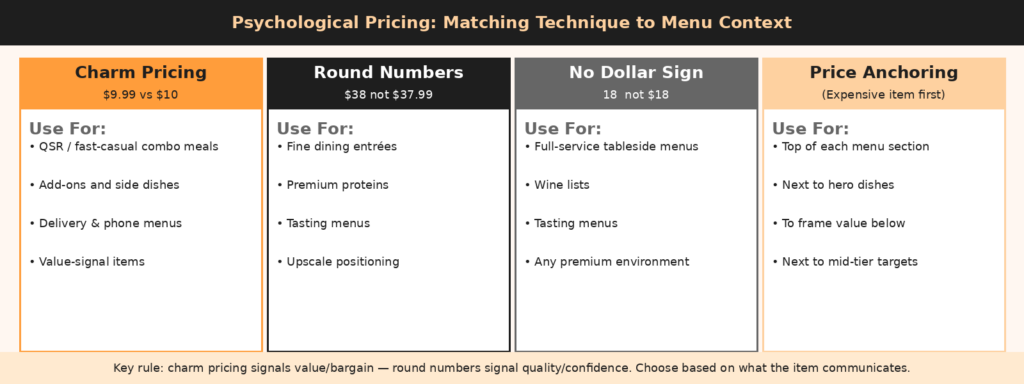
- Charm pricing signals value and deal-seeking; round numbers signal quality and confidence — choose based on what you want the item to communicate.
- Anchoring, decoy pricing, and removing dollar signs are equally powerful and often more applicable to full-service restaurants than cents-ending prices.
- Psychological pricing is not a substitute for competitive pricing — the techniques work best when the underlying price is already reasonable for the item and the format.
The Left-Digit Effect: Why One Cent Changes Everything
How the brain processes prices
People tend to see $9.99 as meaningfully cheaper than $10.00, even though the actual difference is just one cent — that’s left-digit bias in action. The first number influences how we judge the whole price. When we read $9.99, the brain anchors on the “9” in the tens position and processes the number as “nine dollars and change” rather than “essentially ten dollars.”
This isn’t a fringe finding. Analysis of retail pricing patterns shows that between 40% and 95% of all retail prices end in the number 9. Businesses use this strategy because it measurably works: charm pricing has been shown to increase sales by at least 24% in controlled analyses, with some studies showing higher lifts depending on the product category and context.
When charm pricing is most effective
Charm pricing performs best on items that are: purchased frequently, evaluated on value, and where the customer is making a quick decision. This maps well to fast-casual and QSR menus — the lunch special at $9.99 instead of $10 makes sense because the customer is scanning quickly, thinking about whether to add something to the order, and is somewhat price-sensitive.
A study published in the Journal of Consumer Research confirmed that charm pricing works when the left-most digits of prices differ — $4.99 versus $5.00 produces the effect, but $4.99 versus $4.95 does not, since the leading digit is the same. The magic is specifically in crossing the whole-dollar threshold, not in the cents themselves.
When Round Numbers Are Better
Prestige pricing and the fine-dining signal
Charm pricing carries a signal: “this is a value-oriented purchase.” That’s the right signal for a combo meal. It’s the wrong signal for a $38 duck confit at an upscale restaurant.
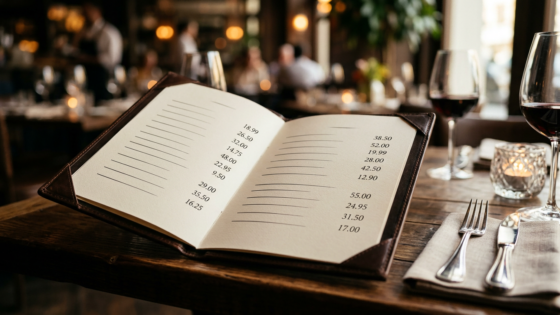
Fine-dining establishments have largely abandoned cents-ending prices in favor of round numbers or even price-free menus. The reasoning is behavioral: a round number like $38 communicates confidence in the value of the dish. A price of $37.99 on a high-end menu creates a slightly dissonant “bargain” feeling that undercuts the premium experience.
In a study conducted by MIT and the University of Chicago, shoppers presented with prices of $34 and $39 overwhelmingly chose the item priced at $39 — no cents involved. The higher round number communicated higher quality. For premium restaurant items, pricing at $39 rather than $38.99 can actually increase perceived quality and purchase likelihood.
Removing dollar signs entirely
One of the more counterintuitive findings in menu psychology is that dollar signs themselves can suppress spending. Diners at an upscale restaurant spent 8% more when the menu did not use dollar signs or the word “dollar” — using numerals only. The “$” symbol activates associations with cost and loss, subtly shifting attention from the food to the price. Many fine-dining menus now present prices as “38” rather than “$38” for exactly this reason.
Beyond Charm Pricing: The Other Techniques That Actually Move Orders
Price anchoring
Anchoring is the practice of using a high reference price to make other items seem more affordable by comparison. A $58 prime rib at the top of an entrée section makes the $32 branzino below it feel like a reasonable choice — even if the branzino would feel expensive on a different menu. Price anchoring means that a very expensive item makes everything else look like a deal — put a $50 steak at the top of the menu, and a $30 chicken seems far more reasonable by comparison.
Smart menu design places anchor items in visible positions — typically the first item in each category — and ensures the items you most want customers to order follow immediately after.
Decoy pricing
Decoy pricing adds a third option specifically designed to make one of the other two look more attractive. The classic example is three sizes of popcorn: small ($5), medium ($9.50), large ($10). Almost nobody wants the medium at that price, but its existence makes the large look like an obvious deal. The medium is the decoy.
In a restaurant context, this might look like offering a standard bowl, a large bowl, and an extra-large bowl where the large and extra-large are priced close together. The extra-large becomes the value choice, and more customers choose it than they would have without the decoy. The rule of three — offering good, better, and best options — works because customers often gravitate toward the middle option, perceiving it as the best value.
Descriptive language and perceived value
Research cited by menu engineering experts shows that evocative descriptions can increase sales of a dish by up to 27%. “Slow-braised pork shoulder with roasted garlic and house-made hoisin” moves more orders than “pork with garlic sauce.” The description raises the perceived quality of the dish, which in turn supports a higher price without triggering customer resistance.
A Practical Framework for Applying These Techniques
| Menu Context | Best Technique | Example |
|---|---|---|
| Fast-casual / QSR combo meals | Charm pricing (.99 ending) | $9.99 lunch combo instead of $10 |
| Premium entrées at full-service | Round numbers, no dollar sign | “38” on menu instead of “$38.99” |
| High-margin items you want to push | Anchoring (expensive item placed first) | $55 whole fish at top, $32 fillets below |
| Size upsells (drinks, portions) | Decoy pricing (three sizes) | Small $3 / Medium $5.50 / Large $6 |
| Slow-selling high-margin dishes | Descriptive language + visual highlight | Chef’s recommendation callout + evocative description |
The Danger of Overusing Charm Pricing
Every psychological pricing technique can backfire when applied without restraint. A menu where every single item ends in .99 starts to feel like a dollar store, not a restaurant. Overusing charm pricing can train customers to expect discounts and make them hesitant to pay full price — its effectiveness also varies across markets, with U.S. consumers responding more positively than those in other regions.
The right approach is selective deployment: charm pricing where you want to signal value (combo meals, side dishes, add-ons), round numbers where you want to signal quality (signature dishes, premium proteins), and anchors placed intentionally at the top of each section to frame what follows.
Frequently Asked Questions
Does charm pricing work for phone orders or online ordering?
Yes — the left-digit effect applies in any ordering context where the customer reads a price before making a decision. Phone orders have a specific dynamic: when a customer is choosing between add-ons or upgrades over the phone, the price framing still influences the decision. An AI voice agent that presents options clearly — “you can add a side for $3.99” — captures the same psychological benefit as on-screen charm pricing.
Should Chinese restaurants use charm pricing or round numbers?
It depends on the format and the customer. For a busy takeout counter or delivery-heavy operation, charm pricing on combo and family meal items fits the value-signal context. For a full-service dim sum restaurant or upscale regional Chinese dining room, round numbers align better with the premium experience. In practice, many Chinese restaurants use both — .99 endings on lunch specials and combo plates, round numbers on dinner entrées and premium dishes.
How does menu layout affect which items sell?
Significantly. Research shows customers’ eyes tend to land first on the upper right corner of a menu — often called the “golden triangle” — and then scan the first items in each section. High-margin items placed in these positions see higher order rates. Descriptive callouts, boxes, and visual highlights on specific items also direct attention and increase selection of featured dishes.
What’s the relationship between phone-order pricing and in-person pricing?
They’re often the same menu, but the psychological dynamics differ slightly. Phone customers don’t have the visual layout cues that in-person menus provide — no anchors, no decoys, no font hierarchy. This is where how an AI voice agent presents upsells matters: presenting a combo option at $11.99 after a customer orders individually-priced items replicates the bundle upsell that would happen naturally if they were looking at a menu board.
Pricing psychology works on the menu — but not if the phone goes unanswered during dinner rush. Tunvo’s AI voice agent answers every call, presents your menu clearly in English and Mandarin, and guides customers toward higher-value orders automatically. Book a demo or start your free trial.