Imagine this: a customer searches for your restaurant on Google Maps and finds your address. They drive there — but it’s your old location from two years ago. Frustrated, they go somewhere else. Meanwhile, on Yelp, your phone number has a different area code than the one on your website. A delivery driver tries to call and gets a disconnected line.
These aren’t edge cases. When we work with restaurant owners on their technology setup, we frequently discover that their business information differs across platforms — sometimes in ways they didn’t even realize. This is the NAP consistency problem, and it’s one of the simplest yet most damaging local SEO issues a restaurant can have.
Key Takeaways
- NAP stands for Name, Address, and Phone number — the foundational data Google uses to verify your business across the web.
- Inconsistencies across directories can reduce your local search visibility by up to 16% — even minor differences like “St.” vs. “Street” can cause issues.
- A quarterly audit of your listings takes less than an hour and can meaningfully improve how often your restaurant appears in local search results.
What Is NAP and Why Does Google Care About It?
NAP is simply your business’s Name, Address, and Phone number — the three most basic pieces of information customers need to find and contact you. Google uses this data as a core identity signal for local businesses.
How Google Uses NAP to Build Trust
When someone searches for “dim sum near me,” Google doesn’t just look at your Google Business Profile. It scans hundreds of other sources — Yelp, TripAdvisor, Facebook, Apple Maps, Yellow Pages, industry directories — to cross-reference your information. As BrightLocal explains, when Google finds the same information everywhere, it gains confidence that your business is legitimate, active, and trustworthy. That confidence translates directly into higher rankings.
When the data doesn’t match, Google faces uncertainty. And Google’s response to uncertainty is simple: it shows businesses it’s more confident about instead of yours.
The Real-World Impact on Rankings
A study cited by BrightEdge found that NAP consistency can impact a site’s local search performance by as much as 16%. For a restaurant that depends on local foot traffic, that percentage represents real customers walking through your competitor’s door instead of yours.
Common NAP Mistakes Restaurants Make
Most NAP inconsistencies aren’t intentional — they accumulate over time through small oversights that add up to a big problem.
The Usual Suspects
| Inconsistency Type | Example | Risk Level |
|---|---|---|
| Business name variation | “Golden Dragon” vs. “Golden Dragon Restaurant” vs. “Golden Dragon Chinese” | High — Google may treat these as separate businesses |
| Address format differences | “32 6th Ave” vs. “32 Sixth Avenue” vs. “32 6th Avenue, Suite 1” | Medium — modern algorithms handle some abbreviations, but extra details cause confusion |
| Old phone number | Previous number still listed on Yelp after switching providers | High — customers can’t reach you, and Google sees conflicting data |
| Former address | Moved locations but forgot to update DoorDash, Apple Maps, or a food blog listing | Critical — sends customers to the wrong place entirely |
| Duplicate listings | Two Google Business Profiles for the same restaurant, one outdated | High — splits reviews and confuses search engines |
Why These Mistakes Are So Common for Restaurants
Restaurants change phone numbers, move locations, or rebrand more often than many business types. Staff turnover means the person who originally set up the Yelp page may be long gone. Third-party platforms and aggregators sometimes create listings automatically based on public data — and that data may be outdated. As Local Falcon notes, these auto-generated listings can introduce errors you never even knew existed.
How to Audit Your NAP in Under an Hour
You don’t need expensive tools to find and fix NAP problems. Here’s a practical process any restaurant owner can follow.
Step 1: Create Your Master NAP Document
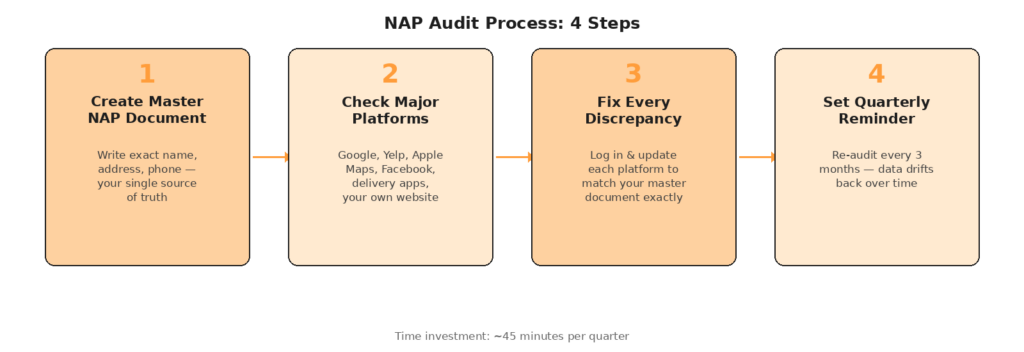
Write down the exact, official version of your business name, address, and phone number. This is your single source of truth. Every listing everywhere should match this document exactly.
For example, if your restaurant is part of a small restaurant group, make sure each location has its own distinct NAP document to avoid cross-contamination between locations.
Step 2: Check the Major Platforms
Start with the platforms that matter most for local SEO. Check these in order of priority:
Tier 1 (check first): Google Business Profile, your own website (footer, contact page, and schema markup), Yelp, Apple Maps, Facebook Business Page.
Tier 2 (check next): TripAdvisor, Uber Eats, DoorDash, Grubhub, your POS system’s online ordering page.
Tier 3 (check quarterly): Yellow Pages, Foursquare, Better Business Bureau, local chamber of commerce, any food blog or directory that lists you.
Step 3: Fix Every Discrepancy
Log in to each platform and update the information to match your master document. For platforms you can’t directly edit, look for a “suggest an edit” or “claim this business” option. Keep a spreadsheet tracking which platforms you’ve updated and the date of the last check.
Step 4: Set a Calendar Reminder
NAP isn’t a one-time fix. Set a quarterly reminder to re-audit your listings. Things change — platforms update their interfaces, third-party aggregators may reintroduce old data, and you might change your hours or phone line. According to The Ad Firm, consistent NAP information across your website, directories, and social profiles directly strengthens your visibility in local search results and the Google local pack.
NAP Consistency and Your Phone System
One often-overlooked source of NAP inconsistency is the phone number itself. Restaurants that use call forwarding, VoIP services, or have recently switched providers sometimes end up with multiple active numbers — one on Google, a different one on Yelp, and a third on their takeout menus.
Why Phone Number Consistency Is Especially Critical
Unlike your address (which customers typically use for GPS navigation) or your name (which they can usually recognize despite minor variations), a wrong phone number means a direct lost connection. The customer calls, gets no answer or a wrong number, and moves on. This is particularly costly for restaurants that take a significant volume of phone orders.
When we built Tunvo’s AI voice agent, one of the first things we help restaurants verify is that their phone number is consistent everywhere — because even the best AI phone system can’t help if customers are calling the wrong number. Getting the basics right is always the foundation.
Consolidating Your Phone Presence
Use one primary phone number for all public-facing listings. If you have a separate number for catering or private events, keep that off your NAP listings. Your main business line — the one customers call to order food or make reservations — should be the same everywhere, from your printed menus to your Google profile.
Beyond the Basics: NAP and Voice Search
Voice search is growing rapidly. When someone asks Siri or Google Assistant “where’s the nearest Chinese restaurant,” the device pulls from local search data — which means your NAP data. As BrightLocal reports, research shows that 80% of voice search results come from the top three organic positions, and NAP consistency is a factor in achieving those positions.
For restaurants serving multilingual communities, this is especially important. Your business name needs to be listed consistently in one language across all directories to avoid fragmentation.
Frequently Asked Questions
Does Google really penalize small differences like “St.” versus “Street”?
Modern search algorithms are sophisticated enough to recognize common abbreviations. However, larger inconsistencies — like different business names, missing suite numbers, or wrong phone numbers — absolutely affect your rankings. The safest approach is to keep everything identical, but don’t panic over minor formatting differences.
How many directories do I need to worry about?
Focus on the top 15–20 platforms where customers actually find restaurants: Google, Yelp, Apple Maps, Facebook, TripAdvisor, and the major delivery apps. Beyond that, checking your listings on data aggregators can help prevent issues from spreading to smaller directories automatically.
Can I use a tool to manage NAP consistency automatically?
Yes. Platforms like Yext, BrightLocal, and Moz Local can scan for inconsistencies and push updates across multiple directories at once. For a single-location restaurant, a manual quarterly audit may be sufficient. For multi-location groups, automated tools are usually worth the investment.
Getting your NAP right ensures customers can find you. Making sure every call is answered ensures you don’t lose them. Tunvo’s AI voice agent answers every call in English, Mandarin, and more — and sends orders straight to your POS. Start your 15-day free trial.