SMS marketing is the most direct channel a restaurant owner has to their customers. But “most direct” cuts both ways. Done right, a text from your restaurant feels like a message from someone who knows you — timely, relevant, and genuinely useful. Done wrong, it feels like spam from a business that bought your phone number.
The difference between those two outcomes often comes down to a handful of specific decisions: when you send, what you say, how often you say it, and whether you’ve followed the rules that protect your customers and your business. This guide covers the practical do’s and don’ts that separate effective restaurant SMS from the kind that drives unsubscribes.
Key Takeaways
- Always get explicit opt-in consent — sending marketing texts without it is illegal and can cost $500–$1,500 per message in TCPA fines.
- Send 2–4 messages per month maximum — more than that and opt-out rates climb sharply.
- Keep messages under 160 characters and lead with the offer, not your restaurant name.
- Personalization — even just a first name — dramatically increases conversion.
- Never send before 8 AM or after 9 PM — it’s not just bad practice, it’s a legal requirement.
The Foundational Do’s: Building SMS Marketing That Lasts
DO: Get Explicit Written Consent Before Sending Anything
This is the single non-negotiable rule in restaurant SMS marketing. The Telephone Consumer Protection Act (TCPA) requires prior express written consent before you send marketing texts to any customer. Violations carry fines of $500–$1,500 per text message, with no cap on total damages — and class-action lawsuits in this area are common.
Consent means the customer actively agreed. An order confirmation, a loyalty stamp, or simply having called your restaurant does not count. They need to have checked a box, replied to a keyword opt-in text, or verbally agreed (confirmed in writing) to receive marketing messages from your business specifically.
The practical setup: post an opt-in prompt at your counter (“Text VIP to [number] for exclusive deals”), include it in your online ordering confirmation, and ask at the end of phone orders. Your SMS platform will handle the compliance confirmation text automatically.
DO: Always Include Your Restaurant Name
Your customers may have hundreds of contacts and don’t necessarily save business numbers. Every text should include your restaurant name, especially in the first message and in any message containing a new offer. “Golden Dragon: Free soup tonight with $30+ orders. Call [number].” is far better than an unsigned message that leaves the recipient wondering who’s texting them.
DO: Personalize With First Names When You Can
Most SMS platforms let you insert subscriber data like first name into messages automatically. Using someone’s name — “Hi Sarah, we have a special for you tonight” — makes the message feel individual rather than broadcast. Personalized messages consistently outperform generic broadcasts in open rates and conversion, even when the underlying offer is the same.
DO: Make Every Message Immediately Valuable
The test for any restaurant text is simple: if you received this message from a restaurant you occasionally order from, would you be glad you got it? If the answer is no — if the message is just a reminder that you exist, or contains information the customer doesn’t need right now — it shouldn’t be sent. Every SMS should deliver immediate value: a discount, an exclusive offer, useful information, or a time-sensitive opportunity.
DO: Include a Clear, Simple Call to Action
Every marketing text needs one clear next step. “Call us at [number].” “Reply ORDER.” “Show this text to redeem.” A message that’s interesting but doesn’t tell the customer what to do next is a missed conversion. Keep the action as simple as possible — ideally a single tap or a single phone call.
DO: Send During Meal-Planning Hours
Restaurant SMS has natural peak effectiveness windows that align with when customers are thinking about food. For lunch promotions, send between 10:30 AM and noon. For dinner promotions, send between 4 PM and 6:30 PM. Beyond the effectiveness argument, TCPA legally prohibits sending texts before 8 AM or after 9 PM in the recipient’s local time zone.
The Critical Don’ts: What Destroys SMS Marketing Programs
DON’T: Send More Than 4 Times Per Month
Frequency is the most common reason customers unsubscribe from restaurant SMS lists. When a restaurant texts multiple times per week, subscribers start to feel harassed, and the opt-out rate spikes. Effective restaurant SMS programs aim for 2–4 messages per month — enough to stay top of mind, not so many that customers start dreading the next notification.
The exception is transactional messages (order confirmations, estimated delivery times) — these are not marketing messages and don’t count against your promotional frequency. Send as many of those as the customer finds useful.
DON’T: Write Long Messages
Standard SMS messages are 160 characters. Messages longer than that get split into multi-part texts, which can display in the wrong order on some phones and generally feel unprofessional. More importantly, long texts lose readers — the value of SMS is brevity and immediacy, and a message that requires scrolling has already lost. Write your offer, your business name, the action, and the expiry date. Cut everything else.
DON’T: Text at Night or Early Morning
Beyond the legal rule, texting after 8 PM or before 8 AM is simply bad customer experience. People have their phones on Do Not Disturb, texts might wake them up, and the emotional response to an interruption at the wrong time is negative — not the association you want with your restaurant. Even for urgent promotions or same-day events, wait until a reasonable hour.
DON’T: Ignore Opt-Out Requests
When a customer replies STOP or CANCEL, you are legally required to stop sending them marketing texts. Under updated FCC rules effective April 2025, businesses must honor opt-out requests within 10 business days, and you may send one final confirmation message acknowledging the opt-out but nothing promotional after that. Any reputable SMS platform processes this automatically — but verify that yours does before you launch.
DON’T: Send Generic Blasts Without Segmentation
Sending the same message to every subscriber on your list regardless of their history, preferences, or relationship with your restaurant is inefficient and drives higher opt-outs. A customer who orders vegetarian food every time doesn’t need your pork special. A regular who orders every week doesn’t need a “we miss you” win-back offer. Segmenting your list — even into basic groups like “frequent buyers” and “lapsed customers” — significantly improves relevance and conversion.
DON’T: Use SMS as a Broadcast Megaphone
The power of SMS is its personal nature — it arrives in the same inbox where customers receive messages from their families and friends. Using that channel to blast the same promotional content you’d post on a flyer in your window wastes its potential and erodes trust. The best restaurant SMS programs feel like a conversation, not a one-way announcement.
Message Structure: What Good Restaurant SMS Looks Like
Here is a practical breakdown of what an effective restaurant SMS message contains, and what to cut:
| Element | Include? | Example |
|---|---|---|
| Restaurant name | Always | “Golden Dragon:” |
| Customer first name | When available | “Hi Sarah,” |
| The offer / value | Always — lead with this | “Free hot and sour soup tonight with $30+ orders” |
| Expiry / urgency | Always | “Valid until 9 PM” |
| Call to action | Always | “Call [number] to order.” |
| Opt-out reminder | First message; periodically after | “Reply STOP to unsubscribe.” |
| Backstory / context | Never — cut it | — |
| Multiple offers at once | Never — pick one | — |
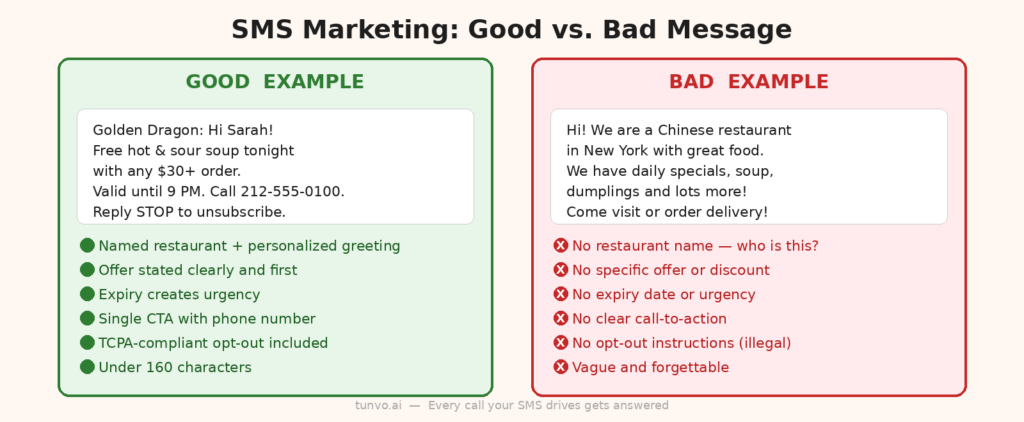
The difference between a message that drives orders and one that drives unsubscribes often comes down to structure, not content.
Connecting SMS to Your Phone Order Operation
Every effective SMS promotion creates a spike in phone calls. Customers see the offer, decide to act on it, and call to place an order. If those calls aren’t answered, the entire investment in your SMS program — the list building, the message crafting, the offer — is wasted. More than wasted, actually: the customer is now frustrated, and you’ve paid (in subscriber fatigue and list size) to generate that frustration.
In my conversations with restaurant owners across New York, the ones who’ve had the best results with SMS marketing are also the ones who’ve solved the call-answering problem. Some have hired additional staff. Others — and increasingly this is the smarter path — have deployed AI voice agents that answer every call instantly, take the order, and push it to the POS without requiring a human to be available. Tunvo’s AI voice agent was built specifically for this scenario: answering every call, handling orders in English and Mandarin, and integrating directly with MenuSifu POS so there’s no gap between your SMS driving intent and your restaurant capturing the order. See Tunvo’s pricing — it’s significantly less than the cost of a single missed promotion.
Frequently Asked Questions
How do I know if my SMS messages are working?
Track at minimum: order volume on days you send promotions vs. comparable non-promotion days, your subscriber list size (growing = healthy program), and your opt-out rate (below 1% per month is a healthy benchmark). More advanced metrics — like click rates if you include links, or redemption rates on specific offers — give you a clearer picture of what’s resonating. Most SMS platforms include basic analytics at no extra cost.
Can I use emojis in my restaurant SMS messages?
Yes, with restraint. A single relevant emoji (🌧️ for a rainy day special, 🎂 for a birthday offer) can add warmth and visual distinctiveness to a message without feeling unprofessional. More than two emojis per message starts to look noisy. Avoid emojis that could display differently across devices (some older phones render them as empty boxes or question marks).
What’s the difference between SMS and MMS for restaurant marketing?
SMS is text-only and limited to 160 characters. MMS (Multimedia Messaging Service) supports images, GIFs, and up to 300KB of content. MMS can be effective for showcasing a new menu item with an appealing food photo, but it costs more per message and displays differently on different devices. For most Chinese takeout promotions, a well-written SMS outperforms a mediocre MMS — start with text, experiment with images once your program is running smoothly.
How do I handle bilingual subscribers for my Chinese restaurant?
For a restaurant with a significant Chinese-speaking customer base, running two versions of your SMS campaigns — one in English, one in Mandarin — is worth the extra effort. The most elegant solution is to ask subscribers at opt-in which language they prefer and segment accordingly. This level of personalization signals that you understand your community, which is particularly meaningful for a Chinese-owned restaurant serving a Chinese community. Tunvo’s AI voice agent, for reference, handles both English and Mandarin phone orders natively — so your bilingual marketing doesn’t hit a wall when the call comes in.
Great SMS drives calls. Make sure every call gets answered. Tunvo’s AI voice agent answers every call instantly — in English and Mandarin — and pushes orders straight to your MenuSifu POS so your SMS investment always converts.