Pricing comparisons in restaurant tech are rarely as simple as comparing monthly subscription costs. The real question is: what does each system actually cost when you account for everything — not just the vendor fee, but the full picture of what it replaces, what it captures, and what it leaves on the table? In comparing Tarro’s model to Tunvo’s, that full-picture analysis matters a great deal, because the two systems have fundamentally different cost structures built on fundamentally different approaches to the technology.
I want to be transparent: I work at Tunvo, so I have a perspective here. But the ROI math I’ll walk through is based on publicly available industry data and reasonable assumptions, not manufactured numbers. You can run the same calculations for your own restaurant and get an honest answer.
Key Takeaways
- Tarro’s pricing reflects human labor costs — their model was built on outsourced call center economics, which means their price point includes the margin on human agents.
- Tunvo’s pricing reflects software costs — no human labor in the loop means the cost structure is fundamentally different.
- The biggest ROI driver isn’t the subscription fee — it’s how much revenue you recover from calls that would otherwise be missed or mishandled.
- For Chinese restaurants running 80–150 calls/day, the annual ROI difference between the two models is significant.
Understanding the Two Cost Structures
Tarro’s business was built on a fundamentally sound insight: restaurants were losing money on unanswered phone calls, and a remote call center that knows your menu is better than nothing. According to Sacra research, Tarro generates approximately $24,000 in average annual revenue per customer, which positions them in the premium tier of restaurant tech services. Their pricing is customized, but public materials suggest it’s structured around order volume and includes services beyond just phone ordering — delivery management, SMS marketing, and other add-ons.
That bundling is a key thing to understand: Tarro’s price isn’t just for an AI phone agent. It’s for a managed service that includes human agents, delivery operations (with roughly 15% delivery take rate, per Sacra), and marketing campaigns. If you need all of those, the bundle may make sense. If you primarily need phone ordering solved, you’re paying for a lot more than that.
Tunvo’s pricing is available on their website and reflects a software-based model without the embedded cost of human agents or delivery operations. The comparison isn’t simply “Tunvo is cheaper” — it’s that the two models are solving different problems with different economic structures, and the right choice depends on what you actually need.
The ROI Framework: What Actually Drives Returns
Whether you’re evaluating Tarro, Tunvo, or any AI phone system, the ROI framework has three components: revenue recovered from previously missed calls, labor cost savings from reducing phone-answering staff, and order value improvements from consistent upselling. Let’s look at each.
Component 1: Missed Call Revenue Recovery
The most direct ROI driver for any phone-answering solution is how much revenue it recovers from calls that would have gone unanswered. Industry research consistently shows that 83% of customers who reach voicemail will not call back — they order elsewhere. During peak dinner hours, independent analysis suggests 30–40% of incoming calls go unanswered at restaurants without a dedicated phone solution.
For a Chinese takeout restaurant handling 100 calls per day with an average order value of $40, a 25% missed call rate represents: 25 calls × $40 × 365 days = $365,000 per year in theoretical maximum recoverable revenue. In practice, not every missed call would have converted — but even capturing an additional 10% of those calls (2.5 orders per day) is $36,500 in annual additional revenue. That’s the category of number that makes the subscription fee of any phone solution look small in comparison.
Both Tarro and Tunvo solve the missed call problem — neither lets calls go unanswered. The difference appears at peak hours, where Tunvo’s unlimited simultaneous capacity means it can handle 8 calls at once during a rush without any caller reaching a busy signal. Tarro’s human agent model, as noted in their public materials, can also handle multiple simultaneous lines, but capacity is ultimately bounded by agent availability.
Component 2: Labor Cost Savings
Industry cost analysis puts dedicated phone staff labor at roughly $15–17 per hour in 2025, including payroll taxes and training overhead. For a restaurant providing 60 hours of phone coverage per week, that’s approximately $46,800 per year — before accounting for turnover and recruitment costs.
Both Tarro and Tunvo reduce or eliminate that labor cost. The difference is in what you pay the vendor in exchange. Tarro’s pricing (at ~$24K average per customer per year across their entire product bundle, per Sacra) substitutes one labor cost with another service cost that includes delivery and marketing. Tunvo’s phone ordering solution, priced as a focused AI software product, positions the exchange differently — you’re buying compute and software, not labor resourcing.
The key question isn’t “which one is cheaper” — it’s “what am I actually buying, and what return am I getting on that specific purchase?” A delivery service included in a bundle is only valuable if you’re going to use it. If you already have DoorDash and Uber Eats handling your delivery, paying for delivery infrastructure in your phone ordering vendor isn’t giving you additional return.
Component 3: Order Value Improvement
AI phone agents have a structural advantage over human agents on upselling consistency. A human agent who has taken 200 calls today is less likely to offer the upsell on call 201 than on call 1. An AI offers the same upsell prompt on every single call, with the same energy. Industry analysis of AI phone systems suggests average order values increase when AI handles phone orders, driven by consistent upsell prompting that human agents tend to skip during high-volume periods.
According to Tunvo, customers report 13%+ higher order revenue after implementing the AI voice agent. On a restaurant doing $500,000 annually in phone order revenue, a 13% lift is $65,000. That’s a return that compounds every year, and it grows as your phone order volume grows — without adding any labor cost.
Annual ROI Model: A Chinese Takeout Restaurant Example
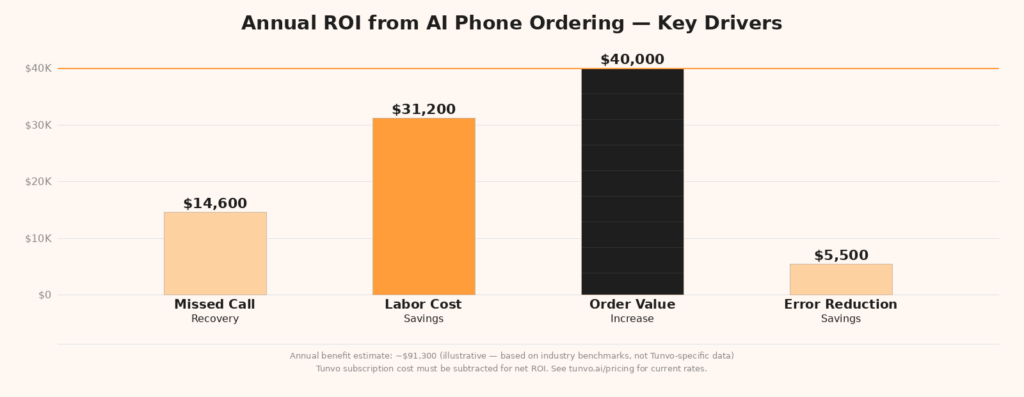
| ROI Driver | Assumption | Annual Value |
|---|---|---|
| Missed call recovery | 100 calls/day, 20% previously missed, $40 AOV, 50% conversion of recovered calls | +$14,600/yr |
| Labor cost savings | 1 part-time phone staff @ $15/hr × 40hrs/week | +$31,200/yr |
| Order value increase | $400K phone revenue × 10% lift from consistent AI upselling | +$40,000/yr |
| Error reduction savings | Fewer remakes, returns, and refunds from AI accuracy | +$3,000–8,000/yr |
| Total gross benefit | ~$88,800–$93,800/yr | |
| Tunvo subscription cost | Software-based pricing (see tunvo.ai/pricing) | Check pricing page |
Note: This model uses industry benchmark assumptions, not Tunvo-specific case study data. Your actual results will vary based on call volume, average order value, and current staffing costs. Run the same calculation with your own numbers — the ROI framework applies regardless of which vendor you choose.
The MenuSifu Integration Factor
One ROI factor that’s often overlooked in price comparisons: what does each system do with your order data after the call? Tarro sends orders to your printer — a functional approach that generates correct tickets, but doesn’t integrate with your POS data layer. Order history, customer data, and reporting stay in separate systems.
Tunvo’s deep integration with MenuSifu means phone orders flow into your POS as full orders — trackable, reportable, and connected to your customer data. Over time, that data is worth more than the short-term revenue recovery. Understanding which menu items generate the most phone orders, which customers order most frequently, and when your phone peaks hit allows you to make better operational decisions. A printer ticket doesn’t give you that.
Pricing Transparency: What We Know
Tarro does not publish standardized pricing on their public website. Based on available research, their average revenue per restaurant runs approximately $24,000 annually across their full platform (phone ordering, delivery, and marketing combined), per Sacra. Their pricing is negotiated with each restaurant based on volume and service mix.
Tunvo publishes pricing information on their website and offers a 15-day free trial, meaning you can test the system with your actual call volume before making a financial commitment. Tunvo also offers a free trial starting point, which means the ROI calculation starts from Day 1 of the trial, not just from when you sign a contract.
Which Is Right for You?
If you need a full-service partner who handles phone ordering, delivery logistics, and SMS marketing under one umbrella — and you’re comfortable with the economics of that bundle — Tarro’s model is coherent. They’ve helped thousands of Chinese restaurants, and the track record is real.
If your priority is: pure AI performance on phone ordering, Mandarin language support, deep MenuSifu POS integration, software-based pricing, and the flexibility to start with a trial — Tunvo is the better fit. The ROI model is transparent, the setup is fast, and you’re not paying for services you don’t need.
AI voice’s core scalability advantage — unlimited simultaneous calls, 24/7 availability, consistent upselling — compounds over time in a way that human-assisted models structurally cannot match. For a restaurant planning to grow phone order volume, building on pure AI infrastructure now means the incremental cost of handling more calls is close to zero. That doesn’t hold for a human-assisted model.
Frequently Asked Questions
Can I see Tunvo’s pricing before signing up?
Yes. Tunvo’s pricing is available on their website, and they offer a 15-day free trial so you can evaluate the system with your real call volume before committing.
Does Tarro offer a free trial?
Based on their public materials, Tarro advertises no contracts and no upfront costs, with a pay-per-order model. The specific terms should be confirmed directly with Tarro.
How quickly can I expect ROI after switching to AI phone ordering?
Most restaurants see positive ROI within 30–60 days of implementing AI phone ordering, according to industry analyses of phone AI deployments. The exact timeline depends on your call volume, current missed call rate, and whether you’re also reducing labor costs simultaneously.
Does Tunvo handle delivery like Tarro does?
Tunvo is focused specifically on AI phone ordering — calls, orders, and POS integration. Tunvo does not currently operate a delivery service. If delivery management is a key part of what you’re looking for in a vendor, Tarro’s broader platform covers that. If you’re already using DoorDash, Uber Eats, or direct delivery, Tunvo’s phone ordering layer integrates with your existing operations without requiring you to switch your delivery model.
Every missed call is missed revenue. Tunvo’s AI voice agent answers every call in English and Mandarin, sends orders directly to your MenuSifu POS, and starts delivering ROI from day one. See the numbers for your own restaurant.