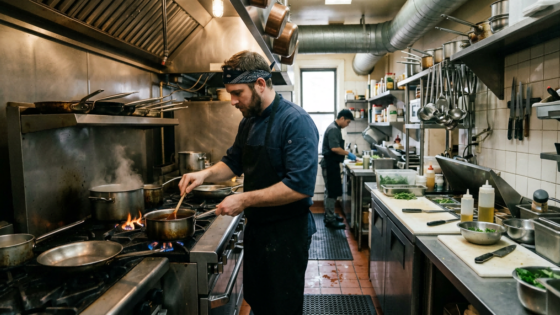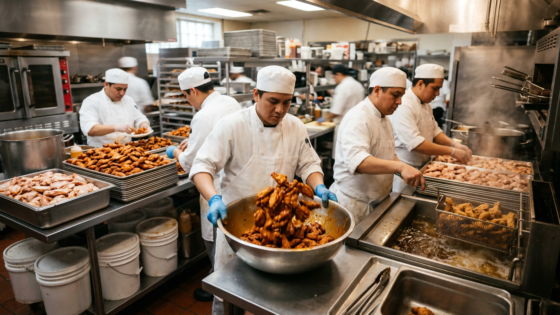
Super Bowl Sunday is less like a holiday and more like a controlled explosion for restaurant kitchens. The orders come fast, the stakes are high, and the window for mistakes is almost zero. For restaurants that do wings — and especially for Chinese restaurants that serve hot wings, honey garlic, or Sichuan-spiced varieties — game day can be either the biggest revenue day of the first quarter or a chaos-fueled nightmare that burns through inventory and leaves customers waiting two hours for cold food.
The restaurants that win Super Bowl Sunday don’t improvise. They plan it like a production line, starting weeks out. This guide covers what to prepare, how to structure your orders and staffing, and — critically — why your phone system could be the most expensive weak point in your entire game-day operation.
Key Takeaways
- Wing orders on Super Bowl Sunday surge dramatically — restaurants that pre-sell in bundles control their production and reduce chaos at the counter.
- Takeout dominates on game day — in-store traffic actually drops while takeout and pre-orders surge; your off-premise setup matters more than your dining room.
- Phone lines become your biggest bottleneck — peak demand hits 7+ hours before kickoff, and a missed call in that window is a lost order.
- A simplified throughput menu outperforms a creative new menu — bundle-format items, standardized counts, and fewer SKUs let your kitchen move faster under pressure.
Why Super Bowl Sunday Is Different From Any Other Busy Day
The Numbers Behind the Rush
Super Bowl Sunday is often described as a massive restaurant boom, but the reality is more complicated. Toast data from 2024 showed that restaurants saw about 16% fewer in-store transactions on game day compared to a typical Sunday, with average ticket size running smaller. But that tells only half the story. Off-premise orders — takeout, pre-orders, and pickups — surged dramatically, especially in the hours leading up to kickoff.
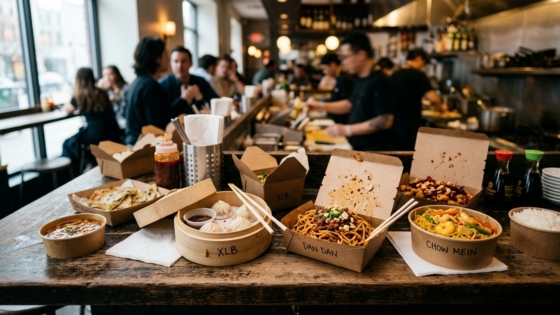
An estimated 48 million people place delivery or takeout orders on Super Bowl Sunday, accounting for roughly 3% of all third-party app orders nationwide on that single day. The key takeaway for operators: this is not a dine-in holiday. It’s a send-food-to-people-on-their-couches holiday. Your kitchen is the star; your dining room is secondary.
Wings Are the Undisputed MVP
Wing orders in 2024 climbed by 87% compared to a typical Sunday, with average wing prices up 18%. The National Chicken Council projects over 1.4 billion wings consumed on Super Bowl Sunday each year. If your restaurant does wings in any form — classic buffalo, crispy garlic, or your own house sauce — this is the moment to double down. It’s also the moment to plan your inventory precisely, because running out of wings mid-afternoon on Super Bowl Sunday is a story your regulars will tell for years.
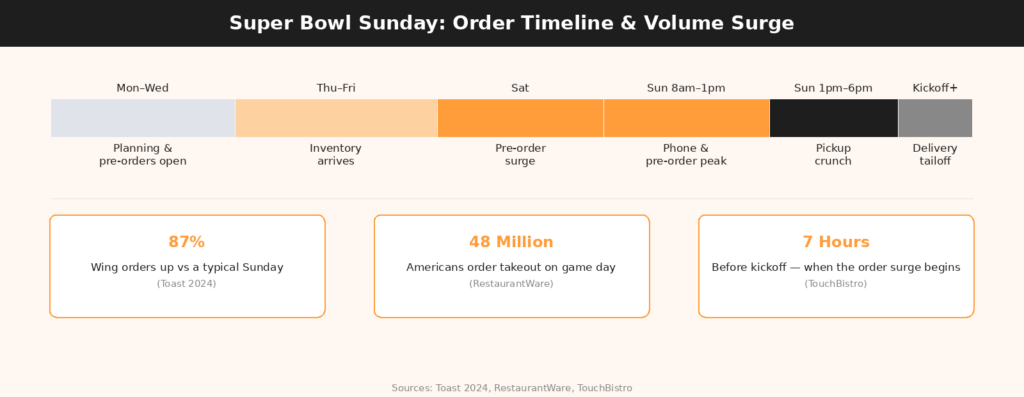
When orders hit: restaurants receive a surge in wing and takeout demand starting 7+ hours before kickoff
How to Structure Your Menu for Game Day
Sell Counts, Not Categories
One of the most operationally sound changes you can make before Super Bowl Sunday is restructuring how you list wing items. Analysis of independent restaurant POS menus shows that 46% of Super Bowl chicken and wing items include an explicit piece count — “20-piece,” “40-piece,” “80-piece” — rather than generic labels. This serves two functions: customers can easily do the mental math for how much to order for their party size, and your kitchen gets a predictable production plan. A customer ordering “wings” is vague. A customer ordering “40-piece bucket” tells you exactly what you’re building.
The same logic applies to sides and combo items. “Nachos for 4” moves faster than “large nachos” because the buyer knows what they’re getting, and you know exactly what to prep.
Build Bundles, Not New Items
The temptation on Super Bowl Sunday is to create elaborate game-day specials with new recipes and creative presentation. Resist this. The most successful Super Bowl operators build “throughput menus” — packaging strategies around existing best-sellers, not new inventions. Your kitchen already knows how to execute your top sellers quickly. Wrapping them in a bundle format reduces decision fatigue for customers and speeds up production time.
Consider a tight lineup: 20-piece bucket (single flavor), 40-piece party pack (choice of two flavors), and an 80-piece large group pack. Add a complementary item or two — fried rice, egg rolls, a house specialty — and that’s your game-day menu. Everything else can still be available, but these bundles should dominate your marketing and your prep plan.
Pair Wings With High-Margin Items
Wings can function as the draw, but the real margin often lives in the accompaniments. Industry experts recommend pairing wing promotions with high-profit items to offset inflation on protein costs and boost overall ticket size. If your wings are the hook, your house specialties — a signature sauce, a premium side, a party-size beverage — should be positioned as the obvious add-on. Design your bundles so the upsell feels like a natural recommendation, not a sales tactic.
Inventory Planning: How Much Is Enough?
Use Last Year’s Data, Then Add a Buffer
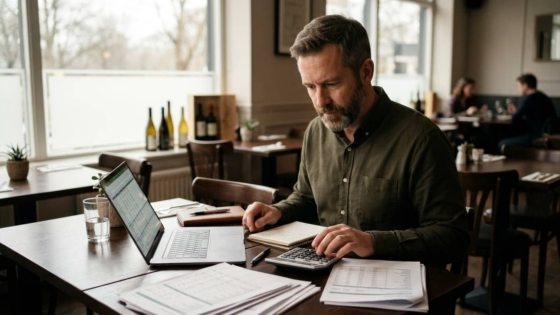
The most reliable starting point for Super Bowl inventory is your own prior-year data. The National Chicken Council projected 1.45 billion wings consumed in 2024 alone — but your specific number depends on your location, your customer base, and how aggressively you market. Pull your sales data from last Super Bowl (or last January if it’s your first game-day push), compare it to your year-over-year growth trend, and add a 15–20% buffer on your top two or three wing SKUs. Running out of your signature item at 5pm when kickoff is at 6:30pm is not recoverable.
Order Ingredients Early — Competition Is Real
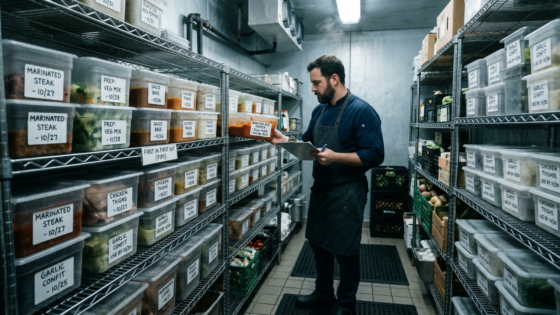
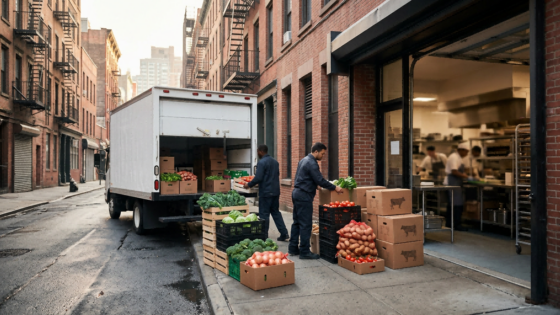
Restaurants across your city are making the same calculations. Industry operators consistently advise completing inventory orders well in advance, as distributor shortages are common during Super Bowl week, particularly for boneless and bone-in wing cuts. Non-perishable items — sauces, packaging materials, condiments — should be ordered two to three weeks out. Perishables should arrive no later than the Thursday before game day so you have time to address any short shipments.
| Item Category | When to Order | Buffer Recommendation |
|---|---|---|
| Wing protein (bone-in / boneless) | 2–3 weeks before | +20% over projected sales |
| Sauces, marinades, rubs | 3 weeks before | +15% — long shelf life, no risk |
| Packaging (boxes, bags, containers) | 3–4 weeks before | +30% — runs out fast on takeout days |
| Side ingredients (fries, rice, dips) | Thurs–Fri before game day | +15% over projected |
| Napkins, utensils, cups | 3 weeks before | Double your normal weekend stock |
Pre-Orders: The Operational Game-Changer
Why Pre-Orders Matter More Than Walk-Ins
Research shows restaurants get overwhelmed with takeout orders beginning seven hours before kickoff. That’s mid-morning for a 6pm or 7pm game. If your kitchen doesn’t know what’s coming until those orders arrive, you’re operating blind at exactly the wrong time. Pre-orders solve this. When customers commit their order 24–48 hours in advance, you can stage production, prep sauces in batches, and schedule staff to specific prep windows rather than scrambling reactively.
To incentivize pre-orders, consider a small discount — even $2–3 off a bundle — that applies only to orders placed before game day. Offering a small discount to customers who pre-order game day meals and advertising the cutoff time on social media has been shown to meaningfully reduce day-of chaos at the counter.
Your Phone System Is Not a Pre-Order System
Here’s the friction point that costs restaurants real money: most of those pre-orders start as phone calls. And on the days leading up to Super Bowl Sunday, your phone is ringing constantly — customers wanting to place orders, confirm pickup times, ask about sauces, or check if you’ll be open. If a call isn’t answered, that order often goes to the restaurant down the street or to a delivery app that charges you 25–30% commission.
Every missed call in the week before Super Bowl Sunday represents a party pack that went somewhere else. Tunvo’s AI voice agent handles every inbound call — takes the order, answers questions about your bundles, confirms pickup times — and syncs directly with your MenuSifu POS. You don’t lose orders because your staff was plating food when the phone rang. Start a 15-day free trial and have it ready before your next big event.
Staffing for the Surge
The Most Important Staffing Decision: Kitchen vs. Phones
Most operators focus their Super Bowl staffing plan on the kitchen and delivery — and they should. But the front-of-house communication role gets underestimated. On a day when pre-orders, walk-ins, and phone inquiries are all coming in simultaneously, someone dedicated to managing incoming orders becomes critical. If that role falls on a line cook or a cashier already handling the counter, orders get mixed up, customers get frustrated, and your best-planned production schedule falls apart.
Industry veterans emphasize that Super Bowl Sunday is a day to overprep staffing — if you usually run with fewer hands on Sundays, this is the day to bring everyone in. If you can’t staff an order-intake role separately, an AI voice agent like Tunvo can fill that function, routing calls to order confirmation without requiring an extra person at the counter.
Briefing Your Team
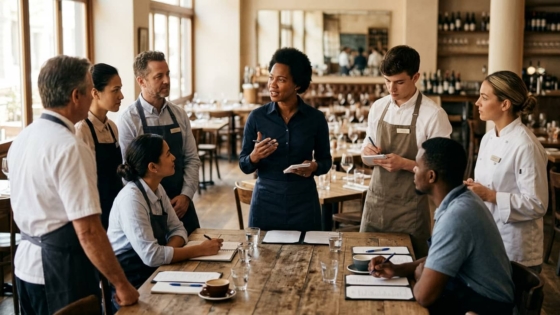
Run a team briefing the morning of. Cover: which bundles are available and their exact counts, estimated pickup wait times at different hours (prep your team to communicate delays proactively), which items are limited and when to cut them off, and what to do when the kitchen falls behind — which it may. Empowering your front-of-house staff to give honest wait time estimates reduces customer frustration far more than optimistic projections that don’t hold up.
The Phone Problem: Your Biggest Operational Risk
When Volume Meets a Two-Ring Phone
In our conversations with restaurant owners across New York, the Super Bowl phone scenario comes up again and again: two lines ringing at the same time, a third customer at the counter, and a kitchen team that can’t afford to pause and take a message. The math is brutal. If a restaurant does 50 wing-bundle orders on Super Bowl Sunday at an average of $45, that’s $2,250 in game-day revenue. If even 10% of inbound calls during the pre-order window go unanswered, that’s five lost orders — potentially $225 gone in a single busy afternoon.
Scale that across the days leading up to the game and across the full peak window, and the revenue loss from unanswered calls becomes significant. Tunvo’s pricing page walks through what a monthly AI voice agent subscription costs compared to what a single unanswered order week costs in actual revenue — for most restaurants, the math resolves clearly within the first weekend.
Making It Work With Your POS
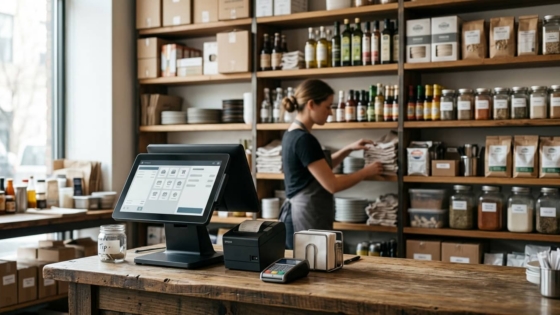
The other operational requirement for a smooth Super Bowl is making sure your POS can handle the volume and that order data flows cleanly from intake to production. For restaurants running MenuSifu, Tunvo’s AI integrates directly — phone orders taken by the AI agent go straight into the POS, no manual re-entry required. That means your kitchen is working from a single, accurate queue rather than a mix of handwritten tickets, verbal calls, and POS entries from different sources.
The Week-Before Checklist
A week out from game day, your preparation should be nearly complete. Use this as a final check:
- Menu locked — bundle sizes, prices, flavors, and any cutoff times published online and on your in-store signage
- Inventory ordered — proteins arriving Thursday at the latest, dry goods and packaging already in-house
- Pre-order window open — customers can submit orders online or by phone, with a confirmed cutoff time
- Staffing confirmed — extra hands scheduled for Saturday prep and Sunday open-to-close
- Phone coverage planned — either a dedicated staff member or an AI voice agent handling inbound order calls
- POS updated — bundle items listed with the correct counts, modifiers for sauce choices, and pricing confirmed
Frequently Asked Questions
How many wings should a restaurant prep for Super Bowl Sunday?
Start with your previous year’s Super Bowl sales data and add a 15–20% buffer. If this is your first Super Bowl push, compare your best recent Saturday volume and double the wing count while reducing other menu prep proportionally. It’s better to have leftover wings — which can run as a special the following week — than to sell out at 4pm and disappoint customers during peak demand hours.
Should restaurants offer dine-in or focus on takeout for Super Bowl?
Takeout and pre-orders are where the Super Bowl volume lives. In-store traffic actually drops compared to a typical Sunday, as most customers prefer to watch the game at home. Focus your operational energy on off-premise: packaging quality, order accuracy, pre-order systems, and pickup logistics. A dedicated pickup station separate from your dine-in service prevents the two from congesting each other.
What’s the best way to handle the phone surge in the week before Super Bowl?
Pre-orders taken by phone need to be managed as a production queue, not a reactive inbox. Options include a dedicated staff member handling inbound calls during peak hours, an online ordering system that routes orders digitally, or an AI voice agent like Tunvo that answers calls, captures order details, and syncs to your POS. The critical thing is that no order inquiry goes unanswered during the pre-order window — those are your highest-conversion calls of the year.
Should a restaurant create new items specifically for Super Bowl?
Generally no, unless you have proven capacity and staff familiarity with the new item. The risk of introducing a new recipe under high-volume conditions is that execution suffers and your kitchen slows down. The better approach is to create bundles around your existing best-sellers — package them for game-day group sizes, give them game-day names if you want the marketing angle, and keep the actual recipes exactly as your kitchen already runs them.
—
Every missed call on Super Bowl Sunday is a party pack walking out of your hands and into a competitor’s bag. Tunvo’s AI voice agent answers every call, takes orders in English and Mandarin, and sends them straight to your MenuSifu POS — so your kitchen stays focused on production, not the phone.
Book a Demo or Start Your 15-Day Free Trial.