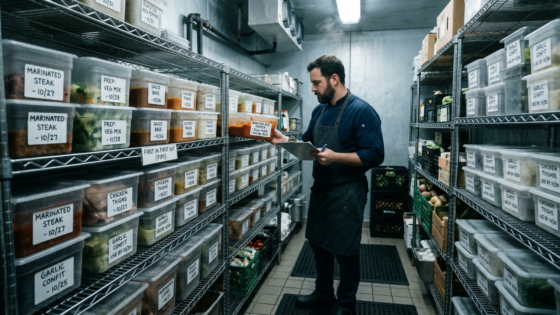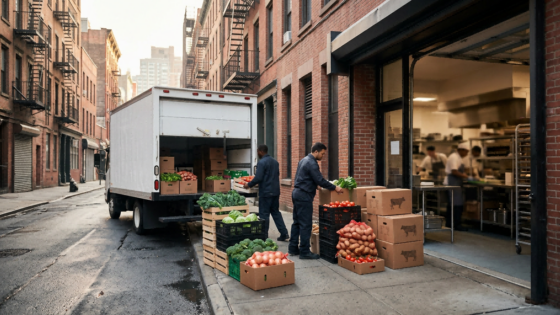
If you’re running a Chinese restaurant in Flushing, a Korean BBQ spot in Sunset Park, or a Japanese izakaya in Astoria, your ingredient supply chain is doing more work than most restaurant owners realize. You’re sourcing proteins that need to meet specific quality standards, fresh produce that turns over daily, specialty items that aren’t available through broadline distributors — and you’re doing it while managing a kitchen, a floor team, and an endless queue of tasks that don’t wait.
The right wholesale supplier network can cut your food costs by 10–20%, reduce delivery complexity, and give you access to products your competitors can’t find. The wrong one leaves you with substitutions, missed deliveries, and mediocre ingredients that affect what ends up on the plate. This guide covers the landscape of wholesale food supply in Brooklyn and Queens — from the national broadline distributors to the specialty local and Asian-focused suppliers that most guides don’t mention.
Key Takeaways
- No single supplier covers every need — most successful NYC restaurants use a primary broadline distributor for staples plus 1–3 specialty suppliers for proteins, produce, and ethnic-specific ingredients.
- Restaurant Depot (headquartered in Whitestone, Queens) is the best starting point for independent operators — free membership, cash-and-carry, no minimums, and immediate availability across a wide range.
- Sysco and US Foods offer better pricing at high volumes (typically $5,000+/week) but require commitment to weekly delivery schedules and have longer onboarding processes.
- Local NYC distributors like Fadaro Foods offer flexibility that national distributors can’t — broken cases, next-day delivery, and locally sourced produce that reduces transit time.
- For Chinese and Asian-specific ingredients, the Flushing wholesale market network and specialty distributors serving the Queens Chinese restaurant community remain the most reliable and cost-effective source.
Understanding Your Supplier Options: The Five Tiers
Wholesale food supply for NYC restaurants operates in five distinct tiers, each serving a different need and operating at a different price point. Understanding where each tier fits in your operation is the foundation of a good supplier strategy.
Tier 1: National Broadline Distributors
Sysco and US Foods dominate this category. Sysco is the world’s largest food distributor — founded in 1969, serving over 730,000 customer locations, with a Metro New York distribution center that covers the five boroughs and surrounding region. US Foods operates approximately 100 distribution centers nationwide and serves around 300,000 restaurants. Both offer online ordering platforms, dedicated account representatives, and delivery scheduling. Their strength is breadth: if it exists in food service, they probably carry it. Their weakness for small operators is pricing — industry analysis suggests initial quotes can differ by 10–15% between the two, and neither offers competitive pricing until your weekly spend reaches a level that puts you on their radar as a meaningful account.
Tier 2: Cash-and-Carry Warehouse
Restaurant Depot is headquartered at 1710 Whitestone Expressway in Queens — making it genuinely accessible to Brooklyn and Queens operators. According to industry data, Restaurant Depot has 130 locations nationwide, requires only a free membership for qualifying food businesses, and operates as a cash-and-carry warehouse, meaning you can shop and take product immediately without delivery scheduling. For independent Chinese restaurant operators, this is often the most practical starting point: you can buy exactly what you need for the week, compare prices across categories, and supplement specialty purchases elsewhere. The main limitation is that it requires someone to physically go there — usually 2–4 hours including transit and selection — which becomes an operational burden at higher volumes.
Tier 3: Regional / Local Distributors
Local NYC-area distributors occupy a critical middle position that national distributors often can’t fill. Fadaro Foods is a family-owned distributor serving Manhattan, Queens, Brooklyn, and Bergen County, with a particular focus on fresh produce, specialty foods, and daily delivery. Their key differentiator for small restaurants is flexibility: they break cases (so you can order less than a full case of a product), accommodate next-morning delivery windows, and work with operators to source specific items. For a restaurant where counter space and walk-in capacity are limited, the ability to order smaller quantities more frequently is genuinely valuable — it reduces waste and allows you to maintain fresher inventory. GrowNYC Wholesale, the mission-driven nonprofit distributor, is another option specifically for produce — it aggregates from New York-area farms and delivers to all five boroughs Tuesday through Saturday, with a minimum order of $250 and a $9.95 delivery fee for orders under $350.
Tier 4: Specialty Ethnic / Asian Ingredient Distributors
This tier is where the mainstream restaurant guides leave Chinese and Asian restaurant operators behind. The national broadline distributors carry generic Asian pantry staples — soy sauce, oyster sauce, rice — but they don’t carry the specific brands, cuts, or specialty items that define authentic Chinese, Korean, or Japanese cooking. The Flushing wholesale district in Queens is the primary hub for these ingredients in New York: dried goods, specialty proteins, regional Chinese sauces, fresh tofu, and produce varieties that appear in no broadline catalog. The network of smaller specialty distributors serving this community operates largely through personal relationships — a rep who visits, a standing order that’s been in place for years. If you’re new to the area, the practical approach is to ask other Chinese restaurant owners in your neighborhood who their specialty supplier is. The network exists and is accessible; it just requires community knowledge to navigate.
Tier 5: Direct Farm / Seasonal Sourcing
For operators who want to differentiate their menu with local or seasonal ingredients, the NYC farmers market system provides access to direct farm purchasing at volumes that work for small restaurants. GrowNYC operates the Greenmarket program, which includes dedicated wholesale purchasing windows at several Manhattan locations. This tier is most relevant for full-service dine-in operators with the kitchen capacity and menu flexibility to adapt to seasonal availability — it’s not a primary supply channel for high-volume takeout or delivery operations.
The Supplier Comparison: Key Decision Factors for Brooklyn/Queens Operators
| Supplier | Best For | Min. Order | Delivery | Key Limitation |
|---|---|---|---|---|
| Sysco | High-volume, consistent delivery, wide SKU range | Varies by rep | Scheduled; 1-2x/week | Best pricing requires high weekly spend |
| US Foods | Mid-size operators; comparable to Sysco | Varies by rep | Scheduled; 1-2x/week | 10-15% price variance vs. Sysco; compare quotes |
| Restaurant Depot (Queens) | Independent operators, early-stage restaurants | None (free membership) | Self-pickup; cash-and-carry | Requires staff time for pickup; no delivery |
| Fadaro Foods | Fresh produce, specialty items, flexible quantities | Low; broken cases available | Daily; early AM windows | Not a broadline distributor; supplement needed |
| GrowNYC Wholesale | Local/seasonal produce, sustainability priority | $250 order minimum | Tue–Sat; 3 delivery windows | Produce only; seasonal availability limits |
| Flushing Specialty Distributors | Chinese/Asian-specific ingredients, specialty brands | Varies | Varies; relationship-based | Requires community referrals to access |
How to Build a Multi-Supplier Strategy That Works
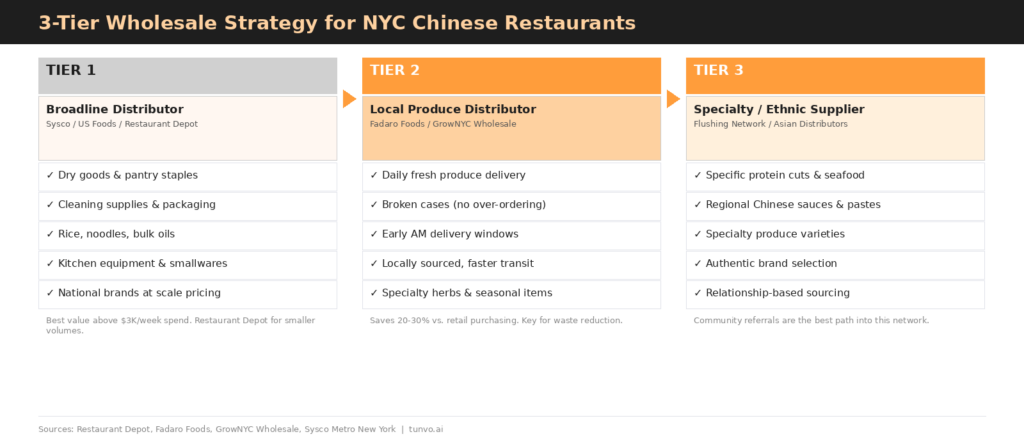
The most cost-effective approach for a Brooklyn or Queens Chinese restaurant is typically a three-supplier stack, not a single-source strategy. Here’s how to think about it:
Layer 1: Broadline for Dry Goods and Pantry Staples
Use Sysco, US Foods, or Restaurant Depot for high-volume, non-perishable staples — cooking oils, sauces, cleaning supplies, packaging, rice, dry noodles. These items are low-risk (long shelf life), high-volume, and benefit from the broadline distributors’ pricing at scale. If your weekly broadline spend is under $2,000–3,000, Restaurant Depot is likely more cost-effective than Sysco or US Foods because you avoid the minimum order requirements and account management complexity. Above that threshold, getting competing quotes from Sysco and US Foods is worth the time investment.
Layer 2: Local Distributor for Fresh Produce
A local produce distributor with daily delivery windows — like Fadaro Foods or an equivalent serving your specific neighborhood — handles your high-turnover fresh items. The key advantage over using a broadline distributor for produce is freshness and flexibility: local distributors can source specific varieties on request, break cases, and deliver at early morning windows that match a restaurant’s prep schedule. The 20–30% monthly savings that local wholesale sourcing can offer versus retail purchasing compounds quickly across fresh produce that turns over 3–5 times per week.
Layer 3: Specialty Supplier for Proteins and Ethnic-Specific Ingredients
Your third supplier handles what the first two can’t: specific protein cuts, specialty sauces, regional Chinese produce varieties, and items that define your menu’s authenticity. In Queens, this typically means a relationship with one of the specialty distributors serving the Flushing/Jackson Heights Chinese restaurant community, or a direct relationship with a seafood distributor for restaurants where fresh fish and shellfish are core to the menu.
Negotiating Better Prices With Your Suppliers
Wholesale food pricing is not fixed. Both national broadline distributors and local suppliers have pricing flexibility that most restaurant operators don’t use because they don’t know it exists or they don’t push for it. Three practices that work consistently:
Get Competing Quotes — and Let Your Suppliers Know You’re Doing It
The single most effective price-reduction tool available to any restaurant buyer is the act of requesting competing quotes and communicating clearly that you’re shopping around. A Sysco regional manager quoted in a PMQ industry forum acknowledged that they had lower margin on accounts that actively compared prices with US Foods — and actively sought to retain those accounts because of their demonstrated price sensitivity. The mechanism is simple: request a quote from both Sysco and US Foods on the same basket of items every 6–12 months. Share the competing quote with your current distributor. In most cases, pricing improves.
Commit Volume in Exchange for Better Pricing
Broadline distributors operate on margin, and larger weekly commitments unlock better pricing. If you’re currently splitting dry goods purchases between Restaurant Depot and Sysco, consolidating your dry goods to a single distributor and committing to a weekly minimum in exchange for improved per-unit pricing is a negotiation that most account reps will respond to positively. The key is making the commitment specific and measurable — “I’ll move all my dry goods to you at $X weekly if you can match this price on these 10 SKUs” — rather than vague.
Watch for Hidden Fees
Broken case charges, fuel surcharges, and delivery minimums are common sources of margin erosion that show up in broadline distributor invoices and are often negotiable, particularly at the beginning of a new supplier relationship when the rep is motivated to win your business. Review your first 90 days of invoices line by line for fees that weren’t discussed during onboarding.
What Phone Order Volume Has to Do With Supplier Selection
This might seem like an unrelated topic, but your ability to forecast demand accurately — and therefore order the right quantities from your suppliers — depends directly on having accurate sales data from all your order channels. For Chinese restaurants in Brooklyn and Queens where phone ordering remains a significant channel, orders that aren’t captured in your POS system create gaps in your demand data. Those gaps lead to inaccurate par levels, which leads to overordering from your suppliers, which leads to spoilage.
Tunvo’s AI voice agent takes phone orders and routes them directly to your MenuSifu POS — which means every phone order becomes part of your sales history, available for inventory planning and supplier ordering decisions. See how Tunvo works for Chinese restaurants →
Frequently Asked Questions
Do I need a license or permit to buy from wholesale food distributors in NYC?
Most wholesale distributors in NYC require proof of business registration — a New York State Certificate of Authority, a business license, or a food service permit issued by the NYC Department of Health. Restaurant Depot specifically requires a free membership that qualifying food businesses (restaurants, caterers, food trucks) can obtain by showing business documentation at their Queens location. National distributors like Sysco and US Foods require an account application that includes business verification. No special wholesale buyer’s license is required beyond standard restaurant operating permits.
Is Restaurant Depot really worth the trip for a small Queens restaurant?
For restaurants in the early stages or with weekly food costs under $3,000, yes — the cash-and-carry model, free membership, and no-minimum structure make it genuinely cost-effective for staples and dry goods. The tradeoff is the time cost of 2–4 hours per trip. As volume grows and your supplier relationships develop, most operators supplement Restaurant Depot with a delivery distributor for categories where immediate availability isn’t required.
How do I find specialty Asian wholesale suppliers in Queens?
The most reliable approach is direct referrals from other restaurant owners in your neighborhood or from the supplier relationships of any staff members who have worked in the NYC Chinese restaurant community. The Flushing wholesale network isn’t a formal marketplace — it operates on trust and referral. Attending Chinese restaurant industry events in Queens, connecting with the Queens Chinese Business Association, or simply asking neighboring restaurant owners who they use for specialty ingredients are the most direct paths into this network.
Should I use one distributor or multiple?
Multiple distributors, almost always. No single distributor is best at everything — national broadline distributors are weakest on fresh produce delivery flexibility and ethnic-specific ingredients; local produce distributors don’t carry the full range of pantry staples; specialty suppliers handle what both others miss. The operational complexity of managing 2–3 suppliers is real but manageable with a good ordering system, and the cost and quality benefits of specialization outweigh that complexity for most operators.
Accurate demand data starts with capturing every order. Tunvo’s AI voice agent answers every phone call in English and Mandarin, sends orders to MenuSifu, and builds the sales history your supplier ordering decisions depend on. Set up in 30 minutes.