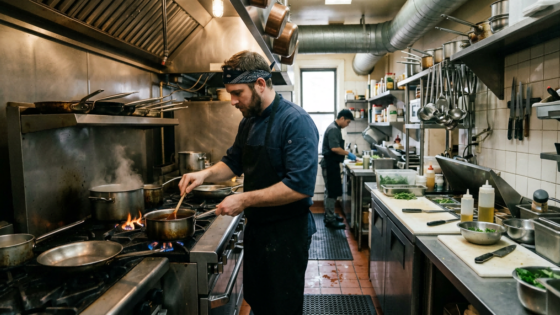
New York City restaurant kitchens are legendary for what they produce — and infamous for the conditions they do it in. If you’ve ever stepped behind the line at a typical Manhattan or Queens Chinese restaurant, you know the reality: 200 to 400 square feet of stainless steel, noise, heat, and controlled chaos, generating hundreds of orders a night. Talking with restaurant owners across the city, I hear the same frustration over and over: the front-of-house can seat 40 guests, but the kitchen was designed for 20. Every inch is contested. Every poor layout decision costs time, and time costs money.
This guide breaks down the five main kitchen layout typologies, explains which ones work in tight NYC spaces, and covers the equipment choices and workflow systems that make the difference between a kitchen that hums and one that bottlenecks every Friday night.
Key Takeaways
- The galley layout is the single best fit for narrow NYC restaurant spaces — two parallel walls of equipment with a central aisle maximize output per square foot.
- Multi-function equipment is not optional in a small kitchen — combi ovens, induction cooktops, and ventless hoods let you do more with less floor space and less ventilation infrastructure.
- Workflow bottlenecks, not just square footage, kill peak-hour throughput — even a small kitchen can run efficiently with clear zone separation, a logical flow from storage to prep to cook to service, and staffing that matches the layout.
- Phone interruptions during peak service are a hidden efficiency killer — in a small kitchen where every staff member has a role, pulling someone off the line to answer phones destroys throughput.
The Five Commercial Kitchen Layouts — and How They Fit (or Don’t) in NYC
Before you rearrange a single piece of equipment, it helps to understand the five layout types that commercial kitchen designers use. Each has a context where it excels — and most small NYC restaurants are using the wrong one.
1. The Assembly Line Layout
Popular in quick-service and fast-casual restaurants, the assembly line arranges workstations in a linear sequence so food moves from prep to cook to service in one direction. Think of a pizza shop where dough gets stretched at one end and a finished pie exits the oven at the other. According to Park Bench Architects, this layout is common in NYC chain concepts like fast-casual build-to-order spots because it fits naturally into narrow storefronts. The main limitation: it’s inflexible. If your menu changes or you run a diverse operation like a Chinese restaurant with wok stations, dim sum, and noodle prep all happening simultaneously, a single linear line creates bottlenecks.
2. The Galley Layout
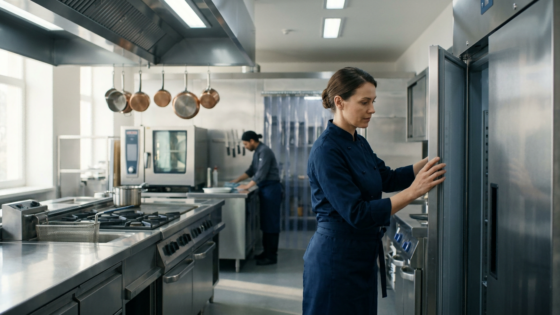
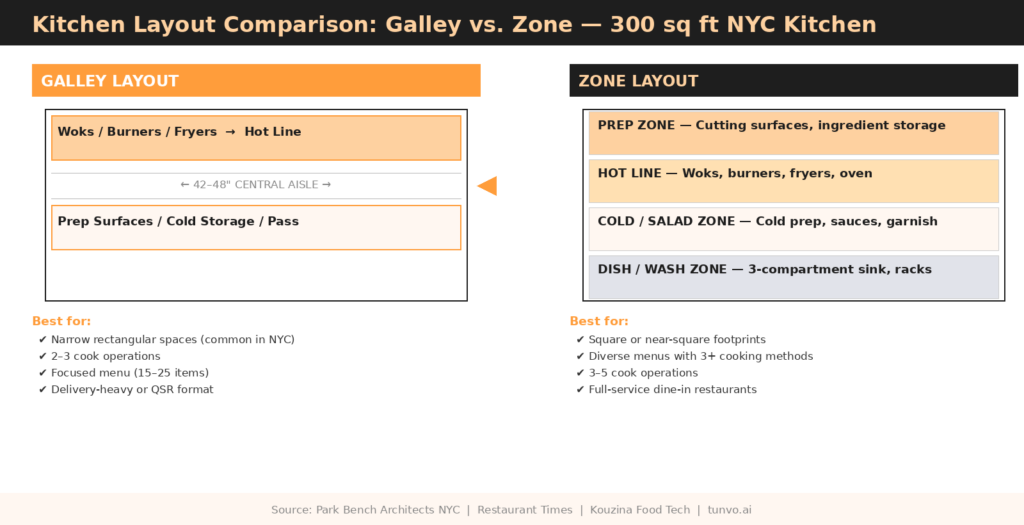
Two parallel work surfaces with a walkway between them — this is the workhorse of small commercial kitchens in NYC. Equipment and prep areas line both walls; your cooks pivot between them without wasted steps. Restaurant Times notes that the galley layout makes excellent use of rectangular kitchen spaces and is well-suited for casual dining and moderate-volume operations. For a typical Queens Chinese takeout operation squeezed into a 250-square-foot kitchen, galley is often the only configuration that allows two or three cooks to work simultaneously without collision. The constraint is width: the central aisle needs at least 42–48 inches to allow safe movement, which means the usable equipment footprint on each wall is limited.
3. The Zone Layout
A zone-style kitchen divides the space into semi-independent stations — prep, hot line, cold/salad, dishwashing — each with its own dedicated equipment and storage. This is the classic brigade system, and it works beautifully in kitchens of 600+ square feet. In a 300-square-foot NYC kitchen, the zone concept still applies, but the “zones” compress into designated areas of a single room rather than separate physical spaces. The benefit, even in a small footprint, is that cross-contamination risk goes down and each cook knows exactly where their tools are. The risk is that with only two or three staff members, you’re managing stations that were designed for larger teams.
4. The Island Layout
A central cooking island surrounded by prep and storage along the walls. Great for collaborative kitchens and open-kitchen concepts where guests can see the action. In practice, this layout requires a minimum of 5–6 feet of clearance on all sides of the island — a luxury most NYC small restaurants simply don’t have. Gallery KBNY notes that the U-shaped variant (which approximates an island on three walls) works best in larger brownstones and co-ops, not tight commercial kitchens.
5. The L-Shaped Layout
Two walls of equipment meeting at a corner. This works in square or nearly-square kitchen footprints, keeping everything within a short radius for a small team. The weakness is corner dead zones — the junction of the two walls tends to create awkward equipment placement unless a corner unit like a rotating shelf or specialty prep station is installed there deliberately.
Space Benchmarks: How Much Kitchen Does an NYC Restaurant Actually Need?
The traditional restaurant industry guideline is a 60/40 split: 60% of your total footprint dedicated to the dining room, 40% to the kitchen and storage. But industry data from Toast shows that quick-service and delivery-focused restaurants often flip this ratio — dedicating 55% or more to kitchen and storage because throughput, not seating capacity, is their primary revenue driver.
For a typical NYC Chinese restaurant or takeout operation, here’s a practical benchmark table:
| Restaurant Type | Total Footprint | Recommended Kitchen % | Best Layout |
|---|---|---|---|
| Chinese takeout / QSR | 800–1,200 sq ft | 50–55% | Galley or Assembly Line |
| Casual dine-in (20–30 seats) | 1,200–2,000 sq ft | 40–45% | Zone or L-Shaped |
| Full-service (40–60 seats) | 2,000–3,500 sq ft | 35–40% | Zone or Island |
| Ghost kitchen / delivery-only | 300–700 sq ft | 80–90% | Galley |
The Equipment Stack That Makes a Small NYC Kitchen Viable
Layout is half the equation. The other half is choosing equipment that does more per square foot. In a small kitchen, buying the wrong gear — oversized for your volume, or single-function when multi-function is available — wastes both floor space and money.
Combi Ovens: One Unit, Five Functions
A combi oven can steam, roast, bake, poach, and reheat in a single footprint roughly the size of a standard convection oven. Sam Tell’s commercial equipment team, which supplies NYC restaurants, identifies the combi oven as one of the top space-expanders for tight urban kitchens. For a Chinese restaurant that roasts duck, steams dumplings, and bakes desserts, replacing three pieces of equipment with one combi unit can free up 15–20 square feet of floor space — and reduce the ventilation burden at the same time.
Induction Cooktops: Less Heat, More Control
In a small kitchen, ambient heat is an operational problem, not just a comfort one. High ambient temperatures cause cook fatigue, increase error rates, and drive up AC costs. Induction cooktops heat the cookware directly through magnetic induction rather than heating a burner or element — which means far less residual heat escaping into the kitchen environment. Sam Tell’s NYC team notes that induction also heats faster than gas or electric alternatives, giving cooks more responsive temperature control on dishes that require precision. The tradeoff: induction requires compatible magnetic cookware, which means an equipment audit before switching.
Ventless Exhaust Hoods: Reconfigure Without Construction
Traditional hood systems require ductwork through the ceiling or walls — a constraint that becomes extremely expensive in NYC buildings, especially in older structures. Ventless exhaust hoods use internal filtration to capture grease, vapor, and contaminated air without requiring any ductwork. Sam Tell highlights that these units are also portable, which matters in kitchens that need to reconfigure seasonally or as the menu changes. If your landlord won’t approve a duct penetration or your building’s structure makes it impractical, a ventless hood system may be the only way to add a new cooking station without a construction permit.
Vertical Storage: The Z-Axis Is Free
NYC restaurant real estate is expensive horizontally but not vertically. Wall-mounted shelving, overhead pot racks, and tall refrigeration units allow you to increase storage capacity without increasing footprint. Restaurant Times specifically identifies vertical storage as critical when floor space is limited — keeping frequently used prep tools and small equipment on the walls near their primary use areas rather than in cabinets or on countertops.
Workflow Design: Where Most Small Kitchens Lose Time
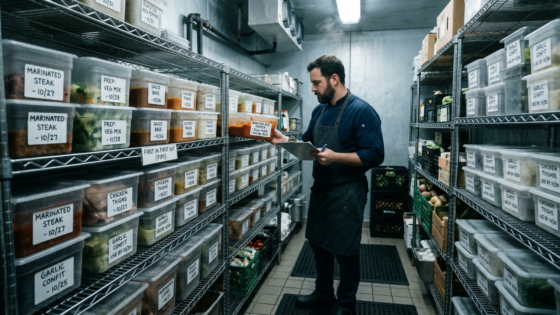
Even a well-equipped kitchen with the right layout can produce bottlenecks if the workflow logic is wrong. Kouzina Food Tech identifies the core principle: food should flow in one direction — from storage through prep through cooking to service — without backtracking. Every time a cook has to walk back past the hot line to reach the walk-in or grab a prep ingredient they forgot, you lose seconds that compound across a full service shift.
The Three Non-Negotiable Zones (Even in 250 Square Feet)
Even in the smallest kitchen, three functional zones need to exist as physically distinct areas, even if they’re only a few feet apart. The prep zone — your counter space and cutting surfaces — should sit between cold storage and the hot line, so ingredients flow naturally without detours. The cooking zone — your woks, burners, fryers, or griddles — should be the hottest, loudest section, ideally near the ventilation and farthest from the pass-through window to keep heat away from plated food. The service/plating zone — the area where finished dishes go before reaching the front of house — should be the coolest, cleanest surface and physically separated from raw prep areas.
Staff Positioning and the Two-Cook Problem
Many small NYC Chinese restaurant kitchens run with two cooks during service: one on the wok line, one handling prep and support. The galley layout serves this configuration well because both cooks can work their respective walls without crossing each other’s path. Where kitchens fail is in designing the layout for three or four cooks and then staffing it with two — creating wide gaps in the workflow where the support cook has to cover too much ground. Design for your actual staffing reality, not your theoretical maximum.
The Hidden Efficiency Killer: Phone Interruptions During Peak Service
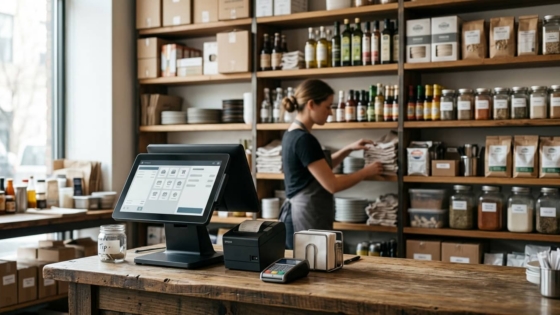
In a kitchen running with two or three people during a Friday dinner rush, every staff member has a defined role. Pulling one of them off the line — even for two minutes to take a phone order — breaks the rhythm of an operation that depends on continuous, coordinated movement. Research from HungerRush shows the average QSR receives 50–75 calls a day, and can miss over $27,000 per year in revenue from unanswered calls during peak hours.
The problem isn’t just missed orders. It’s the kitchen disruption that happens when someone who should be at the wok station is instead standing near the POS trying to accurately capture a complex order through noise and distraction. Order errors cost money twice: once in wasted ingredients, and again when a customer calls back to complain.
In conversations with restaurant owners across New York, this comes up constantly. The cooks can’t stop, the front-of-house staff is managing tables, and the phone keeps ringing. Tunvo’s AI voice agent was built specifically for this scenario — it answers every call, handles ordering conversations in English and Mandarin, and routes orders directly to your MenuSifu POS without requiring anyone to leave their station. Learn how Tunvo works for Chinese restaurants →
NYC-Specific Compliance Considerations
Small NYC kitchens don’t just face space constraints — they face regulatory ones. The NYC Department of Health’s Article 81 governs food service establishment layout requirements, including mandates for three-compartment sinks, hand-washing sinks, and specific equipment placement rules. Letter Grade Consulting notes that hotels and food halls with multiple operators can apply for H-26 Shared Space Permits that allow equipment like refrigeration and dishwashing machines to be shared — a useful option for ghost kitchen operators or food halls trying to make very small footprints compliant.
Two compliance points that affect layout decisions in small kitchens specifically: hand-washing sinks must be accessible without crossing cooking or prep zones (which affects where you place them in a galley layout), and ventilation requirements must be met for any equipment that produces grease-laden vapor — which is where ventless hoods become a compliance tool, not just a convenience.
Putting It Together: A Layout Decision Framework
When evaluating or redesigning your kitchen layout, work through these four questions in order. First: what is your kitchen’s actual square footage and shape? A long narrow rectangle almost always points to galley. A square or nearly-square footprint opens up L-shape or zone options. Second: what is your menu’s operational complexity? A focused menu with 15–20 items needs less zone separation than a full-menu operation running dim sum, stir-fry, and soup simultaneously. Third: how many staff work the kitchen during peak service? Design for your actual staffing, not maximum capacity. Fourth: what equipment do you currently have, and which pieces are single-function that could be replaced by multi-function alternatives?
From those answers, a layout choice usually becomes clear. The mistake most operators make is skipping questions two through four and jumping straight to layout typologies — which is how you end up with an island-configured kitchen staffed by two cooks who spend the whole shift walking in circles.
Frequently Asked Questions
What is the minimum kitchen size for an NYC restaurant?
There is no single minimum square footage mandated by NYC health code — the Department of Health focuses on equipment requirements (three-compartment sinks, hand-washing sinks, proper ventilation) rather than overall size. In practice, most functional small-format NYC restaurants operate with kitchens of 150–300 square feet for delivery-focused or QSR concepts, and 300–600 square feet for casual dine-in operations. The constraint is meeting Article 81 equipment placement and separation requirements within whatever footprint you have.
Is the galley layout the best for small NYC kitchens?
For most narrow rectangular NYC restaurant spaces, yes — the galley layout provides the best throughput per square foot because it eliminates wasted floor space and positions all equipment within a short reach of the central aisle. It works best with 2–3 cooks and a focused menu. For more complex menus or square-shaped kitchens, an L-shaped or compressed zone layout may offer better workflow.
Do induction cooktops really make a difference in a small kitchen?
Yes, primarily through heat reduction. A small kitchen running multiple gas burners can reach ambient temperatures that make sustained peak-hour service physically difficult for staff. Induction eliminates most of that ambient heat output because it heats cookware directly without heating a surrounding burner or element. The additional benefits — faster heat response, easier cleaning, and better energy efficiency — are secondary but real. The main requirement is compatible magnetic cookware, which means an equipment replacement cost if your current pots and pans aren’t induction-compatible.
How do I handle phone orders during peak hours without pulling staff off the line?
This is one of the most common operational pain points in small NYC restaurant kitchens. The most effective solution is an AI voice agent that answers calls automatically, handles the full ordering conversation, and pushes orders directly to your POS — eliminating the need for any staff member to handle inbound calls during service. Book a demo with Tunvo to see how it works for Chinese restaurants using MenuSifu.
What’s the biggest layout mistake small NYC restaurants make?
Designing for a theoretical full-staff scenario rather than the actual operating reality. A kitchen planned for five cooks that runs with two during most services will have dead zones, poorly positioned equipment, and workflow gaps that slow down every shift. Design your layout around the staffing configuration you actually operate with 80% of the time — and build flexibility for peak staffing into the design rather than assuming it as the baseline.
Your kitchen layout can only do so much if your phones are still pulling staff off the line. Tunvo’s AI voice agent handles every call in English and Mandarin, sends orders straight to MenuSifu, and sets up in 30 minutes — so your team can stay focused on the food.