A single health code violation can cost a restaurant thousands in fines — and far more in lost customer trust. Yet most independent restaurant owners don’t fail inspections because they’re careless. They fail because cleaning tasks slip through the cracks during busy shifts. The difference between a spotless kitchen and a citation is almost always a system: a clear, repeatable cleaning schedule that assigns every task to a specific person at a specific time.
In our conversations with restaurant owners across New York, one theme keeps coming up: they know what needs to be cleaned, but the daily chaos of running service makes it easy to forget the less obvious tasks — the ice machine, the hood vents, the walk-in door gaskets. This guide gives you a practical, printable framework you can implement today.
Key Takeaways
- Break cleaning into three tiers — daily, weekly, and monthly — so nothing gets missed even during your busiest weeks.
- Assign every task to a named person and a specific time slot; unassigned tasks are the ones that don’t get done.
- Digital checklists and photo verification are replacing paper logs — and health inspectors are noticing.
Why Most Restaurants Struggle With Cleaning Consistency
The “We Clean When We Can” Trap
Many small restaurants operate on an informal system: the kitchen crew cleans up after close, the morning opener wipes down surfaces, and deep cleaning happens “when things slow down.” The problem is that things rarely slow down. According to the CDC, roughly 48 million Americans get sick from foodborne illness each year, and a significant portion of outbreaks trace back to improper cleaning and sanitization in commercial kitchens. An ad-hoc approach to cleaning is essentially a gamble with your customers’ health and your business license.
The Staffing Factor
High staff turnover in the restaurant industry — which the Bureau of Labor Statistics consistently reports as one of the highest of any sector — means your newest employees may not know your cleaning standards. Without a written schedule, institutional knowledge walks out the door every time someone quits. That’s why the schedule itself matters more than any individual employee’s work ethic.
The Three-Tier Cleaning Framework
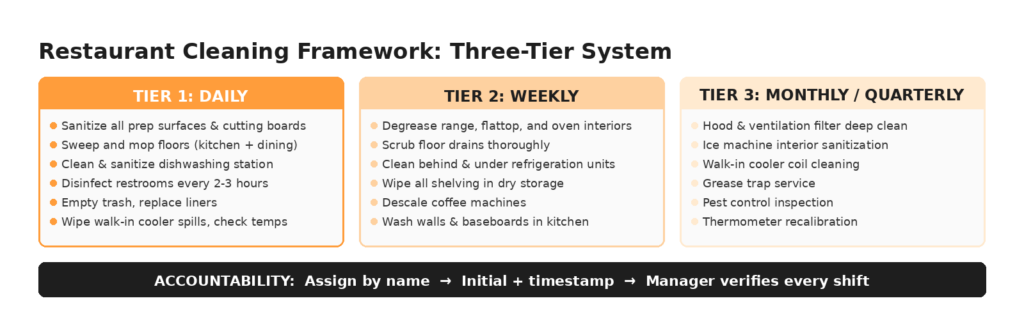
The most effective restaurant cleaning programs operate on three overlapping cycles. Each tier covers different equipment and surfaces based on how quickly they accumulate grime and how much risk they pose if neglected.
Tier 1: Daily Tasks — The Non-Negotiables
These tasks must happen every operating day, no exceptions. Most should be completed both during and after service. The FDA Food Code requires food-contact surfaces to be cleaned and sanitized at least every four hours during continuous use, making mid-shift cleaning a legal requirement, not just a best practice.
| Area | Tasks | When |
|---|---|---|
| Kitchen Surfaces | Sanitize all prep tables, cutting boards, and food-contact surfaces | Every 4 hours + after close |
| Floors | Sweep and mop kitchen, dining area, and restrooms | After each shift |
| Dishwashing Station | Clean and sanitize sinks, check sanitizer concentration | Start and end of day |
| Restrooms | Disinfect all surfaces, restock supplies, check for leaks | Every 2-3 hours during service |
| Trash & Recycling | Empty all bins, replace liners, wipe exterior | When full + after close |
| Walk-in Cooler | Wipe spills, check temperature logs, organize shelves | Opening + closing |
Tier 2: Weekly Tasks — Deep Clean Rotations
Weekly tasks target buildup that daily cleaning doesn’t fully address. The key is assigning each task to a specific day so the work distributes evenly rather than piling up. Many owners assign weekly deep cleans to slower days — typically Monday or Tuesday for restaurants that are busiest on weekends.
Weekly tasks typically include thoroughly degreasing the range and flattop, cleaning the interior of ovens and microwaves, scrubbing floor drains, wiping down shelving units in dry storage, descaling the coffee machine, and cleaning behind and underneath all refrigeration units. Walls and baseboards in the kitchen should also get attention weekly, as grease splatter accumulates faster than most people realize.
Tier 3: Monthly and Quarterly Tasks — The Ones Everyone Forgets
These are the tasks that catch owners off guard during inspections. They’re not hard to do — they’re just easy to forget. Monthly deep cleans should cover your hood and ventilation system (filters at minimum, with a professional duct cleaning quarterly), the interior of your ice machine, walk-in cooler coils, grease traps, and light fixtures throughout the restaurant. Quarterly, you should also have pest control inspections, check fire suppression systems, and recalibrate thermometers.
The National Fire Protection Association (NFPA 96) mandates that commercial kitchen exhaust systems be inspected and cleaned on a schedule based on cooking volume — monthly for high-volume operations, quarterly for moderate ones. Failing to comply doesn’t just risk a fine; it’s a fire hazard.
Building Your Cleaning Schedule: A Step-by-Step Process
Step 1: Walk Every Inch of Your Restaurant
Before building a schedule, do a full walkthrough with fresh eyes. Start at the front door and move through the dining room, bar area, kitchen, prep stations, storage areas, restrooms, and exterior. Note every surface, piece of equipment, and fixture. You’ll almost certainly find spots that have been missed for months — the undersides of booth seats, the area behind the POS terminal, the track of the sliding door on the walk-in.
Step 2: Categorize by Frequency
Sort your complete list into the three tiers: daily, weekly, and monthly/quarterly. If you’re unsure where a task belongs, ask one simple question: what happens if this doesn’t get done for a week? If the answer involves health risk or customer-visible dirt, it’s a daily task. If it’s a buildup issue that compounds over time, it’s weekly. If it’s a maintenance or deep-clean item, it’s monthly.
Step 3: Assign Names, Not Roles
The most common mistake restaurant owners make is assigning tasks to roles rather than people. “Kitchen staff cleans the line” means everyone assumes someone else will do it. Instead, assign each task to a specific person on each shift. Post the schedule where everyone can see it — on the wall near the time clock, on a whiteboard in the kitchen, or in a shared app.
Step 4: Add Accountability Checkpoints
Each completed task should be initialed and timestamped. Whether you use a paper checklist on a clipboard or a digital tool, the critical element is the same: someone must confirm the task was done, and a manager must verify at least once per shift. Many restaurants now photograph completed cleaning tasks, which creates a visual record that’s far more reliable than a checkmark.
Health Inspection Preparation: What Inspectors Actually Look For
The Top 5 Violations That Catch Restaurants Off Guard
According to data from local health departments, the most frequently cited violations during restaurant inspections are improper food temperature holding, lack of proper hand-washing facilities or supplies, cross-contamination risks from unclean surfaces, evidence of pest activity, and improper chemical storage. Notice that three of these five are directly related to cleaning. Your schedule should explicitly address each one.
Creating an Inspection-Ready Culture
The restaurants that consistently pass inspections don’t prepare for inspections — they maintain standards daily. If your kitchen is only spotless when you’re expecting the inspector, you have a culture problem, not a cleaning problem. The schedule is the tool that bridges the gap between knowing what to do and actually doing it every day.
Digital Tools vs. Paper Checklists
When Paper Still Works
For single-location restaurants with a small, stable team, a laminated checklist and a dry-erase marker can be perfectly effective. The key advantages of paper are zero learning curve and zero cost. Tape it to the wall, hand your team a marker, and you’re running. The downside is that paper checklists are easy to falsify, can’t send alerts, and don’t create a searchable history.
When to Go Digital
If you run multiple locations, have high staff turnover, or want a verifiable record for insurance or legal purposes, digital cleaning management tools are worth the investment. Apps like Jolt, MarketMan, or even a shared Google Sheet with timestamp columns can provide real-time visibility into task completion. Some systems allow photo uploads for each task — a powerful accountability tool.
For restaurant owners already automating parts of their operation — like using Tunvo’s AI voice agent to handle phone orders and reservations — digital cleaning checklists fit naturally into a broader technology strategy. The philosophy is the same: automate the repeatable so your team can focus on what requires human judgment and care.
Common Mistakes to Avoid
Overcomplicating the Schedule
A 50-item daily checklist will be ignored. Start with the 10-15 most critical daily tasks and build from there. You can always add granularity later once the habit is established. The goal is consistency, not comprehensiveness on day one.
No Manager Verification
A checklist without verification is just decoration. Assign a closing manager to walk the full checklist every night before anyone leaves. This single practice catches more problems than any other accountability measure.
Ignoring Front-of-House
Kitchen cleaning gets all the attention, but customers judge cleanliness by what they can see: sticky menus, smudged glassware, dusty light fixtures, dirty restrooms. Your schedule must cover both sides of the house equally.
Frequently Asked Questions
How often should a restaurant kitchen be deep cleaned?
Most restaurants should do a full deep clean weekly, with specific equipment on monthly or quarterly rotations. High-volume kitchens with fryers and grills may need more frequent deep cleaning — some do partial deep cleans after every shift. The key is matching frequency to volume: the more you cook, the more buildup accumulates, and the more often you need to address it.
What’s the best way to train new employees on cleaning procedures?
Pair every new hire with a senior team member for their first three shifts and walk the cleaning schedule together. Provide a printed copy they can reference. Many restaurants film a 10-minute walkthrough video showing exactly how each task should be done — this is especially helpful when language barriers exist, a common situation in multicultural kitchen teams.
Can a cleaning schedule actually help us pass health inspections?
Absolutely — and inspectors will tell you the same. A posted, initialed cleaning schedule signals to inspectors that your operation is systematic, not reactive. Some jurisdictions even look for written cleaning procedures as part of their evaluation. Beyond inspections, a consistent schedule reduces the risk of the kind of incidents — pest sightings, foodborne illness complaints — that trigger unscheduled inspections in the first place.
Running a restaurant means juggling a hundred tasks at once. While a cleaning schedule keeps your kitchen spotless, an AI voice agent can make sure you never miss a customer call during the rush. Tunvo answers every call, takes orders in English and Mandarin, and sends them straight to your POS. Try it free for 15 days →