You just wrapped a brutal Friday dinner rush. The kitchen is finally quiet, your feet are aching, and you glance at your phone to see a new Google notification: someone left a one-star review. Your stomach drops. You want to respond, but you’re exhausted, and anything you write right now might come out wrong. Sound familiar?
In our conversations with restaurant owners across New York, this scenario comes up again and again. The review sits unanswered for days — or worse, forever. And the data shows that’s costly: according to ReviewTrackers, nearly 45% of consumers are more likely to visit a business if the owner responds to negative reviews. Meanwhile, research from Harvard Business School found that a one-star increase in a restaurant’s rating can lead to a 5–9% revenue increase for independent restaurants.
This article gives you ready-to-use response templates you can customize in under two minutes — so you never leave a review unanswered again.
Key Takeaways
- Respond to every review within 24–48 hours — speed signals professionalism and can even prompt reviewers to upgrade their rating.
- Use the templates below as starting points — personalize with the reviewer’s name and specific details to avoid sounding robotic.
- Negative reviews are recoverable — a thoughtful response influences future customers more than the original complaint does.
Why Responding to Reviews Matters More Than You Think
Reviews aren’t just feedback — they’re public conversations that prospective diners read before deciding where to eat. And the numbers behind this are striking.
The Revenue Impact of Your Online Reputation
According to a 2026 BrightLocal survey, 93% of consumers have made a purchase after reading reviews. For restaurants specifically, GatherUp’s research shows that 46% of customers are influenced to visit a restaurant after reading positive reviews, while 29% will avoid one after reading negative reviews.
The financial impact compounds quickly. Black Box Intelligence data shows that a 3.1% increase in annual sales — driven by improved star ratings — can translate to an additional $39,000 for a quick-service restaurant and $125,000 for a casual dining establishment.
Why Your Response Matters to People Who Haven’t Visited Yet
Here’s the part most owners miss: your response isn’t really for the reviewer. It’s for the hundreds of people who will read the exchange later. According to ReviewTrackers, responding to a 1- or 2-star review within 24 hours has a 33% higher chance of the reviewer upgrading their rating by as much as three stars.
And per The Food Institute, a SOCi audit of nearly 600 U.S. chain retailers found that 54% of all consumer feedback goes unanswered. That’s a massive opportunity for independent restaurants who take the time to reply — you’ll stand out simply by showing up.
The 4-Part Response Formula That Works Every Time
Before we get to the templates, here’s the framework behind every effective review response. Whether the review is glowing or brutal, this structure keeps you professional and efficient.
The Framework: Thank, Acknowledge, Address, Invite
| Step | What to Do | Example Phrase |
|---|---|---|
| 1. Thank | Thank the reviewer by name | “Hi [Name], thank you for taking the time to share your experience.” |
| 2. Acknowledge | Reference something specific they mentioned | “We’re glad you enjoyed the crispy duck” or “We’re sorry about the wait time.” |
| 3. Address | Explain what you’ve done or will do (for negatives) or reinforce what worked (for positives) | “We’ve spoken with our team about this” or “Our chef will be thrilled to hear that.” |
| 4. Invite | Encourage a return visit or offer to continue the conversation privately | “We’d love to welcome you back” or “Please reach out to us at [email].” |
Timing: How Fast Should You Respond?
Industry consensus is clear: aim for 24–48 hours. SOCi’s research, reported by The Food Institute, found that brands averaged 6.3 days to respond to Google reviews in 2023. If you can beat that by responding within a day or two, you’re already ahead of most competitors.
Templates for Positive Reviews
Don’t skip these. Thanking happy customers reinforces their loyalty and shows future diners that you’re engaged and appreciative.
Template 1: The General Positive Review
“Hi [Name], thank you so much for the kind words! We’re really happy to hear you enjoyed your visit. Our team works hard to make every meal special, and your feedback means a lot to us. We look forward to seeing you again soon!”
Template 2: When They Mention a Specific Dish
“Hi [Name], so glad you loved the [dish name]! It’s one of our favorites too — our chef puts a lot of care into getting it just right. Next time you visit, you might also enjoy the [suggest a related dish]. Thanks for sharing your experience!”
Template 3: When They Praise the Staff
“Hi [Name], thank you for highlighting [staff member’s name or ‘our team’]! We’ll be sure to pass along your kind words — it really makes their day. We’re lucky to have such dedicated people and we’re glad their hard work made your dining experience memorable.”
Templates for Negative Reviews
These are the ones that keep owners up at night. The key: stay calm, be specific, and move the conversation offline when possible. As Restaurant Growth notes, 88% of consumers are likely to still order from a business if it replies to all reviews — both positive and negative.
Template 4: Slow Service or Long Wait
“Hi [Name], thank you for your honest feedback. We’re sorry your experience didn’t meet the standard we aim for — long waits are frustrating, and we understand that. We’ve reviewed our staffing for peak hours and are making adjustments to ensure smoother service. We’d love a chance to show you a better experience. Please feel free to reach us at [email/phone] so we can make it right.”
Template 5: Food Quality Complaint
“Hi [Name], we appreciate you letting us know about your meal. This isn’t the quality we’re proud of, and we take it seriously. We’ve shared your feedback with our kitchen team and are reviewing our preparation process for [dish name]. We’d appreciate the opportunity to welcome you back — please contact us at [email/phone] and we’ll make sure your next visit is much better.”
Template 6: Order Error (Wrong or Missing Items)
“Hi [Name], we sincerely apologize for the mix-up with your order. Getting the details right is fundamental to what we do, and we clearly fell short this time. We’ve followed up with our team to prevent this from happening again. Please reach out to us at [email/phone] — we’d like to make this right for you.”
Order errors are one of the most common sources of negative reviews, especially for phone orders. When your restaurant handles high volumes of phone calls during rush hours, mistakes happen. This is one reason many restaurants are exploring tools like AI voice agents that can process orders with consistent accuracy, even during the busiest periods.
Template 7: Rude Staff or Poor Customer Service
“Hi [Name], we’re truly sorry to hear about your experience with our staff. This is not the level of hospitality we expect from our team. We’ve addressed this internally and are committed to ensuring every guest feels welcome. We would value the chance to host you again — please contact us at [email/phone] so we can personally ensure a better visit.”
Templates for Mixed or Tricky Reviews
Not every review is clearly positive or negative. Some are nuanced, vague, or just plain confusing. Here’s how to handle the gray areas.
Template 8: The “Good Food, But…” Review
“Hi [Name], we’re glad you enjoyed the food! We also appreciate you flagging [the issue they mentioned]. It’s exactly this kind of detailed feedback that helps us improve. We’re looking into it and hope to give you an even better overall experience next time.”
Template 9: The Vague 3-Star Review (No Details)
“Hi [Name], thank you for your feedback. We’d love to learn more about what we could do better to earn a higher rating from you. If you have a moment, please reach out to us at [email] — your input helps us keep improving.”
Template 10: The Pricing Complaint
“Hi [Name], thank you for sharing your thoughts. We understand that value is important. Our pricing reflects our commitment to fresh, high-quality ingredients and the dining experience we aim to provide. We hope you’ll give us another try — we’d love the chance to make sure you feel the meal was worth every dollar.”
Building a Review Response Habit (Without Losing Your Mind)
Having templates is one thing. Actually using them consistently is another. Here’s how to make it sustainable when you’re already working 12-hour days.
Set a Daily 10-Minute Review Window
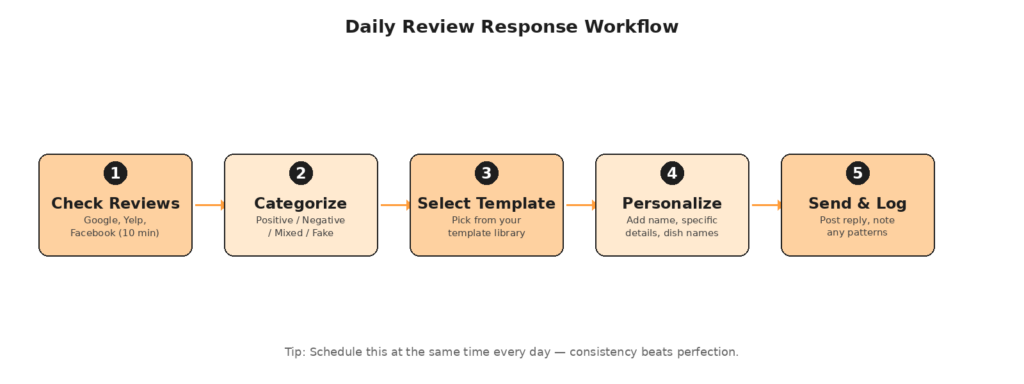
Pick a time — maybe right before the lunch shift or right after closing — and check your Google, Yelp, and Facebook reviews. Ten minutes a day is enough to stay on top of things. Use your phone’s bookmarks to go directly to your review pages so there’s zero friction.
Delegate to a Trusted Team Member
You don’t have to write every response yourself. As The Food Institute reports, savvy restaurant owners sometimes identify a team member with strong writing instincts and give them a small stipend for monitoring and drafting responses. Pre-approved templates make this delegation safe.
Track What You’re Learning
Reviews are free market research. If three different reviewers mention slow service on Friday nights, that’s a pattern worth investigating. If the same dish keeps getting praised, feature it more prominently on your menu. The restaurants that treat reviews as operational data — not just reputation management — tend to improve fastest.
Frequently Asked Questions
Should I respond to every single review?
Yes — or as close to every review as possible. Businesses that respond to all reviews build stronger trust with potential customers. According to Restaurant Growth, 88% of consumers are more likely to order from a business that replies to both positive and negative feedback. Even a short “thank you” on a positive review goes a long way.
What if a review is unfair or seems fake?
Still respond professionally and briefly. Potential customers can usually tell when a review is unreasonable, and your calm response only reinforces your credibility. If you believe the review violates platform guidelines (spam, fake, or from someone who never visited), you can flag it for removal through Google, Yelp, or the relevant platform.
Can responding to reviews actually improve my Google ranking?
Google has confirmed that responding to reviews is a factor in local search visibility. Active engagement signals to Google that your business is attentive and trustworthy, which can contribute to higher placement in local search results and the Maps pack.
How do I handle a review that mentions a staff member by name negatively?
Acknowledge the experience without naming the staff member in your response. Keep it focused on the customer’s experience and what you’re doing to improve. Handle any internal matters privately. Something like: “We’re sorry about your experience. We’ve addressed this with our team and are committed to better service.”
Every missed call is a missed opportunity — and every unanswered review is a missed connection with a future customer. If phone order errors are a recurring theme in your reviews, Tunvo’s AI voice agent handles every call with consistent accuracy and sends orders straight to your POS. Book a demo or start your 1