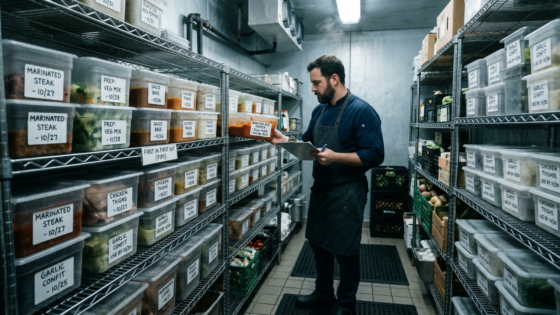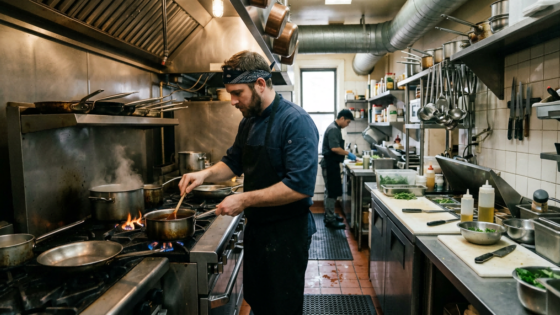
The NYC Health Department calls it an open-book exam — they publish the exact checklist their inspectors follow. That means there is no excuse for surprises. What I hear from restaurant owners in New York, though, is that most of them don’t actually use the checklist. They know their kitchen is “usually clean” and they assume that’s enough. It often isn’t. An A grade is 13 points or fewer. One pest harborage violation can be 10–28 points. One missing food protection certificate on the floor can be 10 points. The math is unforgiving, and it doesn’t care that your kitchen looks clean most of the time. This checklist is built around the specific categories NYC inspectors evaluate — organized so you can work through it section by section before each inspection cycle.
Key Takeaways
- The DOHMH publishes the exact inspection worksheet they use — running through it yourself once a month is the most efficient preparation you can do.
- A missing Food Protection Certificate on the floor is automatically 10 points, which puts an A grade at risk before anything else is assessed.
- Temperature documentation and pest control logs signal ongoing compliance, not just performance on inspection day.
- The DOHMH offers free consultative inspections for new food service establishments — a no-consequence practice run before your first graded inspection.
Before We Start: The Free Resources You Should Already Have
The DOHMH Self-Inspection Worksheet
The NYC Department of Health and Mental Hygiene publishes a Self-Inspection Worksheet for Food Service Establishments — the same form their inspectors use in the field. It is available on the DOHMH website in multiple languages including Traditional Chinese, Simplified Chinese, and Korean. If you are running a Chinese restaurant and your head chef does not read English fluently, printing the Chinese-language version and posting it in the kitchen is a practical first step that costs nothing.
The DOHMH also offers free consultative inspections for new food service establishments — a practice run conducted by an actual DOHMH inspector that does not produce a grade or result in fines. If you’ve never been through an NYC inspection cycle before, this is worth scheduling. As of 2025, the Department also began emailing restaurants before their expected initial inspection, providing direct links to preparation resources.
The Pre-Inspection Checklist
Section 1: Food Protection Manager Certification
This one comes first because it can decide your grade before an inspector looks at anything else. NYC requires a certified food protection supervisor to be on-site and available with their certificate during all operating hours. If that person isn’t present when the inspector arrives, it’s a 10-point critical violation. With 10 points already on the board, almost any additional violation pushes you above 13 and out of A territory.
The Food Protection Course is available online through the NYC Health Academy — the online course itself is free, and the in-person final exam costs $24. Certifying multiple staff members across shifts eliminates this risk entirely. Think of it as a $24 insurance policy per person.
| Certification Checklist Item | Status to Verify |
|---|---|
| At least one certified supervisor per shift | Confirmed on schedule |
| Certificate physically present and accessible on-site | Not at home, in the car, or expired |
| Certificate not expired (5-year validity) | Check expiration date |
| Backup certified staff for call-outs and vacations | At least 2 certified per location |
Section 2: Food Temperature Control
Temperature violations are among the most common and most expensive in NYC inspections. Cold food must be held at or below 41°F; hot food must be held at or above 140°F. A public health hazard like temperature failure carries a minimum of 7 points — meaning two separate temperature issues already put you at or near the A/B threshold before anything else is counted.
For Chinese restaurants specifically, the temperature challenge is more complex than it sounds. Dishes like congee, fried rice, and dim sum move through multiple temperature zones during prep and service. Garlic in oil — a common ingredient in Chinese kitchens — is treated the same as raw protein by inspectors and must be held below 41°F at all times or discarded within 4 hours if left at room temperature.
| Temperature Checklist Item | Required Standard |
|---|---|
| All refrigerators at or below 41°F | Verified with calibrated thermometer |
| All hot-held food at or above 140°F | Check multiple points in steam tables |
| Garlic in oil refrigerated or discarded within 4 hours | Timed and logged |
| Thermometers calibrated and available at each station | In-use and readable |
| Temperature log maintained with twice-daily readings | Current log present on-site |
| Foods not left in the temperature danger zone (41°F–140°F) for more than 2 hours | Time-tracked during prep and service |
Section 3: Pest Control
Pest-related violations — mice evidence, roach activity, and harborage conditions — account for more than 17% of all violations cited citywide and carry some of the highest point values on the schedule. Evidence of mice can range from 5 to 28 points depending on severity. A single mouse dropping in a food prep area can cost you more points than every other issue in your kitchen combined.
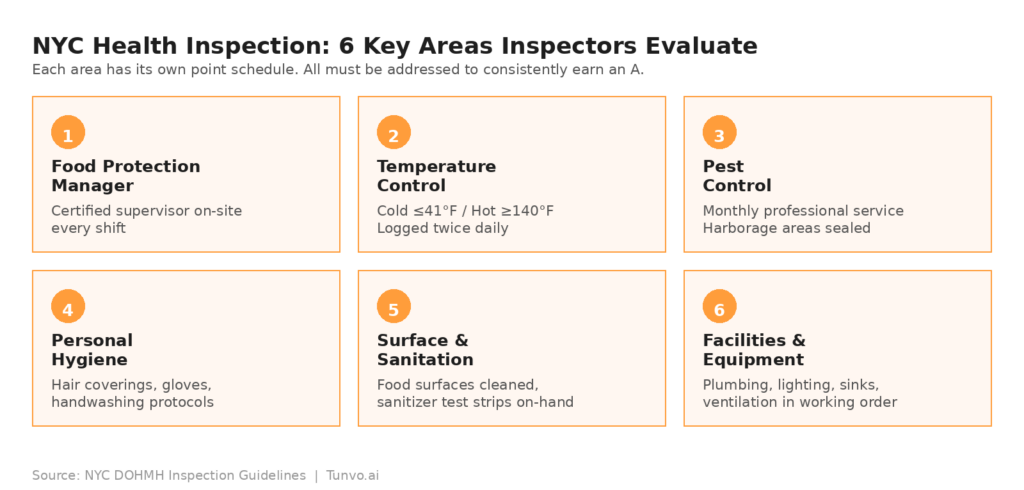 The six key areas NYC DOHMH inspectors evaluate — each with its own point schedule.
| Pest Control Checklist Item | Action Required |
|---|---|
| Professional pest control contract in place | Monthly service minimum; more frequent if history of activity |
| Pest control activity log maintained on-site | All service visits documented with date and treatment |
| All gaps, cracks, and entry points sealed | Check under sinks, around pipes, door sweeps |
| Dry goods stored in sealed containers off the floor | No cardboard boxes used as storage containers |
| Trash cans sealed and removed frequently | Leakproof lids; outdoor containers secure |
| No standing water in kitchen or basement | Mop and dry immediately; report plumbing issues same day |
One practical note from consultants who work with NYC operators: a wet floor is a water source for pests. Mop spills immediately, empty the bucket, and hang the mop to dry. Wet mop buckets left in corners overnight are a harborage condition even if no pests are present.
Section 4: Personal Hygiene and Staff Practices
Inspectors observe staff behavior, not just physical conditions. Staff must wear clean uniforms, hair coverings, and follow proper handwashing protocols. Illness exclusion policies must be enforced — employees with communicable diseases cannot handle food.
| Staff Hygiene Checklist Item | Standard |
|---|---|
| Hair coverings worn by all food handlers | Hats, hairnets — no exceptions on the line |
| Gloves changed between tasks involving different food types | Gloves protect food, not hands — change frequently |
| Handwashing sinks dedicated to handwashing only | Not used for dishes, food prep, or mopping |
| Soap and paper towels stocked at all handwashing stations | Check at start of every shift |
| Illness exclusion policy posted and enforced | Written policy; staff know not to come in sick |
Section 5: Surface and Equipment Sanitation
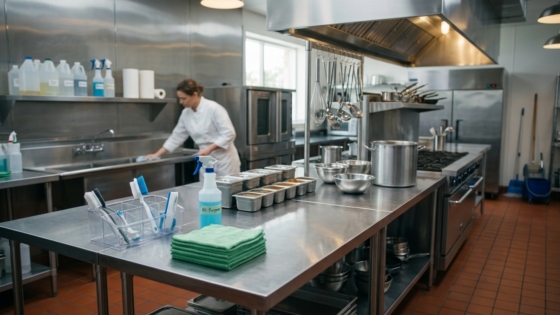
Food-contact surfaces must be cleaned and sanitized on a defined schedule. Cleaning schedules should cover menus, high-touch items, and all food prep surfaces — not just the obvious equipment. Wet cloths must be kept in sanitizer solution at the correct concentration, with test strips present and in active use.
| Sanitation Checklist Item | Standard |
|---|---|
| Wet cloths in sanitizer solution at correct concentration | Test strips on hand; solution replaced as needed |
| All food dispensing utensils have handles and stored correctly | Handle up, in a holder or on a clean surface — not inside the food container |
| Ice machine cleaned with soapy water (not chemicals) | Logged on cleaning schedule |
| Refrigerator coils, shelving, and undersides clean | Part of deep-clean schedule, not just daily wipe-down |
| Cardboard not used as a liner anywhere | Not under food containers, not on shelves, not on floors |
| Food covered and protected from contamination at all times | Cocktail garnishes, prep ingredients, cooling foods all covered |
Section 6: Facilities and Physical Plant
Each food prep area must have a dedicated handwashing station, and every restroom used by staff must also have one. Plumbing must be functional. Lighting must meet code levels in prep and storage areas. Grease traps and ventilation systems must be maintained. These are the kinds of violations that accumulate quietly — the drain that’s been slow for months, the light fixture over the prep station that burned out two weeks ago, the hand sink that staff have been using as a utility sink because it’s convenient.
The Monthly Self-Inspection Routine
Building Inspection-Readiness Into Your Operations
Picking one day each month to conduct a self-inspection using the DOHMH worksheet — before or after service when the kitchen isn’t running — is the highest-leverage habit you can build. Score yourself honestly using the same point system the Department uses. Any score above 10 is a signal to fix something before the real inspector shows up, not after.
Opening and closing checklists for front and back of house are the execution layer underneath the monthly audit. Assigning each staff member specific opening and closing responsibilities — with a manager doing a pre- and post-shift walk-through — ensures that compliance isn’t dependent on everyone remembering the rules at the same time. The tasks need to be written down, assigned, and checked, not assumed.
When the Inspector Arrives
How to Behave on Inspection Day
NYC restaurant owners have a legal right to know what their inspection covers and to accompany the inspector. The DOHMH publishes a Business Owner’s Bill of Rights in multiple languages. Read it once so you know what you’re entitled to.
Practically: be professional and cooperative. Escort the inspector to the kitchen immediately — getting them started quickly is in your interest if there are correctable issues like an improperly heated food item. Cooking temperature violations that are corrected on the spot during the inspection are penalized at 10 points, while those not corrected jump to 28 points. Knowing this, the right play is always to address any temperature issue the inspector identifies as quickly as possible while they’re still in your kitchen.
Frequently Asked Questions
How much does the NYC Food Protection Certificate cost?
The online course is free; the in-person final exam costs $24. The full in-person course (classroom format) costs $114. Both options are available through NYC’s Health Academy. Certificates are valid for 5 years.
Can I request a practice inspection from the Health Department?
Yes. The DOHMH offers consultative inspections for new food service establishments — a no-consequence visit from a DOHMH inspector that does not produce a grade or generate fines. Contact the Bureau of Food Safety and Community Sanitation at (212) 676-1600 to schedule one.
What’s the difference between a critical violation and a public health hazard in NYC?
Both are serious, but a public health hazard carries the highest point minimum. Public health hazards — like improper food temperatures — start at 7 points each. Critical violations — like failing to wash raw produce before serving — start at 5 points. General violations start at 2 points. The key difference is that public health hazards may allow the inspector to order immediate correction during the inspection itself.
Is the DOHMH inspection checklist available in Chinese?
Yes. The Self-Inspection Worksheet and most key DOHMH guidance documents are available in Traditional Chinese (繁體中文) and Simplified Chinese (简体中文), as well as Spanish, Korean, and several other languages. Links are available on the DOHMH restaurant inspection pages at nyc.gov.
Inspection-readiness is fundamentally an operations problem, not a one-time prep event. Kitchens that earn consistent A grades are usually the ones where the daily routines are tight enough that an inspector showing up is an inconvenience, not a crisis. One area where that operational discipline often breaks down: the phone. A busy service where staff are splitting attention between the kitchen and incoming calls creates the exact kind of distraction that leads to temperature checks being skipped and cleaning tasks being deferred.
Tunvo’s AI voice agent answers every call so your team can stay focused on the floor and the kitchen. Learn more about how Tunvo works, or start a 15-day free trial and see what it’s like to never miss an order.