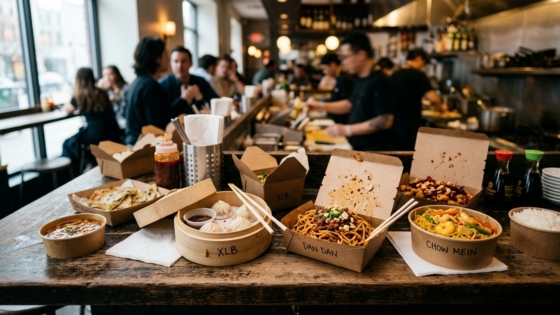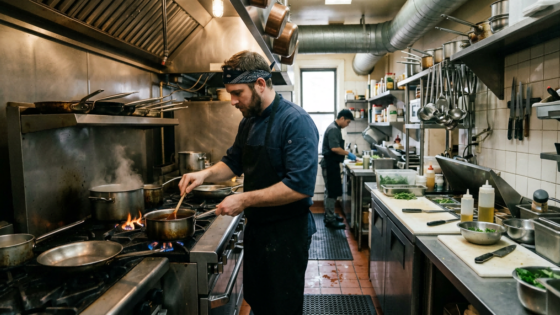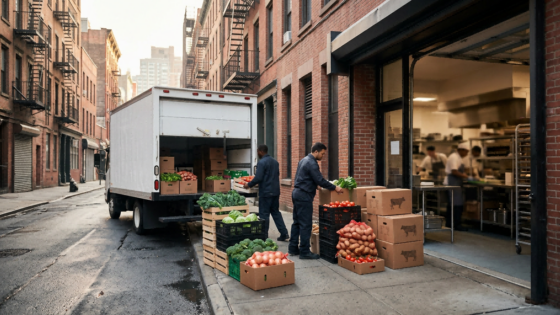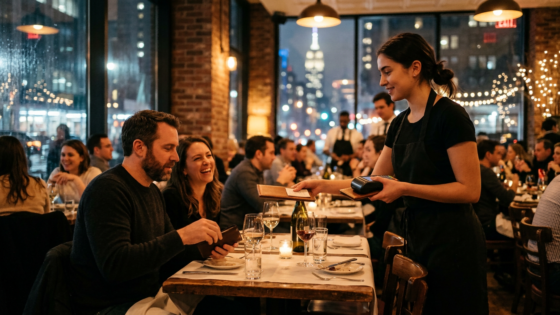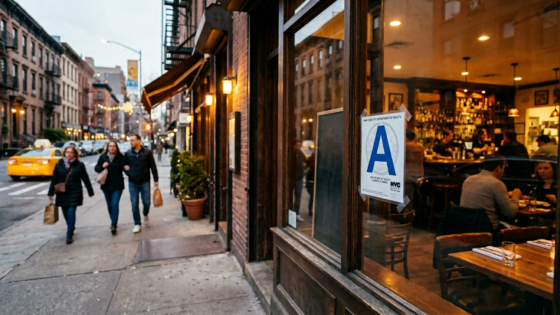
That letter in your window is doing more work than you think. In conversations with restaurant owners across New York, one thing comes up again and again: the “A” grade isn’t just a compliance checkbox — it’s a trust signal that customers read before they even open your door. A lower grade, or worse, a “Grade Pending” sign, can quietly redirect foot traffic down the block. The good news? The NYC grading system is, as the Health Department itself puts it, an open-book exam. Once you understand exactly how points accumulate — and which violations inspectors find most often — scoring 13 or below becomes a system you can manage, not a lottery you’re hoping to win.
Key Takeaways
- An “A” requires scoring 13 points or fewer on your inspection. Every violation carries a defined point value — knowing them in advance is your biggest advantage.
- You get multiple chances per cycle. If you don’t earn an A on the initial inspection, a reinspection follows no fewer than 7 days later. About 77% of NYC restaurants ultimately end their cycle with an A.
- The most cited violations — pest evidence, temperature issues, and surface sanitation — are all preventable with daily operational habits, not expensive renovations.
- A higher grade is linked to higher revenue. Research confirms that better inspection scores increase a restaurant’s sales and reduce the probability of closure.
How the NYC Grading System Works
The Point System Explained
The NYC Department of Health and Mental Hygiene (DOHMH) has operated the letter grading program since July 2010, when it launched to address widespread non-compliance that had persisted under the previous fine-only system. Every unannounced inspection produces a score based on violations found, and lower scores earn better grades:
| Score Range | Letter Grade | Next Inspection Cycle |
|---|---|---|
| 0 – 13 points | A | ~12 months |
| 14 – 27 points | B | 150–210 days |
| 28+ points | C | 90–150 days |
Each violation falls into one of three severity categories. Public health hazards — such as holding food at the wrong temperature — carry a minimum of 7 points. Critical violations, like serving unwashed raw vegetables, carry a minimum of 5 points. General violations start at 2 points. That means a single serious issue (one 7-point hazard plus one 7-point hazard) can already push you to 14 and trigger a reinspection before you’ve addressed anything else in the kitchen.
The Three-Chance Cycle
Many owners don’t realize how much opportunity they have. Each restaurant effectively gets three chances per inspection cycle to receive an A: the initial inspection, a reinspection (conducted no sooner than 7 days after the initial), and finally an adjudication hearing at the Office of Administrative Trials and Hearings (OATH) if you want to contest the reinspection score. If your reinspection earns a B or C, you have the option of posting a “Grade Pending” card while you wait for the hearing outcome. About 77% of NYC restaurants ultimately finish their cycle with an A grade posted.
One important tactical note: the length of your next inspection cycle is based on the higher score received in either the initial or reinspection — not the final grade posted. So even if you appeal a B back to an A, a high initial score will still shorten the window before your next visit.
The Most Common Violations (and Their Point Costs)
What Inspectors Find Most Often
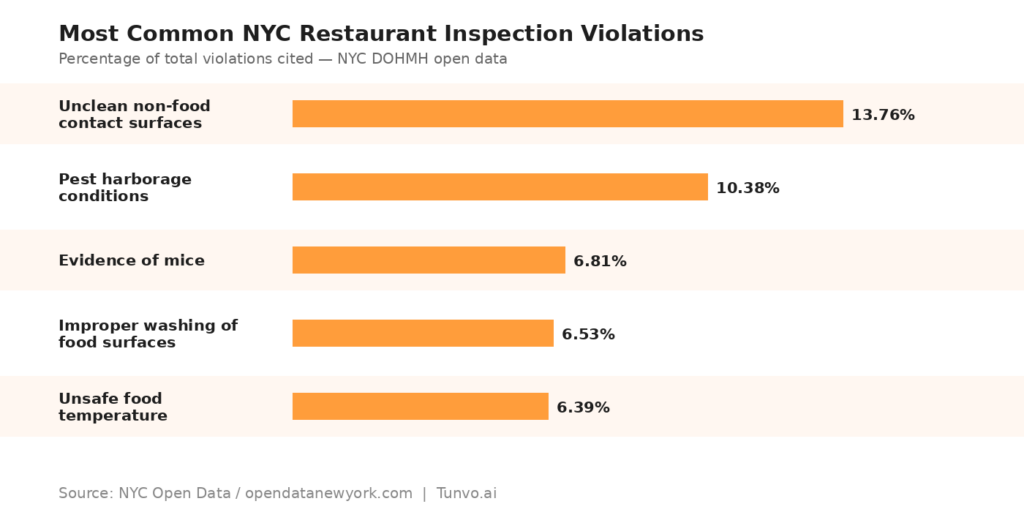
Analysis of NYC’s open inspection data consistently shows the same categories at the top of the violation list. Unclean non-food contact surfaces account for 13.76% of all violations cited, pest harborage conditions for 10.38%, and evidence of mice for 6.81%. Improper washing of food-contact surfaces and unsafe food temperatures each account for over 6% of citations. Together, these five categories represent roughly half of all violations written in New York City.
Point Costs for Common Violations
| Violation Type | Points | Notes |
|---|---|---|
| Evidence of mice or live rodents | 5–28 | Sliding scale based on severity and extent |
| Cold food held above 41°F | 7+ | Public health hazard — minimum 7 points |
| Hot food not held at or above 140°F | 5–8 | Points vary by number of food items affected |
| Improper cooking temperatures | 10 or 28 | 28 points if not corrected during the inspection |
| Unclean non-food contact surfaces | 2–5 | Based on severity |
| No food protection manager on staff | 2+ | DOHMH Food Protection Course certificate required |
One critical detail that surprises many owners: if an inspector finds a cooking temperature violation and it is not corrected on the spot during the inspection, the point penalty jumps from 10 to 28 — which alone puts you in C territory. Getting the inspector into the kitchen quickly and correcting temperature issues in real time is one of the most impactful things you can do to protect your grade on the day of an inspection.
Five Areas That Determine Your Grade
1. Food Temperature Control
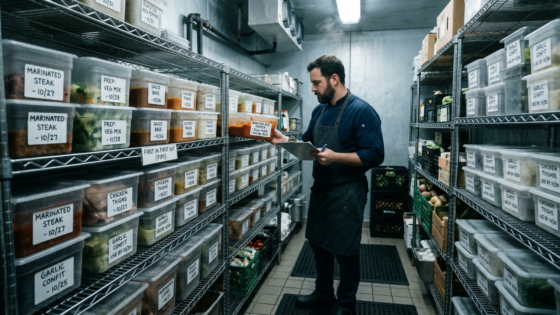
Cold storage must keep food at or below 41°F; hot holding must stay at or above 140°F. Calibrating thermometers regularly and building temperature logging into your daily open and close routines is the single most effective habit you can develop. This is especially relevant for Chinese restaurants, where dishes like fried rice, dumplings, and soups move between temperature zones multiple times during service. A logbook with twice-daily readings signals to an inspector that your kitchen operates by habit — not just when someone is watching.
2. Pest Control
Pest-related violations — evidence of mice, roaches, or harborage conditions — are responsible for a disproportionate share of non-A grades citywide. A professional pest control contract, sealed entry points, properly stored dry goods, and a pest control activity log are all things an inspector will look for. Proactive monthly service is far less expensive than a 28-point rodent citation or a closure order.
3. Personal Hygiene and Food Handler Certification
At least one supervisor on each shift must hold a valid NYC Food Protection Course certificate. The DOHMH offers this course online for free. Beyond certification, inspectors look at whether staff are wearing hair coverings, washing hands correctly between tasks, and following illness exclusion policies. These violations tend to be low-point individually but add up quickly when combined.
4. Surface and Equipment Sanitation
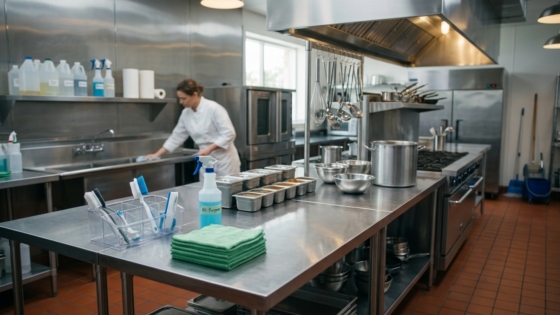
Food-contact surfaces must be properly cleaned and sanitized. Non-food contact surfaces — the sides of equipment, shelving undersides, hood vents — must be clean. Wet cloths need to be kept in sanitizer solution at the correct concentration, and test strips must be available and in use. Inspectors evaluate whether equipment and facilities are in proper working order, including refrigeration, plumbing, lighting, and ventilation. A deep-clean schedule posted in the kitchen — and actually followed — provides both compliance and evidence of compliance.
5. Waste Management
Garbage stored in unsealed containers, or a cluttered rear area, creates both a pest risk and a direct violation. Sealed, leakproof containers and a regular disposal schedule are the baseline. For restaurants with high-volume takeout — including many of the Chinese restaurants we work with in New York — the volume of packaging waste can accumulate quickly during service. A clear disposal protocol for staff, not just equipment in place, is what maintains compliance through a busy Friday night.
Before vs. After the Grade Was Introduced: What Changed
The System Was Built to Change Behavior
The grading system was launched specifically because financial penalties alone hadn’t worked. Before grading, the Health Department noted that most restaurants were performing at what would now be considered a B level, and closures were common because inspection compliance was inconsistent. After grading launched in 2010, food safety practices improved measurably — fewer citations for unsafe food temperatures and pest evidence within the first years of the program.
The financial case for an A grade is clear. Research on the NYC grading program found that a higher grade increases a restaurant’s sales and reduces the probability of closure. The grade card in your window is not a bureaucratic formality — it is a marketing asset that works every day, for every customer who walks past.
What “Grade Pending” Actually Means
How to Handle a B or C on Reinspection
If your reinspection score falls in the B or C range, you have a choice: post the letter grade card you received, or post a “Grade Pending” card while you request a hearing through OATH. Customers who see a “Grade Pending” sign can visit the DOHMH website to view the underlying score and violations, so the card buys time, not secrecy. The strategic value is that it gives you the opportunity to argue your case — inspectors can make errors, violations can be disputed, and some points can be reduced — before a final grade is locked in.
The DOHMH also recently introduced a “cure” provision: certain violations can be corrected within days of the inspection and reported back to the Department to avoid fines. This is available for first-time violations, and it rewards restaurants that respond quickly rather than waiting. Knowing which of your cited violations qualify for curing — and acting within the window — is increasingly part of the playbook for owners who take inspection outcomes seriously.
Practical Steps Before Every Inspection Cycle
Use the Open-Book Exam
The DOHMH publishes the exact checklist inspectors use, in multiple languages. The Department also offers free food safety workshops and low-cost consultative inspections — a practice run with a DOHMH inspector that does not result in a grade. As of 2025, the Department began emailing restaurants a few months before their expected initial inspection to provide preparation resources. If you’re on that mailing list, treat the email as the starting gun for your prep cycle.
A few concrete habits that cost nothing but consistency: temperature logs twice daily, pest control visits logged and documented, equipment repair tickets closed within 48 hours, and a supervisor certification audit at every staff change. None of this requires a consultant. It requires someone in your operation being responsible for it — which, in a busy restaurant, usually means it needs to be built into the daily routine rather than remembered.
Frequently Asked Questions
What score do I need to get an A in NYC?
You need to score 13 points or fewer. A score of 0–13 earns an A, 14–27 earns a B, and 28 or more earns a C. These thresholds apply to both the initial inspection and the reinspection.
What happens if I fail the initial inspection?
You will receive a reinspection no sooner than 7 days later. The grade displayed on your door is based on the reinspection score, not the initial. If you score 13 or below on the reinspection, you receive an A. If you score 14 or above, you may post a “Grade Pending” card and request a hearing.
How often does the Health Department inspect restaurants in NYC?
At least once per year. The frequency increases if you’ve had a higher score previously — restaurants scoring in the B range are reinspected within 150–210 days, and those in the C range within 90–150 days. Essentially, a lower grade means more visits, which means more opportunities to accumulate fines.
Can I contest violations from my inspection?
Yes. You have the right to an impartial review by an administrative tribunal (OATH), which can improve your assigned score and reduce monetary fines. Restaurants are also entitled to request a consultative inspection from the DOHMH before their next cycle — a no-consequence practice run.
Are there resources available in languages other than English?
Yes. The DOHMH publishes guidance materials, the inspection checklist, and grade card requirements in Chinese (Traditional and Simplified), Spanish, Korean, and other languages. The Food Protection Course required for supervisor certification is also available in multiple languages online.
Every missed call during a busy dinner rush is a missed order — but a B or C grade on your window is a missed customer before they ever call. Keeping operations tight enough to earn an A every cycle comes down to daily habits, documented logs, and a team that knows the standards. If your kitchen is running lean — busy phones, short-staffed shifts, no one watching the prep area — that pressure shows up in your inspection score too.
Tunvo’s AI voice agent handles every inbound call — in English, Mandarin, and more — so your team can stay focused on the kitchen, not the phone. Learn how Tunvo helps restaurants run leaner operations, or book a demo to see it in action.