On January 1, 2026, New York’s minimum wage increased again. For restaurant owners in New York City, Long Island, and Westchester County, the base rate moved from $16.50 to $17.00 per hour — a $0.50 bump that sounds modest until you do the payroll math across a full year with a team of 10 or 15 employees. In conversations with restaurant owners across New York this quarter, the question I hear most isn’t “what’s the new rate?” Most owners already know the number. The harder question is what to do about it — especially in a year when food costs haven’t eased and third-party delivery platform fees continue to take 25–30 cents on every dollar of takeout revenue. This article covers the exact 2026 changes, what they mean for different categories of workers in a restaurant, and the practical decisions you need to make now.
Key Takeaways
- NYC minimum wage is now $17.00/hour, effective January 1, 2026. Upstate New York is $16.00/hour.
- Tipped food service workers have a separate cash wage rate of $11.35/hour in NYC, with a tip credit of $5.65 — meaning their cash wage plus tips must equal at least $17.00/hour total or the employer must make up the difference.
- These are the last legislatively set increases. Starting January 1, 2027, New York’s minimum wage will adjust annually based on the CPI-W for the Northeast Region — inflation-indexed, with an “off-ramp” provision if economic conditions warrant.
- Labor is already 25–35% of restaurant revenue for most operators. In 2026, wage pressures are pushing full-service restaurants toward the higher end of that range.
The 2026 Minimum Wage Numbers in Full
Base Rates for Non-Tipped Workers
The increases that took effect on January 1, 2026 apply to all non-tipped hourly workers, which in a restaurant context means kitchen staff, prep cooks, dishwashers, and delivery workers:
| Location | 2025 Rate | 2026 Rate | Increase |
|---|---|---|---|
| NYC, Nassau, Suffolk, Westchester | $16.50 | $17.00 | +$0.50 |
| Remainder of New York State | $15.50 | $16.00 | +$0.50 |
After 2026, the state switches to CPI-indexed increases. Starting January 1, 2027, annual increases will track the three-year moving average of the Consumer Price Index for Urban Wage Earners and Clerical Workers for the Northeast Region. The Director of the Division of the Budget will set the specific rate by October 1 each year, with an off-ramp available if certain economic or budget conditions are triggered.
Tipped Worker Rates: Food Service Workers vs. Service Employees
New York’s hospitality wage rules distinguish between two categories of tipped workers. A food service worker is someone primarily engaged in serving food or beverages — wait staff, bartenders, bussing personnel — who regularly receives tips. Delivery workers are explicitly excluded from this definition. A service employee is a broader category covering tipped workers in other roles.
| Worker Category | Location | 2026 Cash Wage | Tip Credit |
|---|---|---|---|
| Food service workers | NYC, LI, Westchester | $11.35/hr | $5.65/hr |
| Food service workers | Remainder of NY | $10.70/hr | $5.30/hr |
| Service employees | NYC, LI, Westchester | $14.15/hr | $2.85/hr |
| Service employees | Remainder of NY | $13.30/hr | $2.70/hr |
The tip credit is the portion of the employee’s wages that you are permitted to offset with tips they receive. The key compliance requirement: if a tipped employee’s cash wage plus their actual tips for the shift does not equal at least the full minimum wage ($17.00 in NYC), you must make up the difference. This requires tracking actual tip amounts per employee per shift — not just assuming that tips will cover the gap.
Salary Thresholds for Exempt Employees
For any employee you classify as exempt from overtime under the executive or administrative exemptions, the minimum salary threshold in NYC, Nassau, Suffolk, and Westchester County is now $1,275/week ($66,300 annually). The upstate threshold is $1,199/week ($62,353 annually). If you have a salaried manager who doesn’t reach these thresholds, they may not qualify for overtime exemption — meaning overtime worked may be payable at 1.5x their regular hourly equivalent.
What This Actually Costs: The Math for a Typical NYC Restaurant
Annual Payroll Impact
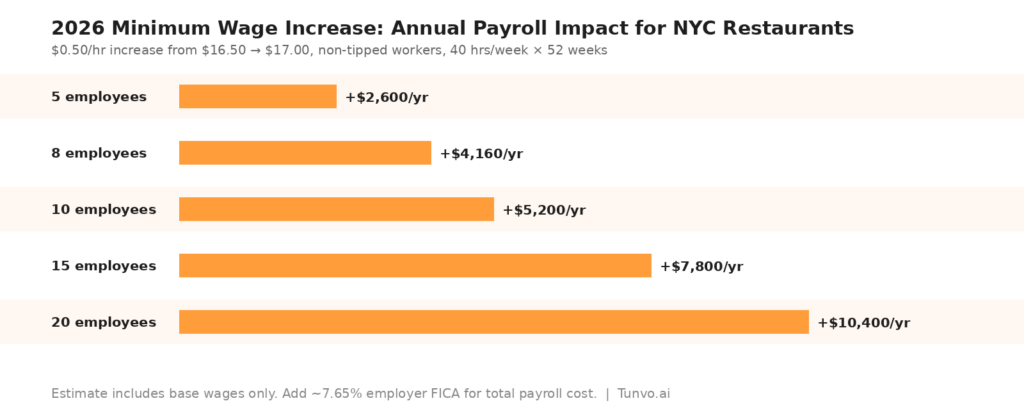 Estimated annual payroll increase for a NYC restaurant moving from $16.50 to $17.00/hr, based on full-time equivalents at 40 hrs/week for 52 weeks.
A $0.50 per hour increase for one full-time employee working 40 hours per week for 52 weeks adds $1,040 per year. For a restaurant with 8 non-tipped kitchen staff, that’s $8,320 in added base wages before payroll taxes and benefits. Factor in payroll taxes (FICA employer contribution is 7.65%), and the total labor cost increase for those 8 positions is closer to $8,956. A swing of just five points in labor cost percentage can mean $50,000 on $1M in annual revenue — so these increments compound quickly as the wage floor rises each year.
Restaurant labor costs typically run 25–35% of total revenue, with full-service restaurants trending toward the upper end of that range in 2026. For a family-owned Chinese restaurant generating $800,000 in annual sales, that puts labor somewhere between $200,000 and $280,000 per year. A $0.50 wage increase with 10 employees means roughly $10,400 in additional direct labor costs — not including the ripple effect of adjusting wages for longer-tenured employees who expect to stay above the floor.
Three Other 2026 Employment Changes Worth Knowing
1. NYC Earned Safe and Sick Time Act Expansion
Effective February 22, 2026, NYC’s Earned Safe and Sick Time Act (ESSTA) was expanded to require employers to provide an additional 32 hours of unpaid sick/safe time upon hire and at the start of each calendar year. This is in addition to the existing paid sick time entitlement. The law also broadened the qualifying reasons employees may use leave, and consolidated coverage across employer sizes. For restaurants, this means more potential schedule disruption — employees using unpaid leave in addition to paid leave — and a higher bar for enforcement compliance.
2. NY Secure Choice Savings Program (Retirement)
Beginning March 2026, employers who have been in business for at least two years and employ 10 or more workers must register for the NY Secure Choice Savings Program or certify an exemption. This is a state-run payroll-deduction retirement savings program. Employers pay no fees, but must facilitate automatic enrollment for eligible employees. If your restaurant has grown to the 10-employee threshold, check whether you need to register before March 2026.
3. Tip Reporting Under the OBBBA
Federal legislation passed in 2025 (the One Big Beautiful Bill Act) created new rules regarding tip taxation that affect how tipped employees report and potentially deduct tips. Tax year 2025 is treated as a transition period, but the IRS is encouraging employers to provide tipped employees with separate accountings of cash tips for 2025 to facilitate the deduction. Payroll systems that don’t currently separate cash tips from credit card tips may require an update.
What to Do Before Your Next Payroll
Compliance Steps for Restaurant Owners
The New York State Department of Labor requires employers to post the updated official NYS minimum wage poster in a visible location in the workplace. Updated posters are available free from the NYDOL website in multiple languages including Chinese. Failure to post is itself a violation.
Beyond the poster: update your payroll to the new rate if you haven’t already, verify your tipped employee tracking is capturing actual tips per shift (not just assuming a tip credit is always available), and if you have any salaried managers, review whether their annual salary still meets the exemption threshold of $66,300 in NYC. If it doesn’t, reclassify them to non-exempt or adjust the salary before they work overtime hours at the exemption rate.
Managing Labor Costs When the Floor Keeps Rising
Where the Margin Pressure Actually Shows Up
The operators I talk to in New York are responding to wage increases in a few different ways. Some raise menu prices — which works if your customer base is less price-sensitive but carries real risk for takeout-heavy Chinese restaurants where customers are comparing prices directly against third-party delivery platform options. Some reduce hours or shift schedules, which creates its own compliance and service quality risks. A $1 increase in minimum wage can add tens of thousands of dollars annually in payroll costs, and those costs tend to land hardest on the labor-intensive parts of an operation.
One area where restaurant owners can genuinely reduce labor exposure without cutting service: the phones. A busy Saturday dinner service where a server is also fielding phone orders is a common pattern in Chinese restaurants. That split attention costs you — in order accuracy, in service quality at the table, and in missed calls when the line is backed up. Labor hours spent answering the phone are not recoverable. According to Tunvo, customers report up to 40% labor cost savings on phone-related work when an AI voice agent handles inbound calls — freeing staff to focus on higher-value, in-person service tasks where a minimum wage bump is at least paired with a corresponding improvement in customer experience.
Frequently Asked Questions
Is NYC’s minimum wage now $17 per hour?
Yes. Effective January 1, 2026, the minimum wage for non-tipped workers in New York City, Long Island (Nassau and Suffolk Counties), and Westchester County is $17.00 per hour. This is an increase from $16.50 per hour in 2025.
What is the tip credit for food service workers in NYC in 2026?
The tip credit for food service workers in NYC is $5.65 per hour, meaning the minimum cash wage you must pay is $11.35 per hour. However, the employee’s cash wage plus actual tips must equal at least $17.00 per hour for any shift. If tips fall short, the employer must pay the difference.
When will New York’s minimum wage increase again after 2026?
Starting January 1, 2027, New York’s minimum wage will increase annually based on the CPI-W for the Northeast Region — a three-year moving average calculated by the Division of the Budget. The rate for each coming year will be announced by October 1 of the preceding year.
Do I need to pay my kitchen staff the tipped worker rate if they never receive tips?
No. The tip credit and reduced cash wage rate applies only to employees who “regularly receive tips.” Kitchen staff, prep cooks, dishwashers, and other non-tipped back-of-house employees must be paid the full base minimum wage — $17.00 in NYC for 2026.
What happens if I don’t post the updated minimum wage poster?
Failure to post the required wage notice is a labor law violation. The NY Department of Labor provides updated posters in multiple languages, including Chinese, free of charge. Download and post one in a location visible to all employees.
Every year the wage floor rises, the cost of each hour of labor increases — including the labor hours your team spends answering the phone instead of serving tables. Tunvo’s AI voice agent handles every inbound call, takes orders directly into your POS, and frees your team to focus on the work only people can do. Learn how Tunvo works, or book a demo to see it in action in a restaurant like yours.