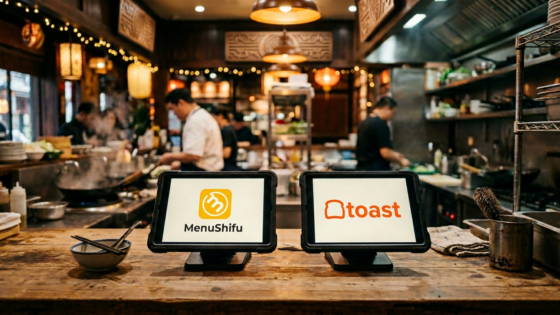
When we were designing Tunvo’s POS integration, one of the earliest decisions we had to make was which system to connect with first. Toast is the most recognized restaurant POS in the U.S. MenuSifu is less well-known outside the Asian restaurant community. We chose MenuSifu — deliberately, and for reasons that go well beyond market share. This article explains why, and what that choice means for your restaurant if you’re evaluating an AI voice agent for phone ordering.
Key Takeaways
- Toast is a general-purpose restaurant POS built for broad adoption. MenuSifu is built specifically for the operational realities of Asian and Chinese restaurants.
- Tunvo’s deep integration with MenuSifu means phone orders flow directly into your existing MenuSifu POS — no manual re-entry, no middleware.
- For Chinese restaurant owners in New York, the combination of Tunvo AI + MenuSifu creates the most seamless phone-to-kitchen workflow currently available.
What Toast Gets Right — and Where It Falls Short for Chinese Restaurants
Toast is a genuinely capable POS. According to Toast’s own product page, it’s been built over 14 years of working directly with restaurant operators, and it serves an enormous range of restaurant types, from fast-casual to fine dining. For an American hamburger joint or a fast-casual chain, it often makes sense.
The Multilingual Gap
The challenge for Chinese restaurants is that Toast was built around an English-first, Western service model. Chinese restaurants have different foundational requirements: multilingual interfaces across every touchpoint — POS terminals, kitchen display screens, receipts, and order tickets — are a basic operational necessity, not a premium add-on. When your kitchen staff works primarily in Mandarin and your front-of-house serves a bilingual customer base, a system that handles English and Spanish but lacks Chinese-language support creates real daily friction. MenuSifu, by contrast, displays menus in English, Spanish, Chinese, and French across all touchpoints simultaneously.
Complex Order Architecture
Chinese menus are structurally complex. A single order might involve nested modifiers (spice level, protein choice, sauce selection, portion size), family-style shared dishes, and multi-item combos where each component can be customized independently. Generic POS systems frequently require workarounds for these scenarios. MenuSifu was designed from the ground up to handle this kind of complexity — a seafood combo that requires customers to select seafood type, sauce, spice level, and sides is a standard use case, not an edge case.
Payment Methods That Match Your Customers
A significant portion of Chinese restaurant customers — particularly in communities like Flushing or Sunset Park in New York — prefer payment methods like Alipay and WeChat Pay alongside standard credit cards. Toast supports Apple Pay and standard card processing well. But if your customer base expects mobile wallet options popular among Chinese-speaking communities, MenuSifu’s native support matters in practice.
Why Deep Integration Beats a Generic API Connection
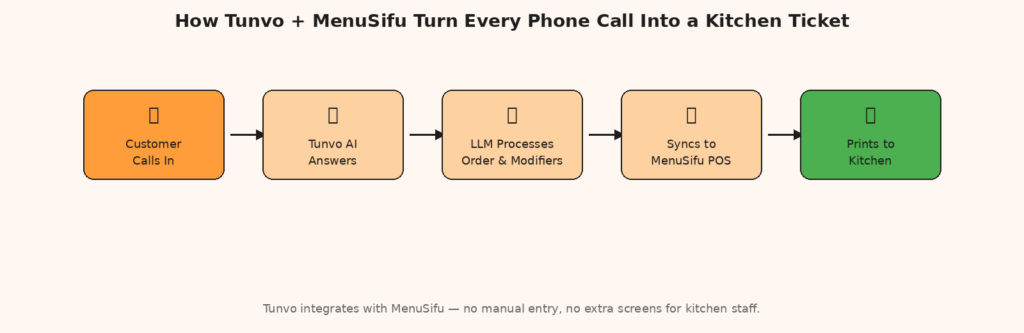
When we designed Tunvo’s MenuSifu integration, the question we kept returning to was: what does “integration” actually mean in practice? A surface-level API connection can technically pass an order from a phone call to a POS. But real integration means the AI knows in real time what’s in stock, what’s been 86’d, what the current lunch special pricing is, and how the kitchen routes different item types.
What “Deep Integration” Means for Your Kitchen
With Tunvo’s MenuSifu integration, a phone order placed with Tunvo’s AI voice agent appears in your MenuSifu POS the same way a counter order does — with all modifier details, item routing, and pricing intact. There is no second screen for staff to monitor. There is no manual re-entry step where errors can creep in. The order lands in the kitchen display or prints on your kitchen printer as if it came from any other ordering channel.
This matters particularly during peak hours. When your restaurant is handling a Friday evening rush — tables seated, delivery orders arriving, and the phone ringing — having the AI answer the phone and route orders automatically means your counter staff stays focused on in-person service. According to Tunvo, restaurants using this setup report an average of 13%+ higher order revenue and 20%+ lower labor costs, because staff time is redirected from phone handling to customer-facing work.
The MenuSifu Partnership Is Strategic, Not Incidental
Tunvo’s relationship with MenuSifu goes beyond a technical integration. MenuSifu serves as both an integration partner and a channel partner for Tunvo in the New York market. That means when you call MenuSifu for support, their team understands the Tunvo connection. When Tunvo encounters a restaurant with a specific MenuSifu configuration, we have the internal access to work through it properly. This kind of joint accountability between two technology partners — rather than a one-sided API dependency — leads to better outcomes when something needs troubleshooting.
A Head-to-Head Look: What Matters for Chinese Restaurant Phone Ordering
| Capability | MenuSifu | Toast |
|---|---|---|
| Multilingual POS interface (Chinese/English) | ✅ Native support | ⚠️ Limited |
| Complex modifier handling (nested, multi-step) | ✅ Designed for it | ⚠️ Workarounds often needed |
| Alipay / WeChat Pay support | ✅ Native support | ❌ Not natively supported |
| Family-style bill splitting | ✅ Multiple split methods | ⚠️ Basic splitting only |
| Tunvo AI voice agent integration | ✅ Deep, native integration | ❌ Not currently available |
| Market focus | Asian / Chinese restaurants, 15,000+ locations | General-purpose, all restaurant types |
| Bilingual customer support | ✅ English and Chinese support available | English-primary support |
Note: This comparison reflects publicly available product information as of early 2026. Toast is a capable general-purpose POS; the comparison above is specific to Chinese restaurant use cases where MenuSifu was purpose-built to excel.
What This Means If You’re a Chinese Restaurant Owner Evaluating Tunvo
If your restaurant currently runs on MenuSifu, the path to adding Tunvo’s AI voice agent is direct. Tunvo’s setup takes approximately 30 minutes, and the integration with your existing MenuSifu system means you don’t need to change how your kitchen works. The AI handles the phone. MenuSifu handles the POS. Your kitchen staff sees the orders the same way they always have.
If you’re not currently on MenuSifu but are considering adding voice AI to your restaurant, it’s worth understanding that the depth of integration between Tunvo and MenuSifu is the reason Tunvo can claim 95%+ order accuracy on phone orders. That accuracy comes from the AI having live, reliable access to your actual menu data — not a static copy that might be days or weeks out of date.
Tunvo’s AI voice agent answers every call, takes orders in both English and Mandarin, handles complex modifier selections, and sends the order directly into your MenuSifu POS — including during peak hours when your staff is otherwise occupied. For Chinese restaurant owners thinking about how to recover revenue from missed calls, this is the practical implementation that makes it work. According to industry research, restaurants lose an average of $27,000 or more per year from unanswered phone calls — and that figure doesn’t account for the additional orders lost because a staff member was on the phone when a customer walked in.
“When we designed Tunvo’s MenuSifu integration, we found that the critical challenge wasn’t just order capture — it was making sure every order landed in the kitchen exactly the way the customer specified, without a human in the loop to translate the phone call into POS entries.”
— Leo Chin, VP of Product, Tunvo
What About Other POS Systems?
We’re often asked about Toast, Square, Clover, and other popular systems. Tunvo currently integrates with MenuSifu. Additional POS integrations are on the roadmap, but we haven’t built them yet — and we’re not going to tell you we have. For a deeper understanding of how Tunvo is priced relative to what it replaces, our pricing page gives a clearer picture. The short version: the cost of one missed shift — or one week of peak-hour phone calls going unanswered — typically exceeds a month of Tunvo’s subscription.
For restaurants on MenuSifu right now, Tunvo is the only AI voice agent with this level of native integration in the market. That’s not just a product claim — it’s the result of deliberate architectural work and a genuine partnership between the two teams.
Frequently Asked Questions
Does Tunvo work with Toast?
Tunvo currently integrates with MenuSifu. Toast integration is not currently available. If your restaurant runs on Toast, you can still use Tunvo with a standalone receipt printer to handle phone orders — but the deep POS sync is specific to MenuSifu at this time. Additional integrations are on our roadmap.
What happens to a Tunvo-handled order if the internet goes down?
Tunvo requires an active internet connection to operate the AI voice agent. For contingency scenarios, we recommend having a standard phone line available as a backup so calls can be answered manually during outages. MenuSifu’s POS itself includes offline capabilities, meaning orders that have already reached the POS can still be processed even if connectivity drops.
Does Tunvo work if my restaurant doesn’t have a POS at all?
Yes. For restaurants without a POS, Tunvo supports direct printing to a standalone receipt printer. When the AI takes a phone order, the order ticket prints directly in your kitchen — no POS required. This is a common setup for smaller operations that haven’t yet adopted a full POS system. Learn more about this option in our product overview.
What is MenuSifu and how widely is it used?
MenuSifu is a restaurant POS platform trusted by over 15,000 restaurants across the U.S. over its 10-year history, with a particular concentration in Asian and Chinese restaurant communities. It’s used by a wide range of restaurant types — from quick-service spots to full-service dim sum houses and hot pot restaurants.
How long does it take to set up Tunvo with MenuSifu?
Most restaurants complete the full setup in approximately 30 minutes. The process involves connecting Tunvo to your MenuSifu account, configuring your menu and hours, and testing the call flow. Our team provides support throughout the setup. You can book a demo to see the integration in action before committing.
Every missed call is a missed opportunity. Tunvo answers every call and connects directly with your MenuSifu POS. Book a Demo or Start Your 15-Day Free Trial — get started in 30 minutes.