You’ve built an SMS subscriber list. You have customers who’ve opted in and given you permission to reach them directly on their phone. Now comes the question that stumps most restaurant owners: what exactly do you say?
The answer matters more than most people realize. A well-written restaurant text can drive 10–15 phone calls in the first hour. A poorly written one can prompt opt-outs from the customers you worked hardest to acquire. The difference isn’t about marketing jargon or clever wordsmithing — it’s about understanding what your customer is thinking when that notification hits their screen.
This guide covers every type of restaurant text message you’ll ever need to write, with real examples you can adapt tonight.
Key Takeaways
- Every effective restaurant text has four elements: who it’s for, what the offer is, when it expires, and how to act.
- Sound like a friend texting, not a brand broadcasting — conversational copy outperforms formal marketing language every time.
- Timing is as important as content — a great text sent at the wrong hour underperforms a good text sent at peak hunger time.
- The opt-out line is not optional — include “Reply STOP to unsubscribe” in every promotional message.
- Test two versions of every new message type before settling on a formula.
The Anatomy of a Restaurant Text That Works
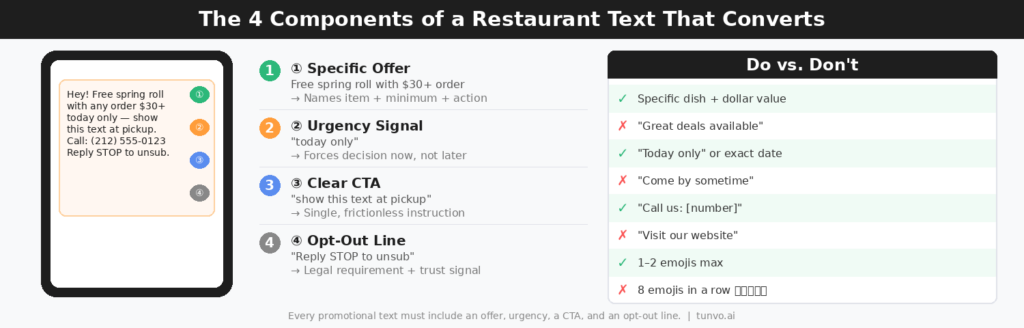
Before looking at examples, understand the structure that makes any restaurant text effective. Every high-performing restaurant text has four components. If any one is missing, conversion drops.
Component 1: A Specific, Concrete Offer
“Check out our specials” is not an offer. “Free spring roll with any order over $30 — today only” is an offer. The specificity does two things: it tells the reader exactly what they’re getting, and it creates a mental image concrete enough to spark appetite.
Vague language (“great deals,” “special savings”) doesn’t activate the hunger response. Food does. Name the dish, name the value, name the condition.
Component 2: Urgency That’s Real
Every effective promotional text has a time limit. Without one, the reader’s reaction is “I’ll do that later,” which means never. “Today only,” “expires tonight,” “this weekend only,” “first 20 orders” — any of these creates a reason to act now rather than later.
The urgency must be honest, though. If you say “today only” and then send the same offer next week, customers learn your urgency signals aren’t real. Use it truthfully, and it retains its power.
Component 3: A Clear Call to Action
Tell the customer exactly what to do. “Call us,” “show this text,” “order now at [link],” “mention this text at pickup.” One action, clearly stated. Not three options, not a question — a single instruction that removes all friction from the decision.
Component 4: The Opt-Out Line
Every promotional text must end with “Reply STOP to unsubscribe” or equivalent language. This is both a legal requirement under TCPA regulations and a trust signal. Customers who see it are more comfortable with your messages, not less — it shows you respect their choice. Customers who don’t want to receive your texts will opt out, which is a good outcome: your remaining list is cleaner and more engaged.
The Golden Rule: Write Like a Friend
The single most important principle in restaurant text marketing comes from a real operator’s experience. Henry Kaminski, CMO of Fabio Viviani Hospitality, put it plainly: “If it sounds salesy, they don’t perform as well. If they sound like a friend is texting you, we get a much better response — and way better ROI.”
Read your draft text out loud. Does it sound like something you’d actually text a friend? Or does it sound like a promotional email that got squished into 160 characters? The former converts. The latter gets ignored or worse, triggers opt-outs.
Here’s the same promotion written two ways:
Formal (underperforms):
“Hello valued customer, we are pleased to offer you a complimentary spring roll with your next purchase of $30 or more. Offer valid today only. Visit us soon. Reply STOP to opt out.”
Conversational (converts):
“Hey! Free spring roll with any order $30+ today only — show this text at pickup 🥢 Call us: [number]. Reply STOP to unsubscribe.”
Same offer. Same opt-out. Completely different energy. The second version sounds like someone at the restaurant actually typed it out for you. The first sounds like software. Customers respond to people, not software.
Timing: When to Send Each Message Type
Even a perfectly written text will underperform if it arrives at the wrong moment. Timing matters significantly by message type — targeting customers when they’re actively thinking about food decisions consistently outperforms generic batch sends.
| Message Type | Best Send Time | Why It Works |
|---|---|---|
| Lunch special | 10:30–11:30 am | Customers deciding before noon; you’re first in their mind |
| Dinner promotion | 3:30–4:30 pm | Hits before dinner decision is made; workday winding down |
| Weekend special | Saturday 9:30–10:30 am | Weekend plans still forming; leisure decision mode |
| Flash sale (same-day) | As early as possible | Urgency works in your favor; more time = more decisions |
| Loyalty reward notification | Mid-afternoon, Tue–Thu | Mid-week, not weekend-distracted; personal feel |
| Re-engagement message | 11 am weekday or Sat | High engagement; receptive to reconnecting over food |
| Holiday promotion | 3–5 days before event | Planning window; before decision is made elsewhere |
Avoid sending any promotional text before 9 am or after 8 pm. 85% of customers open texts within 1–5 minutes of receiving them, which means a text that arrives at 11 pm generates real interruptions and opt-outs rather than deferred engagement.
25 Restaurant Text Message Examples by Category
Daily Specials and Flash Sales
These are your highest-frequency texts — the ones that should make up the majority of your sends. Keep them under 160 characters when possible.
Lunch flash: “Today’s lunch special: Braised pork belly bento — $12, limited qty. Call now or come by. [number]. Reply STOP to unsub.”
Slow day push: “Rainy Tuesday = perfect dumpling day 🥟 Buy 2 orders, get 1 free today only. Mention this text. [number]. Reply STOP.”
Weekend dinner: “Weekend special: hot pot for 2 at $48 (usually $62). Saturday & Sunday only. Book now: [number]. Reply STOP to unsub.”
Loyalty Program Updates
These texts feel personal and drive return visits from your best customers. Reference their progress specifically when possible.
Points milestone: “You’re 2 orders away from a FREE dish! Come back soon 🎉 Call us: [number]. Reply STOP to unsubscribe.”
Reward ready: “Your free dish is ready to claim! Mention this text on your next order. Valid through [date]. [number]. Reply STOP.”
Birthday reward: “Happy birthday! 🎂 This month only — free dessert on any order. Just mention your birthday. We’re excited to celebrate with you: [number]. Reply STOP.”
New Menu Items
Position new items as exclusive early access — customers feel like insiders rather than marketing targets.
New item launch: “You’re first to know: our new Sichuan Crispy Tofu is on the menu starting today. Come try it this week — we think you’ll love it. [number]. Reply STOP.”
Seasonal return: “It’s back — our spicy cold noodles are on the menu for summer 🍜 Limited run, so come in before they’re gone. [number]. Reply STOP.”
Holiday and Event Promotions
Holiday texts work best when sent 3–5 days ahead, giving customers time to plan. A reminder text the day before converts the fence-sitters.
Holiday advance (Lunar New Year): “Our Lunar New Year set menu is almost fully booked — 3 spots left this Saturday. Reserve now before it’s gone: [number]. Reply STOP.”
Holiday day-of reminder: “Mother’s Day dinner starts at 5pm — we saved a table for you. Walk-ins welcome until 6pm. [number]. Reply STOP to unsubscribe.”
Re-Engagement Messages
Covered in depth in our re-engagement guide, but here are the core formats:
30-day check-in: “Hey — it’s been a few weeks! We miss you. Your usual is waiting 😊 Call or come by: [number]. Reply STOP to unsubscribe.”
Win-back offer: “Come back! $5 off your next order — just mention this text. Valid through [date]. We’d love to see you again: [number]. Reply STOP.”
Operational Updates
Don’t forget non-promotional texts — they build trust and goodwill.
Holiday hours: “Quick update: we’ll be closed this Sunday for a family holiday. Back Monday with fresh noodles 🍜 See you then! [number]. Reply STOP.”
Order ready pickup: “Your order is ready! Come grab it whenever — we’re keeping it fresh for you. [number].”
What NOT to Write: Common Mistakes That Kill Conversions
The Non-Offer
“Stop by and see what’s new!” — there’s no reason to act here. No offer, no urgency, no call to action. The reader thinks “maybe later” and moves on. Every promotional text needs something concrete it’s giving the customer.
The Wall of Text
If your text requires scrolling, you’ve already lost. Best practice is 2–4 texts per month with each delivering clear value. Sending long, dense messages frequently is the fastest path to mass opt-outs. Keep promotional texts under 160 characters where possible. If you genuinely need more room, 320 characters is the absolute maximum — and you should reconsider whether this information belongs in an email instead.
Over-Discounting
If every text is “50% off!” or “BOGO!” you train customers to wait for deals rather than ordering at full price. Reserve aggressive discounts for genuine slow periods or win-back campaigns. Regular promotions should be smaller perks ($5 off, free add-on, free delivery) that add value without eroding your margins or your brand’s perceived value.
Missing the Opt-Out
This is a legal requirement under TCPA, not just courtesy. Every promotional text must include an easy way to unsubscribe. SMS campaigns with clean consent and opt-out mechanisms average a 29% conversion rate — compliance isn’t in tension with performance, it enables it.
The Emoji Overload
One or two emojis add warmth and draw the eye. More than three looks unprofessional and can feel aggressively casual, especially for restaurants with a more premium positioning. Use them as punctuation, not decoration.
Testing Your Messages
Don’t guess which version works better — test. For your first few message types (lunch special, loyalty update, flash sale), send two versions to different halves of your list with one variable changed: the offer wording, the call to action, or the time of day. Track which version drives more calls or visits. After three rounds of testing, you’ll have a formula that’s specifically tuned to your customer base.
The difference between a well-tested message and a generic one can be significant. Timing SMS messages to reach customers at peak food decision moments — rather than sending at arbitrary times — consistently drives higher response rates. The same message sent at 11am on a Tuesday versus 4pm on a Sunday can produce 3–4x the response rate.
Frequently Asked Questions
How long should a restaurant text message be?
Under 160 characters is ideal — this fits in a single SMS and renders cleanly on all phones without truncation. For messages that genuinely require more context (like a detailed holiday event announcement), up to 320 characters is acceptable. Anything longer belongs in an email, not a text. When in doubt, read your text out loud — if it takes more than 15 seconds, it’s too long.
Should I use emojis in restaurant text messages?
Yes, sparingly. One or two relevant emojis add warmth and personality that helps the text feel personal rather than corporate. A pizza emoji next to a pizza special, a dumpling emoji in a Chinese restaurant text, a birthday cake next to a birthday message — these work. Avoid using emojis as filler or stacking them in strings. Your brand positioning also matters: a casual takeout spot can use emojis more freely than a fine dining establishment.
Do I need to identify my restaurant in every text?
Yes. Many customers will have opted in to multiple businesses’ SMS lists and won’t recognize your number. Open with your restaurant name or a clear identifier: “Hi from [Restaurant Name]!” or include the name naturally in the message body. Texts from unidentified numbers get ignored or reported as spam at much higher rates.
What’s the best call to action for a restaurant text?
For phone-ordering restaurants: “Call us at [number]” or “Mention this text when you call.” For online ordering: “Order now: [direct link].” Avoid “visit our website” — it adds a step. The best CTAs remove friction and direct customers to a single, immediate action. If your restaurant takes orders by phone, the phone number itself is the best call to action.
How do I build a subscriber list to send texts to?
The highest-leverage moment is when a customer calls to order. Asking “Can I add you to our loyalty text list?” at the end of a call converts at very high rates because the customer is already engaged and happy. Counter signage with a QR code sign-up, receipt opt-ins, and a keyword-to-number shortcode (“Text NOODLES to [number] for deals”) are the other main collection points. The Tunvo team regularly sees that restaurants using an AI voice agent to handle phone orders build SMS lists significantly faster, since every caller gets the enrollment prompt — even during a Friday rush when staff can’t always remember to ask.
The best SMS subscriber lists are built one phone order at a time. Tunvo’s AI voice agent handles every call, ensures every caller gets the loyalty enrollment prompt, and captures the phone numbers that power your future campaigns. Start your 15-day free trial or book a demo to see it live.