You open your Google Business Profile one morning and find three new one-star reviews — all posted within the same hour, all from accounts with no profile photos, and none of them describe anything that actually happened at your restaurant. One mentions a dish you don’t even serve.
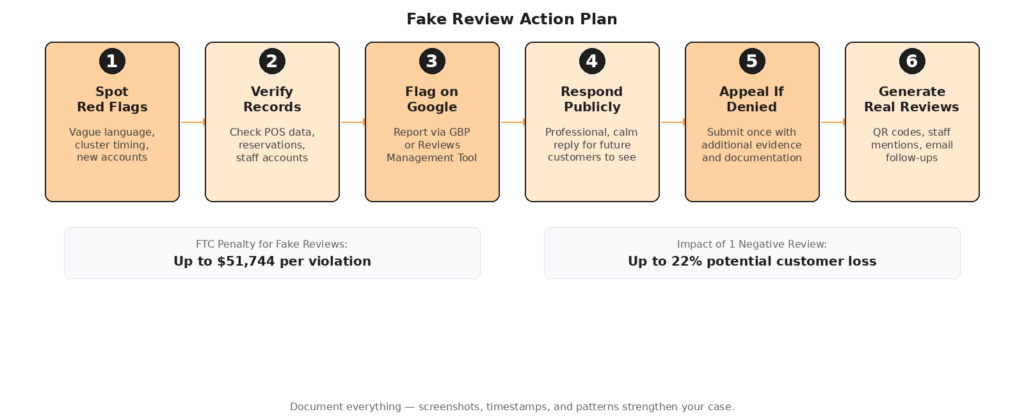
Fake reviews are a growing problem for restaurants. Whether they come from a disgruntled competitor, a bot network, or someone with a personal grudge, they can drag down your rating, scare away potential customers, and undermine years of hard work. According to research cited by Synup via Moz, just one negative review can cost a business up to 22% of its potential customers.
The good news: Google does remove fake reviews that violate its policies, and there are concrete steps you can take to speed up the process. Here’s exactly what to do.
Key Takeaways
- Not every negative review is fake — learn to distinguish genuine criticism from policy-violating content before reporting.
- Google provides a Reviews Management Tool specifically for flagging and tracking suspicious reviews — use it systematically.
- The FTC’s 2024 Consumer Review Rule makes posting fake reviews illegal, with penalties up to $51,744 per violation — a legal deterrent that’s worth knowing about.
How to Identify Fake Reviews
The first step is confirming that a review is actually fake. Google won’t remove a review simply because you disagree with it — it must violate their content policies.
Red Flags That Signal a Fake Review
| Red Flag | What to Look For | Example |
|---|---|---|
| No specific details | Review uses vague, generic language without mentioning any dish, staff member, or specific experience | “Terrible place. Worst ever. Don’t go.” |
| Cluster timing | Multiple negative reviews posted within a short window (same day or within hours) | Five 1-star reviews all posted on a Tuesday morning |
| Suspicious reviewer profile | New account, no profile photo, only one review, or reviews only for competing businesses | Account created the same day as the review, with no other activity |
| Factual impossibilities | Review mentions dishes, experiences, or staff that don’t exist at your restaurant | “The pasta was cold” — at a Chinese restaurant that doesn’t serve pasta |
| Repeated language | Multiple reviews use suspiciously similar or identical wording | Three reviews all containing the exact phrase “food poisoning experience” |
| Competitor connection | Reviewer has left glowing reviews for direct competitors | 1-star for you, 5-star for the restaurant two blocks away |
What Doesn’t Count as “Fake”
It’s important to be honest with yourself here. A review from a genuine customer who had a bad experience — even if they exaggerate or you disagree with their account — is not a fake review. Google will not remove it. Instead, your best response is a professional, empathetic reply. Check our review response templates for guidance on handling legitimate negative feedback.
How to Report Fake Reviews on Google (Step by Step)
Google provides several methods for flagging reviews. Use them in this order for the best chance of removal.
Method 1: Flag the Review Directly
According to Google’s official support documentation, you can report a review directly from your Business Profile:
Go to your Google Business Profile and navigate to your reviews. Find the fake review and click the three-dot menu (or the flag icon) next to it. Select “Report review” and choose the reason that best describes the violation — options include spam, off-topic, conflict of interest, profanity, or harassment. Submit your report. Google’s team will review it, which typically takes a few days to a week.
Method 2: Use the Reviews Management Tool
Google also offers a dedicated Reviews Management Tool that lets you track the status of reported reviews and submit new reports. This is especially useful if you’re dealing with multiple fake reviews at once. You can check whether a previously reported review is pending, approved for removal, or denied.
Method 3: Appeal a Denied Report
If Google initially declines to remove a review, you have one opportunity to appeal. Go back to the Reviews Management Tool, find the review with a denied status, and submit your appeal with additional evidence. Be specific — explain exactly which policy the review violates and provide any evidence you have (such as the reviewer having no purchase history, or the review mentioning services you don’t offer).
Method 4: Contact Google Support Directly
For coordinated attacks (multiple fake reviews at once), you can escalate through Google Business Profile Support. As Local Falcon recommends, use the “Contact us” feature in the Google Business Profile Help Center to chat with or request a call from a support agent. Have your evidence ready: screenshots, timestamps, and patterns you’ve identified across the suspicious reviews.
What to Do While You Wait for Removal
Google’s review process can take days or even weeks. In the meantime, don’t just sit idle.
Respond Professionally to the Fake Review
Even if you’re confident a review is fake, post a brief, professional response. This is for the benefit of future customers who will read the exchange. Keep it calm and factual:
“Thank you for your feedback. We take all reviews seriously. However, we’re unable to find a record of your visit. We’d appreciate it if you could contact us directly at [email/phone] so we can look into this further.”
This response accomplishes two things: it signals to other readers that something may be off about the review, and it demonstrates your professionalism. According to ReviewTrackers, nearly 45% of consumers are more likely to visit a business that responds to negative reviews — even when the review itself may be questionable.
Accelerate Genuine Reviews
The best counter to fake negative reviews is a steady stream of real positive ones. Reach out to your regular customers, use QR codes on table tents and receipts to make leaving a review effortless, and encourage your staff to mention it casually. A business with 200 genuine reviews is far more resilient to a handful of fake ones than one with only 15 reviews. As we’ve seen working with restaurant owners, the restaurants that actively generate reviews are the ones least damaged by fake review attacks.
The Legal Landscape: FTC’s Fake Reviews Rule
Fake reviews aren’t just unethical — they’re now explicitly illegal under federal law.
What the Rule Covers
The FTC’s Consumer Review Rule, which took full effect in October 2024, prohibits creating, purchasing, or selling fake consumer reviews. This applies to both fake positive reviews (boosting your own rating) and fake negative reviews (targeting a competitor). Penalties can reach up to $51,744 per violation.
In December 2025, the FTC sent its first enforcement warning letters to 10 companies under the new rule, signaling that this isn’t just on paper — active enforcement has begun.
What This Means for Restaurant Owners
If you suspect a competitor is posting fake negative reviews against your business, you now have a legal framework beyond just Google’s policies. While pursuing FTC action is complex, documenting patterns of suspected fake reviews creates a paper trail that could be valuable if the situation escalates. More practically, knowing this law exists can help you when communicating with Google support — you can note that the activity may constitute a violation of federal trade regulations.
Preventing Future Fake Review Attacks
While you can’t completely prevent fake reviews, you can build a profile that’s more resilient to them.
Build a Strong Foundation of Genuine Reviews
The math is straightforward: if you have 300 real reviews with a 4.5-star average, five fake one-star reviews barely move the needle. But if you have 20 total reviews, those same five fakes can drop you a full star. Consistent review generation through QR codes, email follow-ups, and staff encouragement is your best long-term defense.
Monitor Your Reviews Regularly
Set up Google Alerts for your restaurant name and check your review platforms at least weekly. The faster you catch fake reviews, the faster you can report them. Some restaurant owners designate a team member to monitor reviews daily — catching a coordinated attack on day one is far better than discovering it a week later after potential customers have already been scared away.
Keep Your Operations Clean
The best defense against reviews — fake or otherwise — is consistently delivering great food and service. When your operations run smoothly, your genuine review count naturally grows, your average rating stays high, and the occasional fake review barely registers as noise.
Frequently Asked Questions
How long does it take Google to remove a fake review?
Typically a few days to two weeks after you flag it. For appeals, add another week. For coordinated attacks where you’ve contacted Google Support directly, response times vary but are often faster due to the severity of the situation. Google also uses automated systems that sometimes catch and remove fake reviews without you needing to report them.
Can I sue someone for leaving fake reviews?
Potentially, yes. Under the FTC’s Consumer Review Rule, posting fake reviews is a federal violation with penalties up to $51,744 per instance. You could also pursue state-level defamation or unfair business practices claims. However, legal action is expensive and time-consuming — for most restaurants, the practical approach is to report through Google, respond professionally, and outpace the fakes with genuine reviews.
Should I buy positive reviews to offset fake negative ones?
Absolutely not. Purchasing fake positive reviews violates both Google’s policies and the FTC’s Consumer Review Rule. If caught, you risk having your Google Business Profile suspended and facing fines. The only sustainable path is generating authentic reviews from real customers.
What if Google won’t remove a review I’m sure is fake?
Sometimes Google disagrees with your assessment, and the review stays up. In this case, your professional response to the review becomes your primary defense. Future customers will see your measured, thoughtful reply and draw their own conclusions. Continue generating genuine reviews to dilute the impact of the fake one.
Protecting your online reputation is only half the battle. Capturing every customer who finds you is the other half. Tunvo’s AI voice agent answers every call — in English, Mandarin, and more — and sends orders straight to your POS. Never miss another order. Book a demo or start your 15-day free trial.