Somewhere in your order history is a customer who used to come in every week. They knew exactly what they wanted — probably the same dish, the same time, the same day. Then one week they didn’t show up. Then another. Now it’s been 30 days, and you haven’t heard from them since.
That customer probably didn’t have a bad experience. They got busy, found a closer option, tried something new, and just haven’t gotten back into the routine. The decision wasn’t permanent — but without any outreach from you, it might become permanent by default.
This is what a re-engagement campaign is designed to solve. And for restaurants, the math is compelling: attracting a new customer costs five times more than keeping an existing one. A customer who already knows your food, already has your number in their phone, and already has a positive association with your restaurant is your best marketing target — and most restaurants do nothing to actively bring them back.
Key Takeaways
- 30 days of inactivity is your re-engagement trigger — wait longer and the cost to win them back increases sharply.
- A three-message sequence (nudge → offer → last chance) converts more lapsed customers than any single message.
- A specific dollar discount outperforms a percentage discount for re-engagement offers.
- SMS should lead the sequence — email can follow with fuller content for customers who don’t respond to the text.
- The best source of re-engagement contacts is your phone order history — every customer who called to order has already proven intent.
Why 30 Days Is Your Window
Restaurant customers who order regularly — especially takeout regulars — tend to fall into predictable cycles. They order weekly, bi-weekly, or monthly based on convenience, habit, and income. A 30-day gap in ordering behavior is a meaningful signal, not just random variation.
The Decay Curve
The longer you wait to reach out, the harder re-engagement becomes. Win-back campaign research identifies three meaningful windows: 30 days (early lapse), 60–90 days (at risk), and 120+ days (churned). Re-engagement rates drop significantly at each threshold. A customer who’s been away 30 days is still thinking about your restaurant occasionally — they just haven’t gotten back into the habit. A customer who’s been away 4 months has formed new habits, and winning them back requires a much more compelling offer.
For restaurants specifically, 30 days is also roughly the average repurchase cycle for takeout regulars. A customer who typically orders every two weeks, then misses two cycles in a row, has crossed a meaningful threshold. That’s your signal to reach out.
What Causes the Lapse
Understanding why customers lapse determines how you respond. Common reasons for a 30-day restaurant dropout:
- Life got busy: A new job, a move, a family change disrupted their routine. Not a judgment of your food.
- A closer competitor: Someone opened a restaurant nearer to their home or office.
- A minor friction point: One long wait, one wrong order, one ignored phone call during a peak period.
- Price sensitivity: They’re watching spending more carefully and defaulted to cheaper options.
- Simple forgetting: The most common reason of all. They liked you. They got busy. They didn’t think about you.
The good news is that most of these causes are fixable with a well-timed, well-crafted message. “Forgetting” is the easiest one to address — you just need to show up again.
The Re-Engagement Sequence That Works
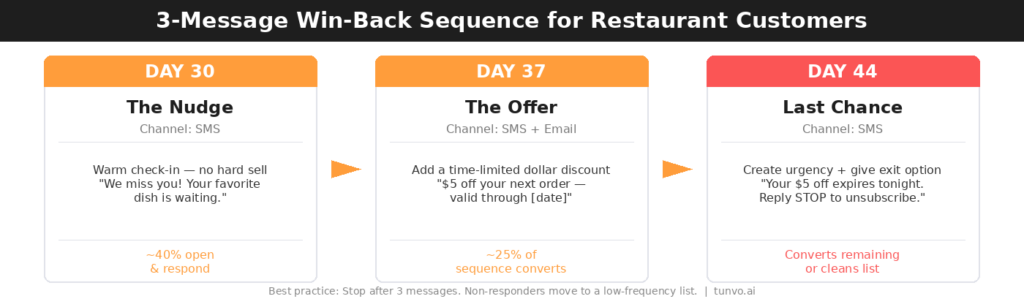
The most effective win-back campaigns use a sequence of messages rather than a single send. A three-message structure — nudge, incentive, last chance — consistently outperforms single-message approaches because it catches customers at different moments of readiness.
Message 1 — Day 30: The Nudge
The first message has one goal: remind the customer you exist. No heavy sell. No urgency. Just a warm, personal check-in that feels like it’s from a restaurant that noticed they haven’t been in a while.
“Hi [Name] — it’s been a few weeks! Come back and your favorite dish is waiting. Call us or order now: [number]. Reply STOP to unsubscribe.”
What makes this work: it mentions their “favorite dish” — which is a vague personalization that still feels personal. If you have their order history, make it specific: “your Dan Dan Noodles are waiting.” If you don’t, the general language still creates the feeling of being remembered.
Message 2 — Day 37: The Offer
If Message 1 didn’t prompt a return visit, it’s time to add an incentive. This is where the offer structure matters significantly. Research consistently shows that a specific dollar amount discount is roughly twice as effective as a percentage discount for re-engagement. “$5 off your next order” outperforms “15% off your next order” even when the dollar value is similar, because a concrete amount is instantly legible and feels more like a gift.
“Miss you! Here’s $5 off your next order — just mention this text when you call. Valid through [date]. Call us: [number]. Reply STOP to opt out.”
Keep the offer time-limited but not aggressively so. A 7–10 day window creates enough urgency without pressure. Longer than 2 weeks and the urgency dissipates; shorter than 5 days and it can feel manipulative.
Message 3 — Day 44: The Last Chance
The final message serves two purposes: it creates genuine last-chance urgency, and it gives non-responders a respectful exit. After this message, you stop the sequence — continuing beyond three messages significantly increases opt-out rates and damages your reputation with the remaining subscribers.
“Last chance — your $5 off expires tonight. If you’d like to stop receiving our texts, reply STOP and we’ll take you off. Otherwise, we hope to see you soon: [number].”
The “if you’d like to stop” line might seem counterintuitive — you’re giving them permission to leave. But it actually increases re-engagement because it frames the choice explicitly: stay and get the offer, or opt out. Customers who stay past this point without opting out are actively signaling continued interest, and your list quality improves as a result.
Offer Types That Work for Restaurants
| Offer Type | Example | Best For | Conversion Strength |
|---|---|---|---|
| Dollar discount | $5 off any order | Most customers | Highest |
| Free add-on item | Free spring rolls with next order | Customers who care about value over price | High — feels like a gift |
| Free delivery | Free delivery on next order | Customers who order delivery regularly | High — removes friction |
| Percentage discount | 15% off your next order | Higher average check customers | Medium — math is unclear to recipients |
| Loyalty bonus | Double points on next order | Active loyalty program members | Medium — only works if they’re enrolled |
| New menu teaser | “We just added [dish] — try it first” | Food-curious customers, regulars who love variety | Lower (but great for re-establishing habit) |
SMS vs. Email for Win-Back Campaigns
The channel question matters for re-engagement campaigns specifically because lapsed customers, by definition, have stopped engaging. Your best option is the channel where engagement rates are highest by default — and that’s SMS.
Lead with SMS, Back with Email
Research shows that combining SMS and email in the same win-back workflow lifts conversion by 54% compared to email alone. The pattern that works best: send the SMS first (it gets read immediately), then follow up with an email a day or two later for customers who didn’t respond to the text (email gives you more room for photos, story, and detail).
For customers where you only have an email address (no phone number), a re-engagement email sequence still delivers meaningful results. 45% of customers who receive a win-back email will open future emails from your brand — even if they don’t re-engage immediately, the message reactivates their awareness.
When to Give Up (Gracefully)
Not every lapsed customer can be won back, and aggressive pursuit can damage your relationship with those who genuinely want to move on. A standard win-back flow triggers when a customer hasn’t interacted in about three months, and the sequence should run its course — usually 3–5 messages over several weeks — before accepting that this customer has permanently churned.
Customers who don’t respond to three messages over a two-week window should be moved to a low-frequency list (once every 60–90 days maximum) rather than continuing regular sends. Continuing to message non-responders aggressively leads to opt-outs, spam flags, and degraded list quality for everyone else.
Where Your Re-Engagement List Comes From
A re-engagement campaign is only as good as your list of lapsed customer contacts. For most independent restaurants, that list comes from one of three sources.
Phone Order History
Every customer who has called to order has a phone number in your records. If you’ve been collecting numbers for loyalty or order confirmation purposes, this is your richest source of contacts. The challenge is that most restaurants store these numbers passively — in a POS system, a notebook, or a caller ID log — without any systematic tracking of last-order date.
The restaurants that do this best have a simple spreadsheet or CRM field that records the last order date for every phone customer. Once a week, they scan for anyone whose last order was 28–35 days ago and add them to the re-engagement queue. It sounds manual because it is — but it only takes 10 minutes a week for most restaurants, and the return per hour spent is very high.
This is where automating the phone order process creates a significant advantage. When every call is handled by Tunvo’s AI voice agent, every caller’s phone number is captured and associated with their order automatically — creating exactly the data foundation you need for systematic re-engagement campaigns without any manual tracking by staff.
Online Order Platforms
If you accept orders through your own website or a direct online ordering system, you likely have customer email addresses and order history accessible in your dashboard. Most platforms have a way to export customers who haven’t ordered in a given time period — check your platform’s analytics or reporting section.
Loyalty Program Enrollment
Loyalty program members are your best re-engagement targets — they’ve explicitly expressed interest in your restaurant, they’ve been rewarded for returning before, and they’re more likely to respond to a re-engagement offer. If you have an active loyalty list, run your 30-day re-engagement sweep there first before touching cold contacts.
Measuring Re-Engagement Success
Track three metrics for every re-engagement campaign:
- Re-engagement rate: Percentage of lapsed customers who placed an order within 30 days of the sequence. A healthy rate for restaurant win-back campaigns is 15–25% — if you’re getting less than 10%, your offer or timing likely needs adjustment.
- Second-order rate: Of customers who came back, how many ordered a second time within 30 days? A re-engagement that produces one order and then another lapse has limited value. The goal is to re-establish the habit, not just generate a single transaction.
- Opt-out rate per message: Monitor which message in your sequence triggers the most opt-outs. If Message 1 causes high opt-outs, your tone is off. If Message 3 spikes opt-outs, your sequence may be too aggressive. High opt-outs at Message 2 suggest your offer isn’t compelling enough to justify the outreach.
Frequently Asked Questions
How do I know which customers to target for re-engagement?
Target customers whose last order was 28–35 days ago. This is your highest-value re-engagement window — early enough that the customer still has a positive, recent memory of your food, late enough that the gap is clearly a behavior change rather than normal variation. Do not send re-engagement messages to customers who haven’t ordered in more than 6 months unless you have a very compelling offer — the opt-out rate will be high and the re-engagement rate will be low.
What’s the best time of day to send a re-engagement text?
For restaurant re-engagement texts, 11:00 am on a weekday or Saturday morning are the strongest windows. The customer sees your message at the moment they’re starting to think about meals for the day. Avoid sending after 8 pm or before 9 am — opt-out rates spike in those windows and the urgency signal gets lost.
How large a discount do I need to win back a lapsed customer?
For a $35–$45 average check, a $5 discount is typically sufficient to prompt re-engagement. You’re looking for a gift that feels meaningful, not a profit-erasing promotional price. If $5 isn’t moving the needle after two sends, try $8 or a free add-on (spring roll, drink, dessert). Escalate the offer size across the sequence rather than leading with your best deal — customers who would have come back for $5 shouldn’t be trained to wait for your best offer.
Should I ask a lapsed customer why they stopped ordering?
Only if you’re prepared to act on the answer. A short survey text — “We noticed you haven’t ordered in a while. Mind telling us why? Reply 1 for too expensive, 2 for too far, 3 for tried something new, 4 for other” — can reveal patterns you didn’t know about. But don’t ask if you’re not going to read the responses and make changes. An unanswered feedback request damages trust more than no request at all.
Is there a risk of annoying customers with re-engagement messages?
There’s a small risk, which is why the sequence structure and opt-out mechanism matter. A well-timed, three-message sequence with clear opt-out instructions generates very low complaint rates. The customers who genuinely don’t want to hear from you will opt out — and that’s a good outcome. Your list becomes cleaner, and the remaining subscribers are those who want to be reached. The risk of NOT reaching out — losing a loyal customer to habit change or competitor proximity — is significantly larger than the risk of a polite, well-structured outreach sequence.
The foundation of a re-engagement campaign is knowing who your customers are and when they last ordered. Tunvo captures every caller’s phone number automatically — building the contact list your win-back campaigns need without any extra work from your team. Learn about how Tunvo works or book a demo to see it in action.