Restaurant owners are caught between two uncomfortable realities right now. Food and labor costs keep rising — since 2019, food costs have climbed more than 35%, and labor expenses have followed a similar trajectory. But raising prices too fast, or too bluntly, risks pushing customers toward the grocery store or the competitor down the block.
The challenge is that simply matching cost increases with price increases isn’t a strategy — it’s a reaction. The restaurant owners who protect their margins through inflationary periods are the ones who reprice intentionally: using their sales data, understanding what customers will accept, and finding ways to deliver perceived value even as the numbers on the menu go up.
This guide covers the practical mechanics of repricing for inflation — the frameworks, the specific tactics, and the communication approaches that minimize customer friction.
Key Takeaways
- Food-away-from-home prices rose 3.9% year-over-year as of 2025 — well above grocery prices at 2.7%, which means customers are increasingly feeling the gap between eating out and cooking at home.
- Across-the-board price hikes are the bluntest tool — strategic repricing by item category, food cost percentage, and customer willingness to pay is more effective and less damaging to customer relationships.
- Transparency helps: surveys show that a large majority of diners prefer to be informed when prices are going up and why, rather than discovering it silently on the menu.
- Small, frequent adjustments cause less backlash than infrequent large jumps — think quarterly reviews rather than annual overhauls.
Understanding the 2026 Inflation Landscape for Restaurants
Where costs are hitting hardest
Since 2019, food and labor costs have each gone up more than 35%, while utilities and swipe fees keep climbing. For a mid-size restaurant doing $1 million a year in sales, a 5–7% rise in food and labor means $50,000–$70,000 comes straight off the bottom line if nothing is adjusted. That can collapse a margin from 5% to below 2% — the difference between a business that’s building toward something and one that’s just surviving.
The categories hitting hardest in 2025 include proteins (beef, chicken, eggs), dairy, and imported goods affected by tariff adjustments. According to the National Restaurant Association, full-service menu prices increased 4.7% year-over-year in January, while limited-service prices rose 3.2% over the same period.
What your customers already know
Your customers are not oblivious to what’s happening. According to Technomic survey data from 2025, 62% of consumers expect restaurant price increases over the coming months — almost exactly mirroring the 61% of operators who anticipate raising prices. The fact that customers are braced for increases gives you a window to adjust, but not without limit. That same survey found that 80% of consumers are concerned about the impact of rising prices on their finances.
The implication: customers will accept price increases that feel reasonable and explained. What they won’t accept is the sense that a restaurant is gouging them while the experience hasn’t improved.
The Right Way to Calculate Menu Price Adjustments
Start with food cost percentage, not gut feeling
The foundational metric for menu pricing is food cost percentage (FCP): the cost of ingredients divided by the menu price, expressed as a percentage. Most profitable restaurants maintain an FCP between 28% and 35%. When ingredient costs rise but prices don’t, FCP drifts above that range — silently eroding margin on every order.
The repricing calculation is straightforward:
New price = ingredient cost ÷ target food cost percentage
If a dish now costs $8.50 in ingredients and you’re targeting 30% FCP, the minimum viable price is $8.50 ÷ 0.30 = $28.33. Round to $28 or $29 depending on your format, and you’re protected.
Don’t treat all items equally
The most common repricing mistake is applying a flat percentage increase across the entire menu. A 10% increase on everything sends a clear signal to customers that prices jumped — and it treats your high-margin items the same as your low-margin ones, which misses the point.
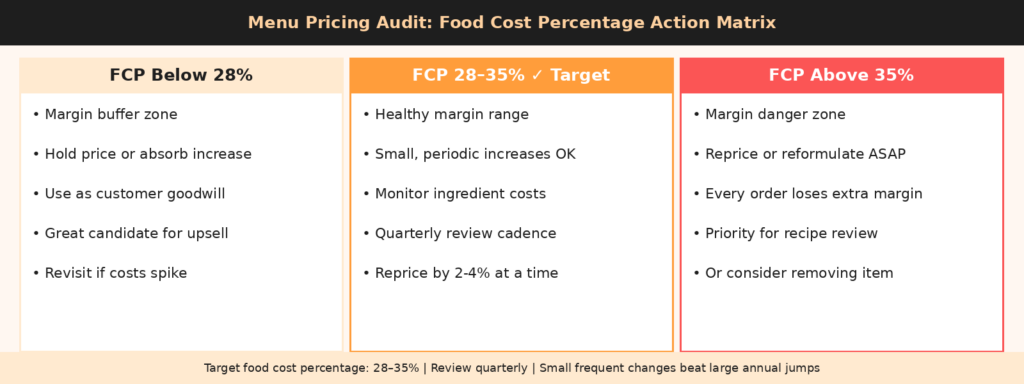
Better approach: reprice by food cost category. Items with FCP creeping above 35% need immediate attention. Items with FCP below 25% can absorb a modest price hold as a goodwill gesture to regular customers. Your highest-margin items are also where customers are most price-elastic — a $2 increase on a $32 entrée lands very differently than a $2 increase on a $10 lunch special.
| Scenario | Action | Why |
|---|---|---|
| FCP above 35% | Raise price or rework recipe to reduce cost | Every order at this margin is costing you margin |
| FCP between 28–35% | Hold or modest increase | Healthy margin — protect customer relationship |
| FCP below 28% | Opportunity to hold price or absorb increase | High-margin buffer — use as customer goodwill |
| Item with no reorder history in 90+ days | Consider removing, not repricing | Carrying cost of dead menu items adds waste |
Practical Repricing Strategies That Work
Small, frequent adjustments beat big annual jumps
Many operators are revisiting prices more frequently than they used to — some updating quarterly, while others dealing with rapid cost changes in meat, eggs, or dairy make monthly adjustments. This approach works because small changes are less jarring than large ones. A customer who sees a dish go from $14 to $14.50 every few months adapts gradually. A customer who sees it jump from $13 to $16 in one revision notices and reacts.
Use portion and recipe adjustments strategically
Not every cost increase needs to become a price increase. Many restaurants are subtly adjusting portion sizes as a way to manage rising costs without directly raising menu prices — trimming a side dish from 6 ounces to 5, for example, or using a slightly leaner protein cut. Done carefully, customers rarely notice. Done clumsily — visible reductions on the plate — it becomes a trust issue.
Recipe reformulation is a longer-term lever. Dishes built around the most volatile ingredients (beef, eggs, imported items) can be tested with substitute proteins or adjusted compositions that hold quality while reducing cost.
Bundle to create value perception
Meal bundles are one of the most powerful tools for maintaining volume during inflationary periods. Offering limited-time deals, combo meals, or prix-fixe menus creates the perception of value while still maintaining profitability, because the bundle price anchors expectations while the restaurant controls which items are included and at what margins.
A family pack or dinner-for-two bundle that combines high-margin items with popular staples gives customers a “deal” that’s engineered to be profitable, not a discount that eats into margin.
How to Communicate Price Changes Without Losing Customers
Be direct and brief
The research on customer responses to price increases is consistent: transparency reduces backlash. According to a Toast survey, 70% of consumers prefer restaurants to communicate when they’re raising prices — and 49% believe raising prices due to economic factors is justified. Customers who understand why the price went up are less likely to feel cheated than customers who simply notice the menu has changed without explanation.
A brief note on your menu, a line in a text to regulars, or a social post explaining that ingredient costs have risen and you’re adjusting prices while maintaining quality — these small acts of communication go a long way. You don’t need to publish a detailed breakdown. Just acknowledge it.
Protect your core items
Every restaurant has a handful of items that define what you are to regulars — the dish people come back for, the thing they tell friends about. These items deserve extra thought before repricing. Upscale venues often use price anchoring — placing a very high-priced item near other dishes to make them seem more reasonable. The same principle applies in reverse: a beloved signature dish held at a familiar price point functions as an anchor that makes surrounding price increases feel less drastic.
Technology’s Role in Smarter Repricing
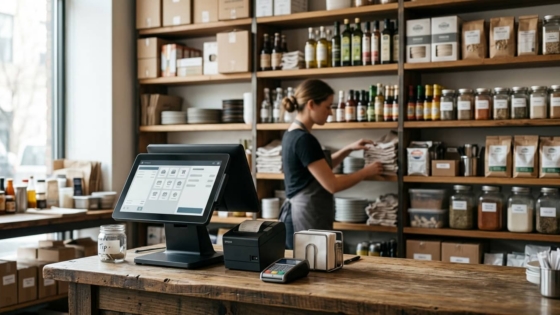
The restaurants handling inflation best in 2026 aren’t doing it purely on instinct — they’re using their POS data. Sales velocity, contribution margin by item, and food cost percentage tracked over time give you the numbers to make repricing decisions with confidence rather than anxiety.
Understanding your real cost-per-order also extends to how orders come in. Phone orders that go unanswered during peak hours represent direct revenue lost — and that lost revenue can be just as damaging as thin margins on a high-cost dish. Restaurants using AI voice agents during peak periods report capturing order volume that previously went to voicemail or competitors, which adds revenue without requiring a price increase.
Frequently Asked Questions
How often should I review and update my menu prices?
Quarterly is a reasonable cadence for most independent restaurants. High-volatility ingredient categories — beef, eggs, dairy — may warrant monthly monitoring even if you only update prices quarterly. The goal is to catch margin erosion early rather than reacting to a crisis at year-end.
How much can I raise prices before customers notice or push back?
Research suggests that a 1% price increase can reduce customer ratings by up to 5%, so there’s real sensitivity here. Small, frequent changes — in the 2–4% range per adjustment — tend to be absorbed better than large one-time jumps. Context matters too: a restaurant with a strong reputation, distinctive food, and excellent service can command more pricing flexibility than one competing primarily on low price.
Should I use a different pricing strategy for dine-in versus takeout?
Many restaurants already do this implicitly, charging slightly more for third-party delivery to offset platform commissions. For phone and in-house orders — where you keep the full margin — capturing every call and converting it to an order is at least as important as the price on the menu. A phone order you miss costs you the full ticket value.
What’s the risk of not adjusting prices when costs rise?
Mathematically, it’s severe. For a restaurant doing $1M in annual sales, a 5% cost increase with no price adjustment means $50,000 less profit — enough to turn a slim profit into a loss. Most restaurants can absorb a quarter of slow adjustment, but beyond that the compounding effect becomes a real threat to viability.
When margins are tight, every order counts. Tunvo’s AI voice agent answers every phone call in English and Mandarin — capturing the orders that would otherwise go unanswered during peak hours. Start your 15-day free trial or book a demo to see how it works.