Food costs are the largest controllable expense in most restaurant operations, typically running 28–35% of total revenue according to the National Restaurant Association. For a Chinese restaurant doing $1.5 million in annual revenue, that’s $420,000–525,000 per year going to ingredient costs alone. A 5% reduction in those costs — entirely achievable through better supplier negotiations — translates to $21,000–26,000 in recovered margin annually.
Most restaurant owners know they should negotiate more aggressively with their suppliers. Most don’t, because they assume they lack leverage, don’t know what to ask for, or don’t want to risk disrupting a supply relationship they depend on. This guide addresses all three concerns with specific, practical tactics that work — even for small independent operators without national chain purchasing power.
Key Takeaways
- Your biggest negotiation leverage is the volume you’re willing to commit — not how hard you push. Suppliers respond to consolidation offers and volume commitments, not pressure.
- Requesting a market basket report is the single most important first step — it reveals what you’re actually paying on key SKUs compared to market rates, giving you concrete data to negotiate from.
- Markup percentage and margin percentage produce different costs for the same product — always negotiate for markup percentage, which is calculated from the supplier’s cost, not margin percentage, which is calculated from the selling price.
- Reducing delivery frequency saves your distributor money — and you can negotiate that saving back.
- Early payment is a powerful, underused negotiation chip that most distributors will reward with better pricing.
Before You Negotiate: Understand Your Position
The foundation of any successful supplier negotiation is knowing your own numbers. A supplier’s sales rep will have visibility into your purchase history — volume, frequency, product mix — and will use that data in any conversation about pricing. You need to have that same data, and you need to have done the homework on what comparable operators are paying.
Step 1: Pull Your Purchase History
Before approaching any supplier, compile a 12-month summary of your purchases: total spend by supplier, top 20–30 SKUs by volume, average weekly spend per distributor, and current price-per-unit on your highest-volume items. This data is your baseline. Without it, you’re negotiating by feel; with it, you’re negotiating with numbers that both parties can reference. Food Market Hub’s analysis notes that suppliers are less likely to raise prices unfairly when they know an operator tracks every change — the act of having clean purchase data signals that you’re a professional buyer, not someone who can be quietly increased.
Step 2: Request a Market Basket Report
A market basket report lists 20–30 of your key ingredients with estimated price benchmarks across distributors. According to JES Restaurant Equipment’s industry guide, requesting market basket reports from multiple distributors is the standard way to compare base prices across options — and to identify which specific items your current distributor is pricing above market. You can request a market basket report from any Sysco or US Foods account rep; for Restaurant Depot comparisons, use their in-store pricing on your top SKUs.
Step 3: Know What Other Operators Are Paying
The most actionable competitive intelligence comes from other restaurant owners in your network. Lavu’s industry guides identify peer-to-peer pricing conversations as one of the most effective tactics available to independent operators — because if you know that a nearby Chinese restaurant is paying $X for a case of cooking oil from the same distributor, you have a concrete reference point to bring to your own negotiation. The NYC Chinese restaurant community in Queens and Brooklyn is connected enough that these conversations happen regularly among owners who trust each other.
The Seven Negotiation Tactics That Actually Work
1. Consolidate Volume With a Single Distributor
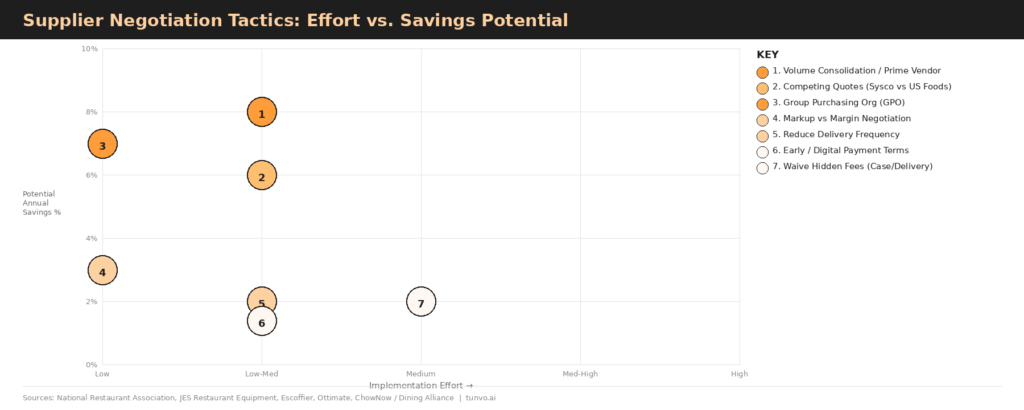
This is the highest-leverage tactic available to small operators. Escoffier’s analysis and Ottimate’s vendor strategy research both converge on the same finding: consolidating 80–90% of your purchases with a single broadline distributor, and communicating that consolidation as a commitment in exchange for improved pricing, consistently produces the best results. Distributors want reliable, high-volume accounts with predictable ordering patterns. When you offer that, you move from “just another customer” to a relationship worth protecting with competitive pricing. The standard prime vendor agreement structure offers you lower fixed margins on all ingredients in exchange for exclusive business at a defined weekly minimum.
2. Use Competing Quotes as Leverage — But Do It Honestly
Get a competing quote from another distributor on the same basket of items, and share it with your current distributor. The goal is not to bluff or threaten — it’s to create honest competitive pressure. As one PMQ industry forum discussion documented, even a Sysco regional manager acknowledged they offer lower margins on accounts that actively compare prices with US Foods. The mechanism works because distributor account reps have pricing flexibility that they use selectively for accounts that demonstrate price sensitivity. You access that flexibility by showing you’ve done the homework.
3. Negotiate Markup Percentage, Not Margin Percentage
This is a technical distinction that most restaurant owners don’t know about, and it costs them money. When a distributor applies a markup percentage to a product that costs them $100, you pay $120 at a 20% markup. When they apply a margin percentage to get a 20% profit margin on the same $100 product, you pay $125 — because margin is calculated from the selling price, not the cost. JES Restaurant Equipment specifically advises operators to negotiate for markup percentage because it is always the cheaper structure from the buyer’s perspective. When reviewing or negotiating contract terms, ask specifically: “Is this structured as markup or margin?”
4. Reduce Delivery Frequency in Exchange for Better Pricing
Every delivery costs your distributor money — truck time, driver labor, fuel, administrative overhead. If you can receive fewer deliveries per week by improving your storage capacity and inventory management, you reduce the distributor’s cost of serving your account. Industry practice consistently shows this as a viable negotiation trade: commit to two deliveries per week instead of three, and ask for a corresponding price reduction that reflects the savings. This works best once you have FIFO and par levels established, so you’re confident that reducing delivery frequency won’t create availability gaps.
5. Offer Faster Payment Terms
Most broadline distributors operate with net-30 or net-45 payment terms, but Days Sales Outstanding on those invoices can stretch to 80 days when mail delays and manual processing are factored in, according to Ottimate’s research on vendor payments. Distributors value prompt payment highly — it reduces their credit risk and improves their own cash flow. Offering net-10 payment terms, digital ACH payment instead of mailed checks, or even prepayment on a portion of your order can unlock price concessions that wouldn’t be available through product-only negotiations.
6. Negotiate Non-Price Terms That Have Monetary Value
Price per unit isn’t the only dimension of a supplier contract with financial impact. According to Restaurantware’s contract negotiation guide, the following contract terms frequently produce monetary savings that rival price reductions: waived broken case charges for partial quantities of low-volume specialty items; waived delivery minimums during slow seasons; clear substitution and return policies that protect you when delivered products don’t meet spec; and fuel surcharge caps or elimination for accounts above a defined weekly minimum. Each of these clauses is negotiable during the onboarding process or contract renewal, and the aggregate value of favorable terms can easily match a 2–3% price reduction on the product itself.
7. Join a Group Purchasing Organization (GPO)
ChowNow’s supplier relations team and Catersource’s 2024 negotiation analysis both highlight GPOs as the most effective option for small operators who lack the time or volume for individual negotiations. A Group Purchasing Organization aggregates the buying power of thousands of food service businesses to negotiate pricing that no individual restaurant can access. Membership is typically free for qualifying businesses, and the pricing benefits apply immediately across hundreds or thousands of line items from national distributors. The tradeoff is reduced flexibility — GPO pricing usually involves commitment to specific products at specific distributors — but for commodity staples with no preference for brand or source, GPO pricing consistently beats individually negotiated rates.
What to Say: Conversation Starters for Each Tactic
Knowing the tactics is one thing; knowing how to open the conversation is another. Here are specific openers that work in practice:
| Tactic | Conversation Opener |
|---|---|
| Volume consolidation | “I’m currently splitting my dry goods between you and Restaurant Depot. If you can match their pricing on these 10 SKUs, I’ll consolidate everything with you at approximately $X weekly.” |
| Competing quote | “I’ve been getting quotes from US Foods and your prices on cooking oil and rice are about 8% higher. Can we align on pricing before my contract renewal?” |
| Market basket report | “Can you send me a market basket report on my top 25 items? I want to review the pricing before our next renewal conversation.” |
| Delivery frequency | “I’m improving my storage and can go from three deliveries a week to two. What does that look like in terms of pricing adjustment?” |
| Payment terms | “I can move to net-10 digital payment if we can adjust pricing by 1–2% to reflect the reduced collections risk for you.” |
| Hidden fees | “I noticed we’re being charged broken case fees on three items we order weekly. Can we get those waived at our current volume?” |
When to Negotiate and How Often
The best time to negotiate a new supplier relationship is during the onboarding process, before you’ve committed any volume. Once you’re in the system and ordering regularly, your leverage for initial terms decreases — the supplier already has your business. The second-best time is at contract renewal, typically annually. And the third-best time is any moment when you have a competing quote in hand and your rep knows it.
For ongoing price management, Catersource recommends reviewing invoices at the end of each quarter specifically for price changes on high-volume SKUs. Broadline distributors adjust commodity prices regularly based on market fluctuations, and those adjustments aren’t always communicated proactively. Reviewing quarterly keeps you aware of trends before they compound into significant cost increases.
The Connection Between Demand Data and Negotiation Power
Here’s something most supplier guides don’t mention: your ability to make credible volume commitments in a negotiation depends on knowing your actual demand with precision. If you don’t have reliable sales data across all your order channels — including phone orders, which for many NYC Chinese restaurants represent a significant portion of total volume — your volume estimates are approximations, not data. An approximation is a weak negotiating position; a data-backed commitment is a strong one.
Phone orders that are manually taken and not properly entered into your POS create gaps in your demand picture. When Tunvo’s AI voice agent handles those calls and routes orders directly to your MenuSifu POS, every phone order becomes part of your accurate sales record — giving you the full-channel demand data that makes supplier negotiations credible and specific. See how Tunvo works for Chinese restaurants →
Frequently Asked Questions
Will pushing for better pricing damage my relationship with my supplier rep?
Not if you approach it as a business conversation based on data rather than a confrontation. Experienced supplier reps expect operators to negotiate — it’s part of their job to manage pricing relationships. Framing the conversation around data (your purchase history, market basket comparisons, competing quotes) and offering something in return (volume commitments, payment term improvements) keeps the discussion professional and leaves room for a mutually beneficial outcome. The reps who react negatively to professional pricing discussions are usually not the reps you want managing your account long-term.
How much can I realistically save through negotiation?
For an independent restaurant working without prior negotiation history, a realistic first-year improvement of 5–10% on broadline distributor costs is achievable through the combination of volume consolidation, competing quotes, and payment term negotiation. On a restaurant spending $400,000 annually with broadline distributors, that’s $20,000–$40,000 in recovered margin per year. More sophisticated tactics — prime vendor agreements, GPO participation — can push this higher over time.
What is a prime vendor agreement?
A prime vendor agreement is a contract with a broadline distributor in which you commit to purchasing 80–90% of your food and supply needs from that distributor in exchange for lower fixed margins across your entire product mix. The restaurant’s biggest bargaining chip in this arrangement is the total volume committed — the more product you promise to buy exclusively, the better the margin structure the distributor will offer. Most national broadline distributors have structured prime vendor programs; ask your account rep specifically about prime vendor terms rather than waiting for them to be offered.
Is it worth negotiating with local distributors or just national broadline suppliers?
Local distributors respond well to negotiation on delivery terms, case minimums, and flexibility around specialty items — areas where national distributors are less flexible. The pricing dynamic is different: local distributors typically operate on tighter margins than national broadlines, so aggressive price negotiations are less productive and risk damaging relationships that provide value through service quality rather than price alone. The most productive approach with local distributors is to negotiate for service terms — broken case availability, delivery windows, substitution policies — while using national distributors as your primary price negotiation target.
Better supplier negotiations start with better demand data. When Tunvo’s AI voice agent routes every phone order to MenuSifu, your full-channel sales history becomes the foundation for volume commitments you can actually back up. Set up in 30 minutes.