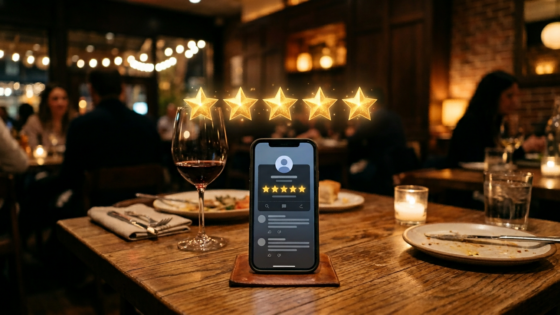
Every week I visit restaurants across New York — talking to owners, watching how their phones ring, seeing how their dining rooms fill up or go quiet. One question comes up more than any other: “How do I get more Google reviews without bothering my customers?” The answer is simpler than most people think, but it requires you to stop treating reviews as a marketing task and start treating them as part of the hospitality you already deliver.
Here’s the reality: 46% of diners check Google Reviews first when researching a restaurant, making it twice as popular as Yelp. And restaurants that fall below a 3.5-star rating lose a significant share of would-be customers before those diners ever walk through the door. Your Google rating isn’t just a vanity number — it’s the first impression you make on every person who searches for your cuisine in your neighborhood.
Key Takeaways
- The best time to ask for a review is immediately after a positive moment — not at the end of every meal.
- Making the process frictionless (QR codes, direct links) roughly doubles your conversion rate on review requests.
- Responding to every review, including the bad ones, signals to Google that your business is active and trustworthy.
- Review recency matters as much as volume — a slow trickle of new reviews beats a one-time burst followed by silence.
Why Google Reviews Matter More Than Ever in 2026
Local search has become the primary battleground for restaurant discovery, and Google reviews sit at the center of it. 93% of diners check Google before choosing a restaurant, and the star rating is typically the first thing they see. But reviews do more than influence customer opinion — they directly shape your visibility in local search results.
Reviews Are a Local Ranking Signal
Google’s local algorithm weighs three core factors: relevance, distance, and prominence. Prominence is directly affected by customer interactions like clicks and calls, which in turn are driven by your review profile. More reviews — especially recent ones — signal to Google that customers are actively engaging with your business. That engagement pushes you higher in the local pack and on Google Maps.
Review recency is a frequently overlooked factor. Case studies from local SEO researchers show that when review velocity drops off, rankings can follow. A restaurant that collected 50 reviews two years ago and has received none since is at a disadvantage against a competitor with 30 reviews but a steady stream of new ones each month. Aim for consistency: a few reviews every week is better than 20 in January and zero in March.
The “Prompted Review” Advantage
Most owners assume that happy customers will naturally leave reviews. They won’t — at least not without a nudge. Research shows that 68% of customers only leave a review when prompted, meaning that if you’re not asking, you’re missing out on two-thirds of your best advocates. The good news is that prompted reviews tend to be more positive: happy customers forget; frustrated ones don’t.
The Right Way to Ask: Timing, Tone, and Channel
The single biggest mistake restaurant owners make is asking for reviews at the wrong moment — handing a receipt to a customer who is distracted, rushing out, or whose experience was only average. The ask should follow a clear positive signal.
Ask at the Peak Moment, Not at the End
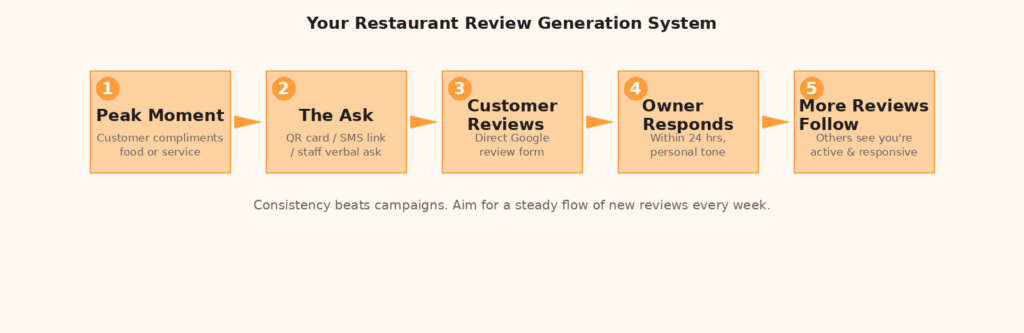
Train your staff to recognize the moments when a customer is genuinely happy: they compliment the dish, they ask for the recipe, they say “we’ll definitely be back.” That’s the window. A natural, conversational request — “It would really help us if you could share that on Google” — converts far better than a generic “please leave us a review” on a printed receipt. The experience is fresh, the emotion is high, and the ask feels like a continuation of the conversation rather than a transaction.
For takeout and phone orders, the timing shifts slightly. The peak moment is right after the food arrives, not right after the order is placed. An SMS follow-up 45 minutes after a pickup order — with a direct review link — captures customers while they’re still eating and feeling good about their decision.
Make It Frictionless
The number one barrier to leaving a review isn’t reluctance — it’s friction. A customer who has to search for your restaurant on Google, find the review button, and navigate through three screens will give up halfway. Remove every obstacle you can.
The most effective tools are simple and cost almost nothing. A QR code on your table tent, the back of your receipt, or the takeout bag links customers directly to your Google review form. No searching, no navigating — one scan and they’re writing. Update the card design seasonally to keep it feeling fresh. You can generate a direct Google review link from the “Get more reviews” section of your Google Business Profile dashboard, and it works on any device.
Which Channel Works Best?
| Channel | Best For | Tips |
|---|---|---|
| Table QR card (dine-in) | Dine-in guests at peak satisfaction | Place near the check, refresh design monthly |
| Receipt QR code (takeout) | Takeout regulars, first-time orderers | Add a simple handwritten note for VIP feel |
| SMS follow-up | Phone and online order customers | Send 30–60 min after pickup/delivery |
| Staff verbal ask | Customers who express satisfaction out loud | Train staff to recognize the right moment |
| Instagram / WeChat | Regulars who already follow you | Link in bio, ask in stories occasionally |
What Not to Do (And Why It Backfires)
Never offer discounts or free food in exchange for a review. Google’s guidelines prohibit incentivized reviews, and the platform actively filters them out — which means you lose the review and potentially face profile penalties. Buying fake reviews is worse still. Even well-intentioned “review swap” arrangements with other businesses violate Google’s terms and can damage your standing in local search results. The only reviews that compound your ranking are the authentic ones from customers who genuinely enjoyed their experience.
The Hidden Review Source: Your Phone Orders
Most review strategies focus on dine-in guests — the customers sitting in front of you, easy to engage, easy to hand a QR card. But for many Chinese restaurants in New York, phone orders represent a significant share of daily revenue. These customers are invisible in most review funnels. Nobody hands them a table tent. Nobody gives them a receipt with a QR code.
That’s a missed opportunity that compounds over time. A customer who orders by phone two or three times a week is one of your most loyal advocates — but they’re never asked to share their experience. Capturing that review requires a system: either an SMS follow-up linked to your phone ordering workflow, or a printed review card included with every takeout bag.
When your phone line is answered consistently — every call, even during the Friday rush — it also sets up a better experience worth reviewing. Customers who have to call five times before getting through are not going to leave you a 5-star rating. At Tunvo, we’ve seen this pattern repeatedly: restaurants that miss fewer calls during peak hours see better post-experience sentiment, because frustration at the ordering stage never gets attached to the food.
Responding to Reviews: The Step Most Owners Skip
Getting reviews is only half the job. Responding to them — all of them — is what converts a good review profile into a trustworthy one. A Yelp survey found that 70% of people who read reviews say they’re more likely to write one if they see the business owner responding. Your responses are not just for the reviewer — they’re public signals to every future customer who reads that thread.
Responding to Positive Reviews
Don’t ignore the good ones. A brief, specific response — mentioning something from the review itself — tells the customer they were actually heard. It also demonstrates to Google and to future readers that your business is active and engaged. Keep it warm but short: three sentences is usually plenty.
Responding to Critical Reviews
A 1- or 2-star review feels personal. It isn’t. Respond within 24 hours, keep your tone professional, acknowledge what the customer experienced, and offer a path forward. Don’t argue facts in a public forum. If there’s a legitimate complaint — a wrong order, a slow table, a cold dish — acknowledge it briefly and invite the customer back. Many owners who respond well to negative reviews find that the original reviewer edits their rating upward.
The customers watching your response matter more than the reviewer. They’re asking: “If something goes wrong when I visit, will this restaurant handle it professionally?” Your public reply is your answer. For more on managing negative feedback across platforms, see our guide to building a resilient restaurant reputation.
Building a Review System, Not a One-Time Campaign
A burst of reviews in one week followed by nothing is worse than a slow but consistent stream. Google’s algorithm values freshness, and so do customers who filter by “most recent.” The goal is to build review generation into your daily operations — not to run a campaign once a quarter and hope for the best.
Assign one person — a manager, a front-of-house lead — to check and respond to reviews at least twice a week. Make QR review cards part of every table setting and every takeout order. If you send order confirmation texts, add a review link to your follow-up message. Once these steps are routine, reviews accumulate without you having to think about them.
Frequently Asked Questions
How many Google reviews does a restaurant need to rank well?
There’s no magic number, and it varies heavily by neighborhood and cuisine category. More important than total count is the combination of volume, average rating, and recency. A restaurant with 80 reviews and a steady flow of new ones each month will typically outrank a competitor with 200 reviews and none in the past year. Start by aiming to be in the top quartile for your immediate local area — check where your direct competitors stand and set your target from there.
Can I ask customers by phone to leave a review?
Yes, though it’s less effective than a direct link. If you take phone orders, a brief verbal ask at the end of the call — “If you enjoy the food, we’d love a quick Google review” — combined with a follow-up SMS with a direct link is the most effective phone-order approach. The link does the heavy lifting; the verbal ask plants the idea.
Is it against Google’s rules to remind customers about reviews?
No. Google’s own guidelines encourage businesses to ask customers for honest reviews. What’s prohibited is incentivizing positive reviews (discounts, gifts) or discouraging negative ones. Asking naturally and making the process easy is not only permitted — it’s the recommended approach.
What should I do about a fake negative review?
If you believe a review is fake or violates Google’s policies (written by a competitor, contains false claims, or isn’t from an actual customer), you can flag it for removal through your Google Business Profile. In the meantime, respond calmly and professionally as if you’re addressing a real customer — future readers don’t know the backstory, but they will notice how you handle it.
Every missed call is a missed opportunity — not just for revenue, but for a potential 5-star review. Tunvo’s AI voice agent answers every call, takes orders in English and Mandarin, and sends them straight to your MenuSifu POS. Try it free →
Start This Week
You don’t need a marketing budget to start collecting more 5-star Google reviews. You need a QR code, a review link, and a staff member who knows when to make the ask. Set those three things up this week. Respond to every review you’ve received in the past 30 days. Then let the system run. The reviews will come — consistently, authentically, and in a volume that moves your ranking over the next few months.
If you want to close the one gap that keeps happy phone-order customers invisible in your review funnel, book a demo with the Tunvo team to see how our AI voice agent can improve the ordering experience from the very first ring.