Every week, a handful of customers order from your restaurant two or three times. They know exactly what they want, they don’t haggle over prices, and when their food is ready, they’re already at the door. These are your most valuable customers — and most restaurants do almost nothing to keep them coming back.
A well-designed loyalty program for takeout customers doesn’t have to be complicated or expensive. In our conversations with restaurant owners across New York, the ones running the simplest programs — a text-based points system, a consistent “10th order free” deal — consistently outperform those waiting to build a full app. The research backs this up: loyalty program members visit restaurants 20% more frequently and spend 20% more per visit than non-members. For a takeout-heavy restaurant, that’s the difference between a one-time order and a customer who calls you every Friday night.
This guide walks you through everything you need to start a loyalty program this week — no app required.
Key Takeaways
- A loyalty program doesn’t need an app or special software to work — a phone number and a simple SMS tool is enough to start.
- The most important metric isn’t signups — it’s how often enrolled customers actually come back.
- Takeout-specific perks (free delivery, priority pickup, order-ahead discounts) outperform generic discounts because they match how takeout customers actually behave.
- Capturing a phone number at pickup is your highest-leverage move — it unlocks every future marketing touchpoint at near-zero cost.
Why Takeout Customers Need Their Own Loyalty Strategy
Dine-in loyalty and takeout loyalty are not the same thing. A dine-in guest lingers — there’s ambient loyalty built into the experience. A takeout customer places an order, picks it up in three minutes, and gets back to their life. If you don’t give them a reason to choose you again next Tuesday, they’ll default to whoever shows up first on Google Maps.
The Takeout Loyalty Gap
Most restaurant loyalty programs were designed around table visits. They assume customers will download an app, log in, and scan a QR code at the register. Takeout customers don’t have that patience. 53% of customers want a loyalty program that is easy to use, and nearly 40% want it to be easy to understand — which means complexity kills enrollment before it starts.
The good news: takeout customers are already in a transactional mindset. They’re not there for ambiance — they’re there to get food and go. A program that rewards that transaction directly (your 10th order is free, or you earn points every time you call to order) fits perfectly into that pattern without requiring behavioral change.
What the Numbers Say About Retention
Restaurant customer retention sits at roughly 55% on average industry-wide — well below the 75% benchmark seen in other consumer sectors. Worse, about 70% of first-time restaurant guests never return. For a takeout operation, that’s devastating, because takeout traffic is already transactional by nature.
Flip those odds slightly, and the math gets compelling fast. Repeat customers generate up to 10x more revenue over their lifetime than one-time visitors. A customer who orders $35 of takeout every Friday for two years is worth over $3,600 in total. Losing that customer to a competitor who offered them a stamp card costs you more than any single promotion you’ll ever run.
Choosing the Right Loyalty Format for Your Restaurant
There are three realistic formats for independent takeout restaurants. Here’s how they compare:
| Format | Setup Cost | Data You Capture | Best For | Main Weakness |
|---|---|---|---|---|
| Paper punch card | ~$30–$80 (printing) | None | Restaurants with no tech setup | Cards get lost; no way to follow up |
| Phone number + SMS | $20–$60/month (SMS tool) | Phone number, order history | Most takeout restaurants | Requires opt-in and basic tracking |
| POS-integrated loyalty | $50–$200+/month | Full order history, spend, frequency | Restaurants with high volume or multiple locations | More expensive; requires staff training |
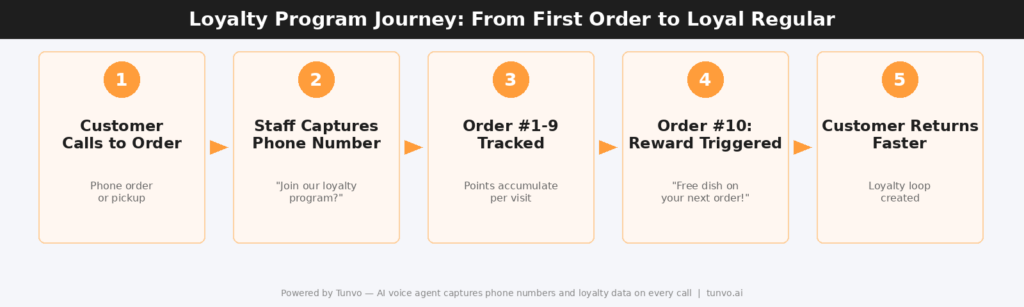
The 5-step loyalty journey for takeout customers — from first call to reward redemption and repeat order.
The Case for Starting with SMS
For most independent takeout restaurants — especially Chinese, Korean, and Japanese spots where phone ordering is still the dominant channel — an SMS-based program is the sweet spot. It costs very little, captures the most valuable thing you can get from a new customer (their phone number), and gives you a direct line to reach them again. The shift from paper punch cards to phone-number-based digital programs is happening across the industry — even small independent operators are making the move because the value difference is clear once you see it in action.
Here’s the simplest version of an SMS loyalty program that works:
- When a customer calls to order, ask: “Can I grab your phone number to add you to our loyalty program? Every 10 orders, you get a free dish.”
- Write it down or enter it in a simple spreadsheet. Mark each order.
- When they hit their 10th order, send a text: “Hi [Name], you’ve earned your free dish! Just mention this text on your next order.”
- Optional: Once a month, text your list a special deal. “Friday only — 15% off all takeout orders. Reply STOP to unsubscribe.”
That’s it. No app. No points software. A $25/month SMS tool and a spreadsheet is enough to get started.
When to Graduate to a POS-Integrated System
If you’re doing more than 200 orders a week, manually tracking loyalty in a spreadsheet will become a headache. That’s when a POS-integrated loyalty module earns its cost. It connects customer phone numbers directly to orders, auto-awards points, and triggers texts without anyone on your staff having to remember. The tradeoff is cost and setup time — but for high-volume operations, it pays for itself quickly.
Designing a Loyalty Reward That Actually Works
Most loyalty programs fail not because of the technology, but because the reward isn’t compelling enough to change behavior. A 2% discount is forgettable. A free dish after 9 orders feels like a genuine win.
The Psychology of the Right Reward
The best loyalty rewards share three traits: they’re attainable (customers can actually reach the threshold), they’re valuable (the reward feels worth the effort), and they’re specific to your product (not a generic dollar discount, but a dish the customer already loves).
For takeout, the most effective rewards tend to be:
- A free entrée after a set number of orders (the classic “10th order free”)
- Free delivery on the next order after reaching a spend threshold
- A bonus item added automatically to the 5th order (e.g., a free spring roll)
- Early access to new menu items for loyalty members
- Priority pickup during peak hours (no waiting in line)
That last one is underused and often more powerful than a free dish. If your restaurant gets slammed on Friday nights and takeout customers know there’s a 20-minute wait, a “loyalty member priority pickup” lane is worth more than any coupon. It doesn’t cost you anything extra — it just rewards the people who already love you with the one thing they actually want: their time back.
Setting the Right Threshold
For an average check of $35–$45, a “10 orders for a free entrée” structure makes the math work: you’re giving away roughly 10% of one order’s value every 10 orders. That’s a 1% cost rate against the retention value of those 10 repeat purchases. Research shows that 64% of loyalty program members actively spend more per order to maximize their points earnings — meaning the threshold itself changes how much customers spend per visit.
Building Your Loyalty List: Getting Phone Numbers at Pickup
The entire system depends on one thing: capturing phone numbers. This is where most restaurants fail — not in the program design, but in the collection step. Here’s how to make it natural.
The Pickup Moment Script
Train every staff member on one short script at the pickup counter. Something like:
“Are you in our loyalty program? Every 10 orders, you get a free dish — we just need your phone number to track it.”
Keep it short. Don’t over-explain. Most people say yes immediately, especially regulars. For customers who hesitate, a quick reassurance — “We only use it for your rewards and the occasional special offer” — usually closes it.
The QR Code Shortcut
Print a small sign or sticker at your counter with a QR code that opens a Google Form with two fields: name and phone number. Customers can sign themselves up while waiting for their food. This removes the staff burden entirely and actually increases signups at busy restaurants where staff don’t have time to manually ask every customer.
Keeping Customers Engaged After Signup
Signing up is not loyalty. The goal is to create a pattern of return visits. Once you have a customer’s number, the cadence of your follow-up determines whether they become a regular or forget you exist.
A Simple Monthly Message Calendar
You don’t need to message customers every week. In fact, over-messaging is the fastest way to lose subscribers. A simple monthly calendar looks like this:
- Week 1: A welcome message confirming enrollment and their current points status
- Week 3: A promotion tied to a specific day or event (“This Saturday only — free soup with any order over $30”)
- Milestone: An automated message when they’re 2 orders away from their reward (“You’re almost there — 2 more orders and your free dish is ready!”)
That’s three touch points a month — enough to stay top-of-mind without annoying anyone. The milestone message is the most powerful of the three because it creates urgency without being promotional. It tells the customer something they actually want to know.
The Tunvo Angle: Capturing Loyalty Data Through Phone Orders
One friction point most takeout restaurants face: when a customer calls to order, there’s no automatic way to link that call to their loyalty profile. Staff are juggling the order itself — confirming items, handling modifications — and asking “are you in our loyalty program?” often gets lost in the rush.
This is where an AI voice agent changes the equation. When every call is handled consistently, the system can ask for and confirm a caller’s phone number every time — linking the order to their loyalty record without staff having to remember. Every phone order becomes a loyalty data point, and no customer falls through the cracks during a Friday rush. If you’re building out your takeout loyalty infrastructure, Tunvo’s AI voice agent handles the phone order flow so your team can focus on the counter — and every caller gets the loyalty enrollment prompt, every time.
Measuring Whether Your Program Is Working
Most restaurant owners track loyalty program membership. That’s the wrong metric. The number of signups tells you nothing about whether the program is actually driving repeat business — databases routinely have 75% of members who haven’t ordered in a year. The metric that matters is engaged member frequency: how often your active members are ordering compared to before they joined.
Three Numbers to Track Monthly
- Loyalty order rate: What percentage of your total orders are from loyalty members? A healthy program should represent 25–40% of order volume within six months.
- Average order value, members vs. non-members: Loyalty members should be spending more per order. If they’re not, your reward threshold might be too low to change behavior.
- Return rate after reward redemption: Do customers come back after they redeem a free dish? If they don’t, the program creates one-time behavior, not a habit.
Track these monthly in a simple spreadsheet. You don’t need analytics software to spot the patterns.
Common Mistakes Takeout Restaurants Make with Loyalty Programs
Making It Too Complicated
A points system where 1 dollar = 1 point, 500 points = a $5 discount, but only on orders over $25, excluding alcohol, and not combinable with other offers — is not a loyalty program. It’s a math test. Keep the structure so simple that your customer can explain it back to you in one sentence.
Forgetting to Promote It
If your loyalty program isn’t mentioned on your menu, your bags, your receipt, and your counter, nobody knows it exists. A program nobody knows about is a program that doesn’t work. Put it everywhere.
Stopping at Signup
Enrollment is not retention. According to Deloitte’s research, 67% of loyalty members belong to two or more programs — meaning your customer is also enrolled in your competitor’s program. The restaurants that win loyalty aren’t the ones with the best signup offer. They’re the ones who stay in touch, consistently deliver value, and make members feel like insiders rather than database entries.
Frequently Asked Questions
Do I need an app to run a loyalty program for my restaurant?
No — a phone number list and a basic SMS tool is enough to run an effective takeout loyalty program. Many independent restaurants start with a spreadsheet to track orders and a simple SMS platform to send reward notifications. Apps add features but also add friction, and most independent takeout customers won’t download an app for a single restaurant. Start simple, and upgrade once you have 200+ active members.
How many orders should trigger a loyalty reward?
A threshold of 8–12 orders is the standard range for most takeout loyalty programs. At 10 orders, you’re giving away roughly 10% of one check’s value every 10 visits — a 1% cost rate that most restaurants easily absorb. Go lower than 8 and the math hurts your margins; go higher than 12 and customers lose motivation before reaching the reward.
What’s the best reward for takeout customers specifically?
Free food tied to your menu — a free entrée, a free side dish, or a free add-on — outperforms generic dollar discounts for takeout customers. The reward should feel like the restaurant is saying “this one’s on us,” not like a coupon clipping exercise. Priority pickup (getting their order ready ahead of the queue) is a powerful non-food reward that costs nothing but has high perceived value during busy hours.
How do I collect phone numbers without it feeling awkward?
Train staff on one short script: “Are you in our loyalty program? We just need your number.” Most customers say yes, especially regulars. A QR code on the counter linking to a short sign-up form also works well for self-service enrollment during busy periods. The key is making it feel like an offer, not a form they have to fill out.
What should I do if my loyalty program isn’t getting redemptions?
Low redemption usually means one of three things: the threshold is too high, customers forgot they were enrolled, or they don’t know how to redeem. Fix it by: lowering the threshold to 8 orders, sending a monthly “you’re at X orders, Y more until your reward” reminder, and making redemption frictionless (just mention this text, no card needed). Simplicity drives redemption more than any promotional offer.
Every missed call is a missed opportunity to add a new loyalty member. Tunvo answers every call and connects directly with your MenuSifu POS — so your team captures phone orders and loyalty signups even during the Friday rush. Book a Demo or Start Your 15-Day Free Trial.