Most restaurant team meetings fail before they start — because they don’t start at all. The daily urgency of running service, managing inventory, and putting out fires makes it easy to skip the meeting, again, and assume everyone already knows what they need to know. But a restaurant that never pauses to align is a restaurant where mistakes repeat, resentment builds, and small problems snowball into big ones.
The fix isn’t long corporate-style meetings with PowerPoint slides. It’s short, structured, focused conversations that happen consistently. In our work with restaurant owners across New York, the ones who run regular team meetings — even just 10 minutes before a shift — consistently report fewer order errors, better morale, and smoother service. Here’s how to run meetings that your team actually values.
Key Takeaways
- Keep meetings under 15 minutes and focused on three things: what’s happening today, what went wrong recently, and what’s changing.
- Pre-shift huddles (5–10 minutes daily) are more effective than monthly all-hands meetings for most restaurants.
- In multilingual kitchens, use visual aids, bilingual leads, and demonstration over lecture.
Why Restaurant Meetings Are Different
You Can’t Stop Service for a Meeting
In an office, you block 30 minutes on the calendar and everyone shows up. In a restaurant, you can’t close the kitchen for a team discussion. This single constraint shapes everything about how restaurant meetings must work: they need to be short, they need to happen at transition points (pre-shift, post-shift, between lunch and dinner), and they can’t require everyone’s simultaneous attendance. The Society for Human Resource Management emphasizes that meeting effectiveness correlates strongly with brevity and focus — a principle that applies doubly in high-pace environments.
Your Team Is Diverse — In Every Way
A typical New York restaurant kitchen might include staff who speak English, Mandarin, Cantonese, Spanish, and Fujianese — sometimes within a single shift. Educational backgrounds, work experience, and communication styles vary enormously. Effective restaurant meetings account for this diversity by using clear, simple language, visual demonstrations, and bilingual team leads who can translate key points. Meetings that work for a corporate sales team will fail spectacularly in a kitchen.
The Three Types of Restaurant Meetings
Type 1: Pre-Shift Huddle (Daily, 5–10 Minutes)
This is the most important meeting format for restaurants and the one most owners skip. Gather the team 5–10 minutes before service starts. Cover three things and only three things: today’s specials or 86’d items, any VIP reservations or large parties, and one operational reminder (a cleaning task, a new procedure, a customer complaint to address). Keep it standing. Keep it fast. End with a positive note — acknowledge something someone did well yesterday.
The pre-shift huddle works because it’s short enough that people don’t resent it, frequent enough that information stays current, and predictable enough that it becomes habit. After two weeks of consistent huddles, your team will start showing up on time for them without being asked.
Type 2: Weekly Team Check-In (15–20 Minutes)
Once a week, hold a slightly longer meeting — typically on your slowest day, before the shift starts. This meeting covers the week’s performance (sales, customer feedback, any incidents), the coming week’s schedule and events, and one learning topic (a new menu item, a procedure update, a food safety refresher). Bring a written agenda — even a handwritten list on a notepad — so you stay focused and finish on time.
Type 3: Monthly All-Hands (30–45 Minutes, Maximum)
Once a month, gather the full team — both shifts, FOH and BOH. This is your big-picture meeting: how the restaurant is performing, what’s changing, and what the team should be proud of. This is where you announce menu changes, introduce new equipment or processes, address systemic issues, and recognize outstanding work. Pay your team for this time — asking people to attend an unpaid meeting breeds resentment faster than anything else.
| Meeting Type | Frequency | Duration | Focus |
|---|---|---|---|
| Pre-Shift Huddle | Daily | 5–10 min | Today’s specials, 86’d items, one reminder |
| Weekly Check-In | Once/week | 15–20 min | Performance review, schedule, one learning topic |
| Monthly All-Hands | Once/month | 30–45 min | Big picture, menu changes, recognition, systemic issues |
Running an Effective Pre-Shift Huddle: A Template
The 3-3-1 Format
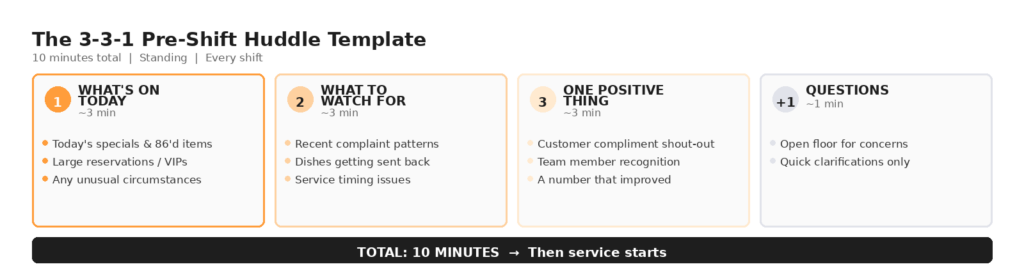
Keep every pre-shift huddle to three sections, three minutes each at most, plus one minute for questions. First, cover what’s on today: specials, large reservations, any menu items that are unavailable, and any unusual circumstances (a private event, a health inspection, a VIP). Second, cover what to watch for: a customer complaint pattern to correct, a dish that’s been getting sent back, or a service timing issue. Third, share one positive thing: a compliment from a customer, a team member who went above and beyond, or a number that improved. Then one minute for questions.
This format works because it’s predictable. After a few days, your team knows the structure and can absorb the information quickly. The positive close matters more than it seems — research on workplace engagement from Gallup consistently shows that employees who receive regular recognition are significantly more engaged and less likely to quit.
Where to Hold It
Stand near the pass (the area between the kitchen and the dining room) or at the host stand. Standing meetings are faster than seated ones. Don’t hold meetings in the walk-in or the office — you want the physical space to signal “this is quick, we’re about to work, let’s go.”
Handling Language Barriers in Meetings
Use Bilingual Team Leads
If your kitchen staff speaks primarily Mandarin or Cantonese and your front-of-house speaks English, designate a bilingual team lead for each language group. Have them translate the key points during the huddle — not every word, just the three main takeaways. This is faster and more effective than trying to run the entire meeting in two languages yourself.
Visual Aids Over Verbal Instructions
A whiteboard with today’s specials, a printed photo of the new menu item, or a simple diagram of a new plating style communicates across language barriers instantly. For recurring information — your 86 list, daily cleaning assignments, station responsibilities — use a whiteboard in the kitchen that’s updated before every shift. Several restaurant owners we’ve spoken with have switched to using photos and simple icons on their boards, which works better than text for multilingual teams.
Demonstrate, Don’t Lecture
If you’re introducing a new dish or a new procedure, show it. Physically plate the dish while the team watches. Walk through the new process step by step. One demonstration is worth ten minutes of verbal explanation — regardless of what language you’re speaking. The National Restaurant Association Educational Foundation training programs have long emphasized hands-on demonstration as the most effective training method in commercial kitchens.
Common Meeting Mistakes to Avoid
Making It a Monologue
If you’re the only one talking for 15 minutes, it’s a lecture, not a meeting. Ask at least one question that requires a response: “What was the biggest issue on the line last night?” or “Does anyone have a concern about tonight’s reservation count?” The goal is a two-way exchange, even if brief.
Not Following Through
If you raise an issue in a meeting and then don’t follow up, your team learns that meetings are performative — talk without action. Keep a simple running list of issues raised in meetings and check them off as they’re resolved. Even crossing items off a whiteboard list is a powerful visual signal that meetings lead to results.
Skipping When You’re Busy
The busiest days are the days you need the huddle most. A two-minute huddle that covers today’s reservation count and the one thing everyone needs to watch for is infinitely more valuable than skipping it because “there’s no time.” Make it non-negotiable. The Harvard Business Review has published extensive research showing that short, consistent team check-ins outperform longer, sporadic meetings across virtually every industry and team size.
Letting It Run Long
Set a timer on your phone. When it goes off, wrap up. Every minute past the scheduled end teaches your team that your meetings don’t respect their time. If a topic needs more discussion, table it and schedule a separate conversation with the relevant people. Respect the clock and your team will respect the meeting.
Technology That Supports Better Meetings
Shared Digital Boards and Messaging
A shared WhatsApp group, a Slack channel, or even a shared Google Doc can serve as an ongoing record of what was covered in meetings, what changed, and what’s coming up. This is especially valuable for staff who missed the meeting — they can check the group and get caught up in 30 seconds. For Chinese restaurant teams, WeChat groups often serve this function naturally.
Reducing Meeting Load With Automation
Part of what makes pre-shift meetings necessary is the need to communicate rapidly changing information — today’s specials, order patterns, customer preferences. The more of this information that’s automatically tracked and accessible, the shorter your meetings can be. For example, when phone orders are handled by an AI voice agent that syncs directly with your POS, your team doesn’t need a verbal briefing on phone order volume or patterns — it’s already in the system. This frees meeting time for the human-judgment topics: service quality, team dynamics, and problem-solving.
Frequently Asked Questions
How often should a restaurant hold team meetings?
Daily pre-shift huddles (5–10 minutes) are the most impactful and should be non-negotiable. A weekly 15–20 minute check-in on your slowest day keeps the bigger picture in focus. A monthly all-hands (30–45 minutes) covers strategic updates and recognition. Most restaurants benefit from this three-tier rhythm without it feeling like meetings are consuming operational time.
What do I do if my team doesn’t participate in meetings?
Start by making meetings shorter, not longer. A team that doesn’t engage is usually a team that’s experienced too many unfocused, rambling meetings. Use the 3-3-1 format consistently for two weeks before judging engagement. Ask specific people direct questions rather than open-ended group questions. Recognize contributions publicly. And make sure meetings lead to visible outcomes — nothing kills participation faster than the feeling that meetings don’t change anything.
How do I handle meetings with a multilingual team?
Designate bilingual team leads who translate the three key takeaways after you present them. Use visual aids — whiteboards, photos, diagrams — for recurring information. Demonstrate new procedures physically rather than describing them verbally. Keep written summaries in multiple languages posted in the kitchen. And keep language simple: short sentences, no idioms, no jargon.
The less time your team spends relaying phone order details, the more time you have for what matters. Tunvo’s AI voice agent handles every call — in English, Mandarin, and more — and sends orders straight to your POS, so your team can focus on service. See pricing or try it free for 15 days →