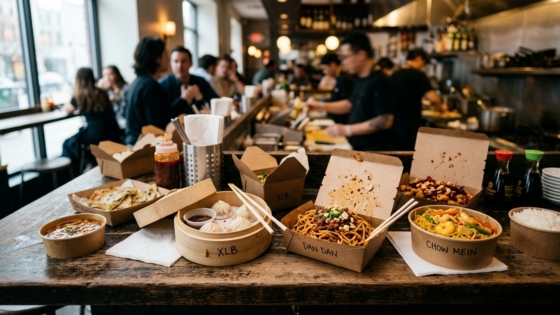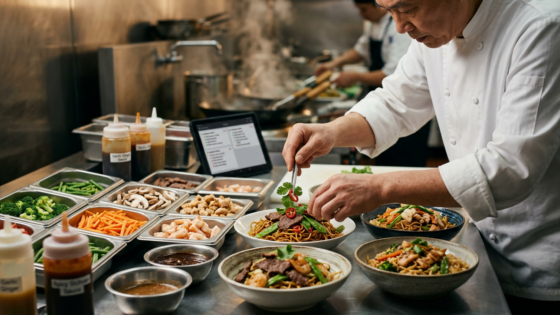
This is the question that stops more restaurant owners from trying voice AI than any other. Not the setup complexity. Not the cost. The specific, practical worry: “My menu is complicated. We have customers asking for no MSG, less oil, extra scallions on the side, make that medium spicy instead of hot — can an AI actually handle all of that correctly?”
It’s the right question to ask. Modifier handling is where the gap between a good voice AI and a mediocre one becomes most visible. For a Chinese restaurant on MenuSifu — with its layered modifier groups, multilingual item names, combo customization, and the particular ways Chinese-American diners phrase their requests — the bar is genuinely high. This article explains exactly how modern LLM-based AI handles modifier complexity, what MenuSifu’s own data structure contributes to the accuracy, and where the real limits are.
Key Takeaways
- Modern LLM-based voice AI handles complex modifiers far better than older ASR+NLP systems — the technology has fundamentally changed in the last two years.
- MenuSifu’s modifier structure is a constraint that actually helps: the AI works within your defined modifier groups rather than accepting arbitrary instructions.
- Chinese restaurant modifier patterns — spice level, oil amount, allergen exclusions, substitutions — are well within current AI capability when the system is purpose-built for this market.
- The AI confirms the full order including modifiers before sending it to MenuSifu, giving the customer a chance to correct anything before it becomes a kitchen ticket.
- Genuine limits exist: extremely complex multi-item orders with cascading modifications are escalated to a human, and that’s the right call.
Why Modifier Handling Is Harder Than It Looks
The Specificity of Chinese Restaurant Modifiers
American fast-casual menus have a relatively constrained modifier vocabulary. Size (small/medium/large), protein choice, a few add-ons. Chinese restaurant menus operate differently. A customer might request: “I want the braised fish, but can you use less oil? And make it not too spicy — my daughter doesn’t like spicy. Oh, and can I get steamed rice instead of fried rice with that? And extra sauce on the side.” That’s four separate modifier decisions in a single sentence, some of which are substitutions (steamed rice instead of fried rice) and one of which is a degree modification (not too spicy, which maps to a spice-level modifier).
These requests aren’t unusual — they’re exactly how regular customers at Chinese restaurants tend to order, especially customers who know the menu well and trust the restaurant to accommodate them. A staff member who knows the menu handles this fluently. The question is whether an AI can do the same.
Why Old-Generation AI Failed at This
The previous generation of restaurant voice AI was built on a pipeline: Automatic Speech Recognition (ASR) converted speech to text, Natural Language Processing (NLP) extracted intent from that text, and a rules engine matched the extracted intent to menu items and modifiers. Each step introduced potential errors, and the rules engine was the limiting factor. It could only match modifier requests to patterns it had been explicitly trained to recognize. “Less oil” works. “Not so greasy” doesn’t — because the rules engine sees a different phrase, even though the intent is identical.
Complex or phrased-differently modifier requests fell through the gaps in these rule systems constantly. The result was either a wrong modifier (the AI picked the closest match and confirmed it confidently), an awkward clarification loop (the AI asks “could you say that differently?”), or a complete failure (the AI escalates to a human for a request that should have been routine). Restaurant owners who tried early-generation voice AI and found it disappointing were usually experiencing exactly this problem.
Why LLM-Based AI Is Different
Large language models approach modifier understanding differently. They don’t pattern-match against a fixed list of recognized phrases. They understand the semantics of a request — what the caller means, not just what words they used. “Not too greasy,” “light on the oil,” “easy on the oil,” and “less oil please” are all recognized as the same modifier request, because an LLM understands the underlying concept, not just the surface phrasing.
This semantic understanding is especially valuable for Chinese-American restaurant customers, who often mix English and Chinese phrasing, use colloquial shortcuts (“can you make it the way you usually make it for me?”), or express modifications through negatives (“I don’t want it too salty”). An LLM handles these formulations naturally because it was trained on real human language, not a curated list of valid modifier phrases.
As restaurant AI specialists at Checkmate have noted, LLMs are particularly strong at understanding vague requests like “I want the spiciest flavor” and accurately recording the order — eliminating scenarios where a caller’s intent gets lost in translation between how they said something and what the AI expected to hear.
How MenuSifu’s Modifier Structure Helps AI Accuracy
Defined Modifier Groups as a Guardrail
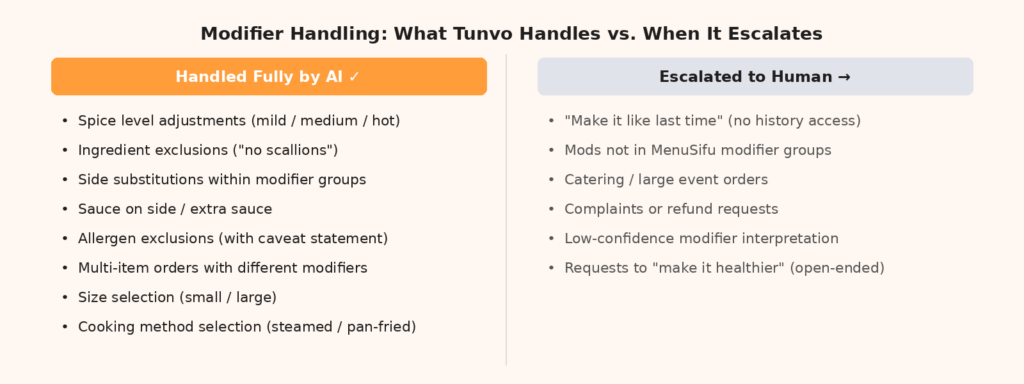
Here’s a counterintuitive point about modifier handling: the AI being constrained by your MenuSifu modifier groups is a feature, not a limitation. When Tunvo reads your MenuSifu menu, it imports not just item names and prices, but the complete modifier group structure — which modifiers exist, which items they apply to, and whether they’re required or optional. The AI can only confirm a modifier that exists in your MenuSifu configuration for that item.
This means the AI won’t take an order for a modification your kitchen can’t fulfill. If a caller asks for “gluten-free noodles” on a dish that doesn’t have a gluten-free noodle option in your MenuSifu modifier groups, the AI will politely explain that the option isn’t available for that dish — not because it’s being unhelpful, but because it’s working within your actual menu. This protects your kitchen from receiving tickets with impossible instructions and protects you from the customer service problem of a caller expecting a modification you didn’t actually commit to.
MenuSifu’s Multi-Step Modifier Support
MenuSifu’s menu management system is designed for exactly the modifier complexity that Chinese restaurant menus require. The platform supports multi-step customization for combos and build-your-own dishes, with the ability to handle ingredient adjustments, open-food items with custom pricing, and preference notes like “no scallions” or “less oil.” This is the same modifier structure that Tunvo reads. The depth and correctness of what Tunvo can handle on a phone call is directly tied to the depth of what you’ve configured in MenuSifu.
A restaurant that has configured its MenuSifu modifier groups thoroughly — with proper spice-level tiers, protein substitution options, sauce-on-side choices, and allergen-relevant exclusions — gives Tunvo’s AI a rich dataset to work from. A restaurant where modifiers were configured minimally at setup will see the AI’s handling be correspondingly simpler. The investment in good MenuSifu modifier configuration pays off across all channels.
Walking Through Real Modifier Scenarios
Spice Level Modifications
Spice-level requests are among the most common modifier patterns at Chinese restaurants. “Not too spicy,” “extra hot,” “medium spice,” “spicy but not crazy,” and “mild please” all need to map to the right spice level in your MenuSifu modifier group. Tunvo handles these by combining LLM semantic understanding with your MenuSifu spice-level options. If your menu has three spice levels (Mild, Medium, Spicy), the AI maps the caller’s expressed preference to the closest option and confirms it explicitly in the order read-back. “I have that as Medium spice — is that right?” The caller can confirm or correct before the ticket goes to the kitchen.
Allergen and Ingredient Exclusions
Allergen exclusions — no peanuts, no shellfish, no gluten where possible — are handled with particular care by a well-designed voice AI. These aren’t just preference modifications; for some callers, they’re health requirements. Tunvo handles allergen exclusions by recording them accurately as modifier notes, but also by not overpromising. If a caller says “I’m allergic to peanuts,” the AI acknowledges the request and records it, but also recommends they verify directly with restaurant staff for dishes where cross-contamination may be a concern. This isn’t a limitation — it’s the appropriate level of care for a request that carries real health implications.
Substitutions: “Instead Of” Requests
Substitution requests are where older AI systems broke down most consistently. “Can I get steamed rice instead of fried rice?” requires the AI to understand that the caller is replacing a default item in a combo with an alternative. This works in Tunvo when the substitution exists as a modifier option in your MenuSifu configuration — for example, if your combo modifier group includes both “Steamed Rice” and “Fried Rice” as options. The AI confirms the substitution in the read-back, the ticket reflects the correct option, and the kitchen sees exactly what to prepare.
Multi-Item Orders with Different Modifications
A caller ordering for a family might want: “The spicy beef for my husband, extra sauce, and for me the steamed fish — but very light cooking, no soy sauce. And two orders of dumplings, one steamed, one pan-fried. Oh, and a large soup.” This is a genuinely complex order with different modifications on different items, a split modifier on the dumplings, and a size specification. Tunvo handles this by processing each item as a separate ordered unit, confirming modifications item by item, and doing a full read-back of the complete order before sending it to MenuSifu. The read-back is the catch-all: if anything was missed or misunderstood, the caller corrects it before the ticket is generated.
Where the Limits Are — And Why That’s Okay
When the AI Should Escalate
Honest voice AI design includes knowing when not to handle a call. Tunvo is configured to escalate when modifier complexity exceeds a confidence threshold — when the AI isn’t sure it has understood a modification correctly, it asks a clarifying question rather than guessing. If a caller’s request requires several rounds of clarification and confidence remains low, the call is transferred to a staff member who can handle it directly.
This escalation is the right behavior. A confident wrong answer — the AI saying “got it, extra spicy” when the caller said “not spicy” — is worse than an escalation. The goal isn’t zero escalations; it’s escalations only when they’re actually warranted, with routine orders handled fully by AI. For a typical Chinese restaurant, that means the vast majority of calls complete without escalation, and the ones that do escalate are the complex situations where a human genuinely adds value.
The Open-Ended Custom Request
Some modifier requests fall outside what any structured menu system can capture. “Can you make it the way you made it for me last time?” requires customer history lookup. “Can you make it a little healthier?” is an intent that doesn’t map to a specific modifier without further clarification. In these cases, Tunvo asks a clarifying question to convert the open-ended preference into a specific, actionable modifier. If clarification doesn’t resolve the request into a menu-valid option, the call escalates.
Improving AI Modifier Performance: What You Can Control
Configure Your MenuSifu Modifier Groups Completely
The single most impactful thing you can do to improve Tunvo’s modifier handling is to ensure your MenuSifu modifier groups are complete and correctly configured. If spice level is a common request for a dish, that dish should have a spice-level modifier group in MenuSifu with clearly labeled options. If customers frequently ask to substitute one side for another, those substitution options should be set up as modifier variants rather than handled through freeform notes. The more of your common modifier patterns that are explicitly structured in MenuSifu, the more the AI can handle with high confidence.
Use Clear Modifier Labels
Modifier labels that make sense to a customer are more useful to the AI than internal shorthand. “Spice Level: Mild / Medium / Spicy” is better than “SL1 / SL2 / SL3.” “No MSG” is better than “NM.” The AI connects what a caller says to what your MenuSifu modifier is labeled — clear, customer-facing labels make that connection more reliable. This is also good practice for your kiosk and online ordering channels, where customers select modifiers directly.
Review Your Call Logs for Modifier Patterns
Tunvo’s dashboard includes call transcripts and order logs. After your first week or two of live calls, review the escalated calls to identify which modifier requests triggered handoffs. A pattern of the same type of request escalating repeatedly is a signal to add that modifier to your MenuSifu configuration. Once the modifier exists in MenuSifu and Tunvo reads it, those same requests become handleable by AI on subsequent calls. The system improves as your menu configuration improves.
Frequently Asked Questions
Can the AI handle “no MSG” requests correctly?
“No MSG” is handled correctly as a modifier note when it exists as an option in your MenuSifu modifier configuration. For restaurants that have set up an MSG preference modifier (or equivalent), the AI records the request and confirms it in the order read-back. For restaurants that haven’t configured a formal modifier for this but where it’s a common request, the AI can capture it as a general order note — though this depends on how your MenuSifu is set up to handle open-text notes on tickets.
What if a customer requests a modification mid-order — after already specifying several items?
Mid-order changes are handled by the AI’s conversational context management. If a caller says “actually, can you change the first item to no spice?” after already moving on to a second item, the AI backtracks in context and applies the change to the correct item. The order read-back at the end covers the full order including any mid-conversation changes, so the caller can verify everything before the ticket is sent.
Does the AI handle Chinese-language modifier requests?
Yes. In bilingual mode, Tunvo handles modifier requests expressed in Mandarin, including common Chinese restaurant phrasing for adjustments like less spice, less oil, extra portion, and no particular ingredients. The AI maps these to the corresponding MenuSifu modifier options using its bilingual understanding — the same semantic flexibility it applies in English applies in Chinese.
What’s the accuracy rate for AI modifier handling on real calls?
Tunvo’s overall order accuracy — including modifier capture — is 95%+ for routine orders, according to Tunvo
. Complex orders with multiple cascading modifications have a higher escalation rate, which is by design. The goal is that escalated calls are genuinely complex, and that the 95%+ of routine modifier requests are handled with full accuracy and confirmed with the caller before the ticket is sent. Restaurants using Tunvo report a meaningful reduction in kitchen errors on phone orders compared to staff-taken calls, because the AI’s confirmation process catches mistakes before they become tickets.
Complex menus are exactly the use case voice AI was built to solve — because the modifier complexity that makes phone orders hard for a rushed staff member is exactly what a patient, consistent AI handles without breaking a sweat. Start your 15-day free trial and test your most complex modifier scenarios on your own MenuSifu menu. Or book a demo and we’ll walk through your specific menu with you.