You’ve put everything into your restaurant — the recipes, the hours, the staff you trained yourself. Then one Tuesday morning you open Yelp and see a 1-star review. The food was “mediocre,” the service was “rude,” and the reviewer has clearly never eaten real Cantonese cuisine in their life. The first instinct is to defend yourself. The right instinct is to pause, take a breath, and respond with precision.
In my work visiting restaurants across New York and talking to owners about what actually drives customers away, Yelp reviews come up constantly — both as a pain point and, for the owners who handle them well, as an unexpected marketing asset. Research shows that 94% of people say they’ve avoided a business because of poor online reviews, and 22% won’t visit a restaurant after reading just one negative review. The stakes are real. But the response strategy is learnable.
Key Takeaways
- Respond to every negative review — quickly, professionally, and specifically. Speed matters.
- Your response is written for future customers, not just the reviewer who complained.
- You cannot delete a legitimate negative Yelp review, but you can make it irrelevant through volume and response quality.
- A common trigger for bad reviews is an operational failure — like a missed call — not just a bad meal.
Why Bad Yelp Reviews Hurt More Than You Think
Yelp is the second most-used review platform after Google, and it has an outsized influence in specific contexts: food delivery decisions, first-time visitors researching a neighborhood restaurant, and younger diners browsing by cuisine. According to BrightLocal research, the share of consumers using Yelp to evaluate local businesses more than doubled between 2020 and 2022, and that number has continued to grow.
For Chinese restaurants specifically, Yelp reviews carry additional weight because a meaningful portion of your potential customers are discovering you for the first time through the platform — people who don’t have a Chinese friend or family member to recommend a spot, and who rely on crowd-sourced ratings to feel confident trying a new cuisine. A negative review that goes unanswered sends a particular signal to this audience: that no one is minding the store.
The 3 Types of Bad Yelp Reviews
Not all negative reviews are the same, and your response strategy should differ by type. Getting this wrong — treating a legitimate complaint like a troll attack, or vice versa — can make things significantly worse.
| Review Type | Signs | Response Strategy |
|---|---|---|
| Legitimate complaint | Specific details, consistent with operational issues you recognize | Acknowledge, apologize, address the root cause, invite them back |
| Misunderstanding | Factual inaccuracies, wrong expectations about cuisine or pricing | Clarify gently without condescending; provide context for future readers |
| Bad-faith / troll | No detail, repeat negatives across many businesses, conflict of interest | Respond briefly and professionally; flag to Yelp if policy violation |
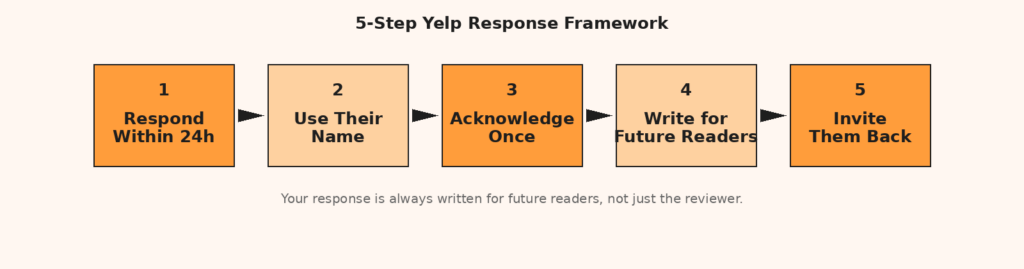
The Response Framework: Five Steps That Work
The following framework applies regardless of review type. Adjust the tone based on what you’re dealing with, but keep the structure consistent.
Step 1: Respond Within 24 Hours
Speed is not just courtesy — it’s strategy. Reviews that go unanswered for days or weeks signal to future readers that the business is unresponsive. A prompt reply shows you’re paying attention and you take customer experience seriously. Set up Yelp notifications on your phone or assign a manager to check Yelp every morning — missing a review for a week is almost as bad as not responding at all.
Step 2: Use Their Name, Reference Their Experience
A generic “We’re sorry to hear about your experience” response tells every future reader that this is a copy-paste. Effective responses use the reviewer’s name and reference at least one specific detail from their review. If they mentioned the mapo tofu was too oily, mention the mapo tofu. If they said the wait was long on Saturday, acknowledge that Saturday dinner service is your busiest hour. Specificity communicates that a real person read the complaint.
Step 3: Acknowledge Without Excessive Apology
Apologize once, clearly, and move on. Excessive apology (“We are so sorry, we feel terrible, we cannot believe this happened…”) comes across as either insincere or defensive. The goal is to acknowledge the customer’s experience as valid — even if you disagree with the interpretation — and to signal that you’ve taken it seriously. Then explain what you’re doing about it, briefly.
Step 4: Write for Future Readers, Not Just the Reviewer
This is the mindset shift that separates owners who are good at reputation management from those who aren’t. The person who wrote the review is unlikely to change their mind based on your response. But the 50 people who read that thread next month will form an impression of your restaurant based on how you handled it. Keep that audience in mind: they’re looking for evidence that you’re a professional operation that cares about customers and handles problems gracefully.
Step 5: Invite Them Back (Where Appropriate)
For legitimate complaints — especially ones where you know something went wrong — a sincere invitation to return, with a specific offer (“please ask for the manager on your next visit and we’ll take care of you personally”), can turn a negative into a recovered relationship. TouchBistro’s reputation management research shows that a small goodwill gesture combined with a genuine apology can not only win back the customer but also prompt them to update their review.
The Review That’s Actually About Your Phone
In my conversations with Chinese restaurant owners across New York, one category of bad review comes up more often than any other: reviews that aren’t really about the food at all. They’re about the phone. “Called three times, no one picked up.” “Phone was always busy when I tried to order.” “Had to use Grubhub instead because I couldn’t reach them.”
These reviews are frustrating because they feel unfair — your dumpling chef is excellent, but someone is leaving you 2 stars because the Friday rush made your phone line a bottleneck. And the reviewer isn’t wrong. Their experience was poor. The fix isn’t in how you respond to the review; it’s in eliminating the operational failure that caused the review in the first place.
When a restaurant’s phone gets answered on every call — during peak hours, after closing, in English and Mandarin — these reviews simply stop appearing. The experience that would have produced the complaint never happens. Tunvo’s AI voice agent was built specifically to close this gap: every call answered, every order captured, zero missed calls during the dinner rush.
What You Cannot Do: Yelp’s Rules
A few things restaurant owners try that reliably make the situation worse.
You Cannot Delete a Legitimate Negative Review
Yelp will only remove a review if it explicitly violates their content guidelines: it contains a conflict of interest (written by a competitor or former employee with disclosed bias), it includes content about a completely different business, or it contains prohibited content like personal attacks or private information. Simply being a negative review is not grounds for removal — even if you believe it’s unfair. Report only reviews that actually violate Yelp’s policies.
You Cannot Offer Incentives to Remove Reviews
Offering a free meal or discount to a reviewer in exchange for removing or changing their review violates Yelp’s terms. Even if the customer agrees, Yelp actively monitors for this behavior and can penalize your business profile. If you want to invite a dissatisfied customer back, do it publicly in your response — not through a private quid pro quo arrangement.
Don’t Argue Facts in Public
Even when a reviewer is wrong — even when their facts are demonstrably incorrect — a public fact-fight looks bad to every bystander. If you need to correct a factual misunderstanding, do it once, gently, in your response. Then offer a path forward. Future readers watching the exchange will judge you by your composure, not by who wins the argument.
The Long Game: Diluting Bad Reviews with Good Ones
The best defense against a negative review isn’t a perfect response — it’s making that review less visible by generating more positive ones. A single critical review among ten will stand out, but when you have 30 reviews, that critical one loses its impact. Consistent review generation — a QR code on every table, an SMS follow-up for phone orders, a staff verbal ask at the right moment — is the most effective long-term strategy for keeping your Yelp profile healthy.
Want a simple framework for generating more reviews consistently? See our guide on building a restaurant reputation system that works whether you’re running a small takeout shop or a full-service dining room.
Frequently Asked Questions
How fast should I respond to a bad Yelp review?
Within 24 hours whenever possible. If you can respond within a few hours, even better — it demonstrates active management. Set up Yelp notifications so you see reviews as they come in. For a restaurant with limited staff time, assign the review responsibility to whoever opens in the morning.
What if the reviewer is clearly lying or writing about the wrong restaurant?
If the review contains false factual claims or appears to be about a different business, you can flag it to Yelp for review. In the meantime, respond professionally and note briefly — for future readers — that the details described don’t match your records: “We don’t recognize this experience and would love to look into it — please contact us directly so we can understand what happened.” This protects your reputation with readers without getting defensive.
Should the owner respond, or a manager?
For Chinese restaurants where the owner is closely involved, an owner response carries significant weight — it signals personal accountability. Research shows that responses from owners or senior leadership are perceived as more sincere than those from generic “Management” accounts. As your business grows and volume increases, a trained manager can handle routine responses, but the owner’s voice should appear for serious complaints.
Can I ask happy customers to leave a Yelp review to balance out the bad ones?
You can encourage customers to share their experiences, but Yelp’s guidelines are stricter than Google’s about soliciting reviews. The safest approach is to make it easy for happy customers to share — QR codes, a Yelp badge on your website — without directly asking for a positive review. Focus your active review-asking efforts on Google, where the guidelines are more permissive, and let Yelp reviews accumulate organically through good service and follow-up touchpoints.
Many bad reviews aren’t about the food — they’re about the phone. When your restaurant answers every call, takes orders without error, and treats every customer interaction as a moment worth reviewing, the complaints stop before they start. Tunvo’s AI voice agent handles every call in English and Mandarin, and sends orders straight to your MenuSifu POS.