Your commercial kitchen never stops consuming energy — and in New York City, where electricity rates rank among the highest in the nation, that consumption hits your bottom line harder than almost anywhere else in the country. When we speak with restaurant owners across Brooklyn and Queens, utility costs are consistently in the top three financial frustrations they mention — right alongside labor and food costs. The good news: energy is one of the few cost categories where smart, incremental changes can compound into meaningful annual savings without requiring a full renovation.
This guide breaks down where your kitchen’s energy is actually going, which improvements deliver the best return, and what NYC-specific rebate programs you should be taking advantage of right now.
Key Takeaways
- Restaurants use 5–7× more energy per square foot than other commercial buildings — the gap is driven by cooking equipment, ventilation, and long operating hours.
- Cutting energy costs by 20% can increase your profit by roughly one-third, according to the ENERGY STAR program — because those savings drop directly to the bottom line.
- Con Edison offers cash rebates covering up to 70% of project costs for small business customers in NYC, including free energy audits for qualifying restaurants in Brooklyn and Queens.
- Most high-impact changes cost little or nothing — equipment startup/shutdown schedules, low-flow spray valves, and refrigeration maintenance require zero capital.
Where Your Energy Budget Actually Goes
Before you can cut costs, you need to understand the breakdown. Most restaurant owners are surprised to learn how energy is actually distributed across their operation. Cooking equipment is the single largest consumer — but HVAC, refrigeration, and water heating each represent significant and often overlooked shares of the total bill.
According to the ENERGY STAR commercial kitchen guide, a typical 4,000 sq ft restaurant spends roughly $15,000 per year on electricity and gas combined. For high-volume operations, that figure can exceed $25,000 annually. Breaking down where those dollars go — and identifying which categories offer the most leverage — is the first step toward a real savings plan.
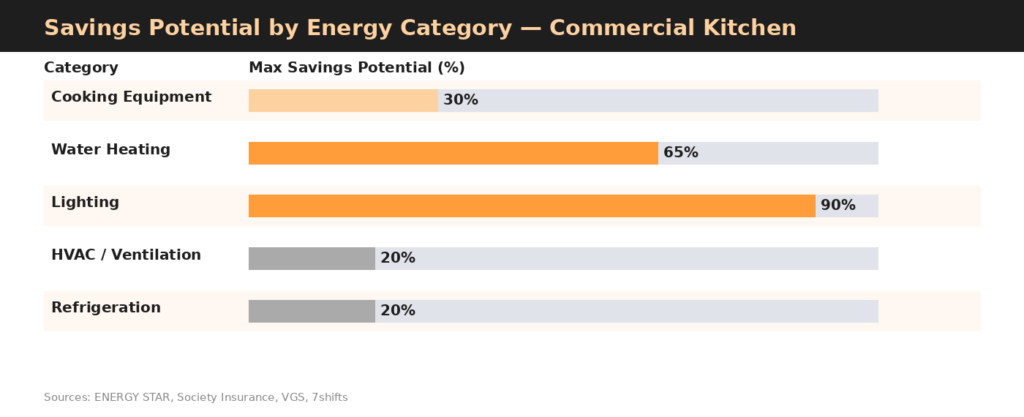
| Energy Category | Approx. Share of Bill | Savings Potential | Capital Required |
|---|---|---|---|
| Cooking Equipment | 35–45% | 14–30% with ENERGY STAR upgrades | Medium–High |
| HVAC & Ventilation | 25–30% | 10–20% with controls & filter maintenance | Low–Medium |
| Water Heating | ~20% | Up to 65% on hot water with low-flow valves | Very Low |
| Lighting | ~13% | 70–90% reduction switching to LEDs | Very Low |
| Refrigeration | ~6% | 20% with coil maintenance & door discipline | Very Low |
Sources: ENERGY STAR; Society Insurance
Cooking Equipment: The Biggest Lever
Upgrade to ENERGY STAR Certified Appliances
A standard commercial deep fryer consumes over 18,000 kWh per year — more than an entire U.S. household uses in twelve months, according to Integrity Energy. Upgrading to an ENERGY STAR certified fryer doesn’t just cut electricity costs by roughly $260 per year — it also extends oil life, which can generate an additional $780 in oil savings annually (per SoCal Gas research cited by ENERGY STAR). Together, that’s over $1,000 in savings from one appliance.
The numbers add up quickly across your kitchen. The Kitchen Spot summarizes certified savings per appliance category:
- Dishmachine: ~$1,500/year savings; 40% more efficient than standard
- Electric convection oven: ~$680/year; 20% more efficient
- Steam cooker: ~$1,000/year; 60% more efficient (and 90% more water-efficient)
- Hot holding cabinet: ~$325/year; 70% more efficient
- Gas vat fryer: ~$410/year; 30% more efficient than standard
Restaurants that upgrade several appliances at once can save up to $5,300 per year on energy costs, according to Integrity Energy. And in New York City, Con Edison’s Commercial and Industrial Energy Efficiency Program can cover up to 70% of upgrade costs for qualifying small businesses — more on that in the rebates section below.
Implement a Startup and Shutdown Schedule
This costs nothing and can be one of the fastest wins in your kitchen. Restaurant chain Shari’s Café and Pies introduced a standardized startup and shutdown schedule for kitchen equipment across all locations — the result was $4,145 in savings per location annually, according to 7shifts. Pre-heating ovens 15 minutes before service rather than 90 minutes early, and powering down equipment immediately after the last order — not after cleanup — adds up to significant monthly savings.
For Chinese restaurant kitchens running lunch and dinner service, a written startup/shutdown checklist posted in the kitchen is a practical, staff-level implementation that requires no technology investment whatsoever.
Consider Induction for New Equipment Purchases
Induction cooktops transfer heat directly to cookware through electromagnetic fields, leaving the surrounding air cooler than gas or conventional electric burners. This reduces both cooking energy and the ambient heat load on your HVAC system — effectively saving energy in two categories at once. Kitchenall notes that high-efficiency cooking equipment including induction can be 15–30% more efficient than standard alternatives.
HVAC and Ventilation: The Silent Budget Drain
Variable Speed Hood Controls
Most commercial kitchen exhaust hoods run at 100% capacity continuously — even during slow periods between rushes when there’s little heat or smoke to capture. VGS notes that installing demand-controlled ventilation (fan speed controls that respond to actual kitchen activity) can generate thousands of dollars in savings annually and qualifies for custom rebates under Con Edison’s efficiency programs.
Filter and Duct Maintenance
A clogged HVAC filter forces your system to work harder to move the same volume of air — meaning higher energy consumption for the same result. Monthly filter checks during peak seasons, and quarterly replacements at minimum, are standard recommendations from ENERGY STAR. Damaged or leaking ductwork has the same effect: conditioned air escapes before reaching its destination, and the system compensates by running longer. Society Insurance recommends automating your thermostat to reduce HVAC workload during off-hours — a programmable thermostat is one of the lowest-cost energy investments available.
Lighting: Low-Cost, High-Impact
Switch to LED Throughout
LED bulbs consume 70–90% less energy than incandescent equivalents and last up to 10 times longer, according to WebstaurantStore. For a restaurant replacing 20 incandescent bulbs, the annual savings can exceed $400. In NYC, Con Edison’s Small Business Program offers free energy audits that specifically identify lighting upgrade opportunities, with incentive coverage up to 100% for lighting in qualifying Brooklyn and Queens neighborhoods, per NY Engineers.
LED bulbs also emit significantly less heat than incandescent alternatives — which matters in a commercial kitchen where every degree of ambient temperature increase adds load to your refrigeration and HVAC systems.
Occupancy Sensors in Low-Traffic Areas
Walk-in coolers, storage rooms, and bathrooms are routinely left lit for hours at a time with no one inside. Occupancy sensors in these areas eliminate the behavior gap entirely — the lights are on when someone is there and off when no one is. The upfront cost for a quality occupancy sensor is typically under $50 per fixture.
Refrigeration: Small Habits, Real Savings
Refrigeration accounts for roughly 6% of a restaurant’s energy budget — a smaller share than cooking or HVAC, but one where maintenance-focused interventions deliver disproportionate returns because the fixes are free.
Clean the Coils Twice a Year
Condenser coils remove heat from refrigeration units. When dust accumulates on them, it acts as insulation — making the coils less effective and forcing the compressor to run longer to achieve the same cooling. Society Insurance recommends cleaning coils at minimum twice per year. This is a 20-minute task that costs nothing beyond labor.
Strategic Kitchen Layout
Placing refrigerators next to ovens, fryers, or steam equipment forces the refrigeration unit to work much harder to maintain temperature. During any kitchen reorganization, heat-generating equipment should be positioned as far from refrigeration as the layout permits. This connects directly to the kitchen layout planning discussed in our guide on optimizing NYC restaurant operations — layout decisions made once have energy cost implications for years.
The Dollar Bill Seal Test
Worn door gaskets on walk-in coolers and reach-ins allow cold air to escape continuously. The simple test: close a dollar bill in the door and try to pull it out. If it slides out easily, your seals are failing and your refrigeration unit is compensating with extra runtime. Replacing door gaskets is a low-cost repair that pays back quickly.
Water Heating: The Overlooked 20%
Water heating can account for up to 20% of a commercial kitchen’s total energy use — driven primarily by dishwashing, prep work, and cleaning, according to VGS. Two changes address most of this cost:
Install Low-Flow Pre-Rinse Spray Valves
The U.S. Department of Energy standard for pre-rinse spray valves (effective January 2019) is 1.28 gallons per minute or lower, per ENERGY STAR. Upgrading to compliant valves reduces water consumption by approximately two-thirds compared to older equipment — with no change to spray patterns or cleaning effectiveness. The valves themselves typically cost under $30 and take minutes to install.
Recalibrate Your Water Heater
Water heater thermostats drift over time. A unit calibrated to 140°F that has crept up to 160°F is spending significant energy on heat that gets mixed down with cold water at the tap. Annual recalibration to manufacturer specifications — a task that takes about 15 minutes — ensures you’re heating water to the temperature you actually need, not higher.
NYC-Specific Rebates You Should Know About
Many NYC restaurant owners leave significant money on the table by not claiming available incentives from Con Edison and state programs. These aren’t obscure programs — they’re actively promoted and funded.
Con Edison Commercial & Industrial Energy Efficiency Program
Con Edison’s CIEE Program provides cash rebates for energy-efficient equipment installations. The Small Business track includes a free energy audit — Con Edison will send an auditor to identify lighting and refrigeration upgrade opportunities at no cost to you. For businesses in select Brooklyn and Queens neighborhoods, incentives can cover 100% of lighting upgrade costs and a high percentage of refrigeration improvements.
Con Edison has disbursed over $115 million in cash incentives to commercial customers in recent years, according to Incentive Rebate 360. Projects must be pre-approved before installation, so contact Con Edison before purchasing new equipment to confirm eligibility.
NYSERDA Business Programs
NYSERDA’s commercial programs offer incentives for HVAC upgrades, lighting controls, and energy management systems that complement Con Edison’s equipment rebates. The two programs can often be stacked, meaning a restaurant owner might receive incentives from both a state program and a utility program for the same project.
ENERGY STAR Equipment Rebates (200+ utilities nationwide)
Beyond New York-specific programs, more than 200 U.S. utilities — including Con Edison — offer rebates specifically for ENERGY STAR certified commercial food service equipment. When purchasing a replacement fryer, oven, or dishmachine, verifying ENERGY STAR certification at the point of purchase is the simplest way to ensure rebate eligibility. The ENERGY STAR guide for small business restaurants includes a savings calculator that estimates annual utility reductions by equipment type.
Building an Energy Culture on Your Team
The most effective energy programs combine equipment upgrades with staff behavior — because equipment running longer than necessary, or at the wrong settings, negates much of the engineering benefit. In conversations with restaurant owners across New York, we consistently find that the highest-impact operational change is also the simplest: a posted startup/shutdown checklist that staff actually follow.
When your team knows to pre-heat ovens 15 minutes before service (not 90), shut down fryers between lunch and dinner service, close walk-in doors completely, and run the dishwasher only on full loads — those habits compound daily across your entire utility bill. Training doesn’t require technology; it requires consistency and accountability.
One area where operational discipline matters as much as equipment is phone management. When your front-of-house staff is pulled between answering the phone, taking walk-in orders, and managing tables during peak service, important tasks — including equipment shutdown checks — get skipped. Tunvo’s AI voice agent handles every phone call automatically in English and Mandarin, so your team stays focused on the floor. That focus makes energy checklists more likely to actually happen. See how it works in a 15-minute demo →
Frequently Asked Questions
How much can a NYC restaurant realistically save on energy costs per year?
A well-executed energy efficiency program targeting equipment, lighting, and behavioral changes can realistically reduce utility costs by 15–25% annually. For an average NYC restaurant spending $15,000/year on utilities, that represents $2,250–$3,750 in annual savings. According to ENERGY STAR, saving 20% on energy operating costs can increase overall profit by roughly one-third — making this one of the highest-leverage cost reduction opportunities for independent operators.
What’s the single easiest energy change for a restaurant to make today?
Installing low-flow pre-rinse spray valves is arguably the highest-return, lowest-effort change available to most restaurant kitchens. The valves cost under $30, take minutes to install with no plumbing expertise required, and cut hot water usage by approximately two-thirds on that fixture. This reduces both water costs and water heating energy — simultaneously. Implementing a written startup/shutdown schedule for kitchen equipment is the second-easiest change and costs nothing at all.
Does Con Edison really offer free energy audits for NYC restaurants?
Yes, qualifying small business customers — including restaurants — can receive a free energy audit from Con Edison that identifies specific lighting and refrigeration upgrade opportunities. For businesses in certain Brooklyn and Queens neighborhoods, Con Edison’s incentives can cover 100% of lighting upgrade costs and significant portions of refrigeration improvements. Projects must be pre-approved before installation begins. Contact Con Edison’s Commercial and Industrial Energy Efficiency Program directly to check eligibility and schedule an audit. The program is listed through the NYC Business portal.
Should I prioritize equipment upgrades or behavioral changes first?
Start with behavioral changes — they cost nothing and take effect immediately. A written startup/shutdown schedule, monthly refrigeration coil cleaning, filter inspections, and low-flow spray valve installation require minimal investment and produce measurable monthly savings. Once those are in place, evaluate equipment upgrades in order of energy intensity: cooking equipment (highest impact), then HVAC controls, then water heating, then lighting and refrigeration. Apply for Con Edison rebates before purchasing replacement equipment — pre-approval is required, and purchasing without it forfeits the incentive.
Every dollar saved on utilities goes directly to your bottom line — so does every phone order you capture instead of miss.
Tunvo’s AI voice agent answers every call in English and Mandarin, takes orders straight into your MenuSifu POS, and frees your staff to focus on the floor. Set up in 30 minutes.