Most independent restaurant owners think about marketing the same way they think about fixing a broken refrigerator: something you deal with when it becomes a problem. A slow Tuesday comes along and suddenly you’re scrambling to post a last-minute deal on Instagram. A slow January arrives and you realize you never planned anything for winter.
The restaurants I’ve worked with that handle slow seasons best — and make the most of busy ones — have one thing in common: they planned their marketing in advance. Not in exhaustive detail. Just enough to know what’s coming and have a response ready.
This guide gives you a practical 12-month marketing calendar built specifically for independent Chinese restaurants in urban markets like New York — with key dates, promotion ideas, and the operational perspective that makes planning actually executable.
Key Takeaways
- Plan at least 4–6 weeks in advance for each promotion — the restaurants that scramble are the ones that didn’t plan.
- Every month has at least one natural marketing hook; the calendar helps you find it before it passes.
- Your phone channel must be ready to handle whatever demand your marketing creates — a campaign that drives calls you can’t answer is worse than no campaign.
- Chinese restaurants in New York have unique cultural marketing assets — Lunar New Year, Mid-Autumn Festival, and more — that most competitors can’t match.
Why a Marketing Calendar Is Not Optional for Independent Restaurants
Restolabs’ restaurant marketing guide cites data showing that 43% of consumers use restaurants to celebrate special occasions, with over a third specifically planning to dine out and 12% opting for takeout on key dates. That’s an enormous base of demand that is specifically occasion-driven — and entirely capturable if you plan for it.
The flip side: NetSuite’s restaurant seasonality research documents that restaurants without a seasonal marketing strategy experience significantly wider revenue swings than those who plan ahead — the difference between a 40% revenue drop in slow months versus a 15–20% dip that’s already budgeted for and offset by proactive promotions.
A marketing calendar is the tool that closes this gap. It doesn’t have to be complex. A spreadsheet with 12 rows works fine. What matters is having a clear answer to the question: “What are we doing next month to drive traffic?”
How to Build Your Restaurant Marketing Calendar
Step 1: Anchor the year around non-negotiable dates
Start with the dates that your customers already mark on their calendars — the occasions that generate natural dining demand. Malou’s restaurant marketing calendar analysis identifies three categories of anchor dates: national holidays, food-specific national days, and cultural celebrations relevant to your customer base.
For Chinese restaurants in New York, the cultural calendar adds a layer of anchor dates that most competitors don’t have: Lunar New Year (late Jan/early Feb), Mid-Autumn Festival (September/October), Dragon Boat Festival (June), and Qingming. These are occasions when your target audience specifically wants the food you serve, often for a celebratory group meal. They should be your highest-priority marketing moments.
Step 2: Identify your slow months and plan around them
Sauce’s restaurant food holiday calendar notes that January, February, and August are consistently the slowest months for urban restaurants. Once you’ve identified your specific slow months from your own POS data, build a proactive promotion into each one — not a panic response, but a planned campaign that you designed two months earlier when you had time to think.
Step 3: Assign a promotion type to each month
Not every month needs the same type of promotion. DoorDash’s restaurant marketing guide recommends mapping your promotional intensity to your revenue calendar: push hard on loyalty and re-engagement in slow months, use peak months for premium experiences and upselling, and use shoulder months for community-building and brand awareness.
Step 4: Plan your phone channel alongside your promotions
This is the step most marketing guides skip, but it’s critical: every successful promotion drives phone calls. If your marketing works and customers can’t get through on the phone, you’ve wasted your marketing budget. Tunvo’s AI voice agent integrates directly with your MenuSifu POS to ensure every call is answered and every order is captured — so your marketing investment actually translates to revenue.
The 12-Month Restaurant Marketing Calendar
| Month | Season / Mood | Key Dates & Hooks | Recommended Promotion |
|---|---|---|---|
| January | Slow; New Year resolutions | Lunar New Year (late Jan/Feb); Dry January | Lunar New Year advance reservations; weekday specials on soups; healthy menu additions for January |
| February | Slow→Peak; winter comfort | Valentine’s Day; Lunar New Year celebrations | Couples hot pot set menu; family Lunar New Year feast packages; gift card push |
| March | Transition; spring teaser | St. Patrick’s Day; spring equinox | Spring menu preview; loyalty re-engagement campaign for winter lapsed customers |
| April | Growing; outdoor dining | Qingming; Tax Day (April 15) | Spring fresh ingredient promotions; “Tax Day treat” discount |
| May | Peak; celebrations | Mother’s Day; Memorial Day | Mother’s Day special menu; family banquet packages; early summer menu launch |
| June | Peak; summer begins | Dragon Boat Festival; Father’s Day; Pride Month | Dragon Boat Festival menu; Father’s Day group dinners; summer seasonal drinks launch |
| July | Slowdown begins | Fourth of July; summer vacations | Loyalty re-engagement envelopes for August; delivery-focused summer specials; event partnerships |
| August | Slowest; back-to-school begins | Back to School (late Aug); summer end | Family meal bundle for school nights; student ID discount launch; teacher appreciation promo |
| September | Recovery; fall momentum | Mid-Autumn Festival (varies); Labor Day | Mid-Autumn Festival mooncake / special menu; school fundraiser night; fall menu launch |
| October | Growing; cozy season | National Noodle Day (Oct 6); Halloween | Noodle Day special; warm comfort food push; Halloween family night promotion |
| November | Peak; holiday season opens | Thanksgiving; Black Friday; early holiday bookings | Black Friday gift card deal; corporate holiday dinner early bookings; hot pot season launch |
| December | Peak; year-end celebrations | Christmas; New Year’s Eve; Winter Break | Holiday group dinner packages; NYE special menu; gift card last push; January re-engagement prep |
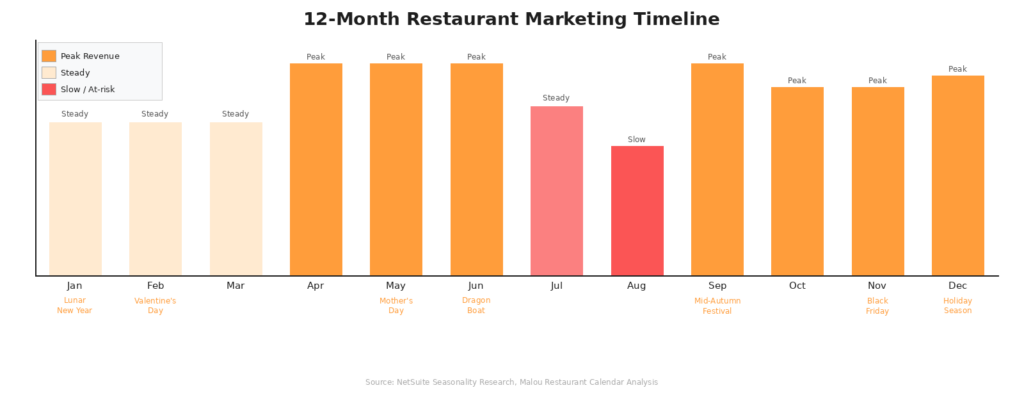 The year in restaurant marketing: knowing when to push and when to protect is the foundation of a profitable annual plan.
The Chinese Restaurant Advantage: Cultural Dates That Others Can’t Match
One of the most underused marketing assets for Chinese restaurant owners in New York is the Chinese cultural calendar. While every restaurant on the block is running a Valentine’s Day special, you have Lunar New Year — one of the most celebratory dining occasions of the year for a large portion of the New York population — with almost no competition from non-Chinese restaurants.
The key cultural dates to build campaigns around:
Lunar New Year (January/February): The single biggest opportunity of the year. Families want celebratory banquet-style dining. Promote advance reservations starting January 1st. Offer special menus with auspicious dishes. Consider a private dining or family feast option.
Mid-Autumn Festival (September/October): A moonlit, communal occasion that pairs naturally with family dinner out. Mooncake giveaways or signature mooncake flavors create shareable social content. SevenRooms’ seasonal restaurant guide notes that limited-edition seasonal items tied to cultural celebrations consistently outperform generic holiday promotions in engagement and conversion.
Dragon Boat Festival (June): Zongzi promotions, whether for dine-in or takeout, are authentic and differentiating. A “Dragon Boat Special” in June gives you fresh social content at a time when every other restaurant is running the same Father’s Day promotion.
Making Your Marketing Calendar Operationally Real
A marketing calendar on paper means nothing if the operations can’t support it. Restroworks’ marketing calendar guide recommends building a simple execution checklist for each promotion: who designs the social content, who writes the SMS, what’s the offer, when does it launch, and who is handling the response on the phone when demand picks up.
That last point is often where independent restaurants lose the ROI on their marketing. A well-executed SMS campaign for Lunar New Year drive calls. If those calls go unanswered because the team is handling dine-in prep, you’ve spent money on marketing and converted none of it to revenue.
Tunvo’s AI voice agent is specifically designed to close this gap. When your marketing works — when a campaign drives inbound calls — the AI answers every call in English or Mandarin, takes the full order or reservation, and syncs it directly to your MenuSifu POS. Your marketing investment doesn’t leak out through an unanswered phone.
Frequently Asked Questions
How far in advance should I plan restaurant promotions?
Plan at least four to six weeks ahead for any promotion that requires menu changes, social media content creation, or staff briefing. Major events like Lunar New Year or Mother’s Day warrant eight to ten weeks of advance planning — especially for reservations, which fill early. The rule of thumb: if you’re thinking about a promotion in the same week you want to run it, you’re already behind.
What’s the most important month to plan marketing for?
January. It’s the slowest month of the year for most restaurants, it follows the highest-revenue holiday period, and it’s also when Lunar New Year preparations should be in full swing. Restaurants that plan January well — with a Lunar New Year advance booking campaign and a comfort food promotion for the post-holiday lull — set the tone for the whole year.
How do I track whether my marketing calendar is working?
Your POS is the most reliable source of truth. Pull weekly revenue data for each promotion period and compare it to the same period in the prior year. DoorDash’s restaurant analytics guidance also recommends tracking call volume and online order volume separately during promotion periods — an uptick in calls that doesn’t convert to orders suggests a phone coverage problem, not a marketing problem.
Do I need to spend money on advertising to make a marketing calendar work?
Not necessarily. Many of the highest-value promotions in this calendar — school fundraiser nights, teacher appreciation week, Lunar New Year advance reservations — require almost no paid advertising. They work through community channels, existing customer relationships, and your social media presence. The marketing calendar’s value is in planning and consistency, not in ad spend.
Every promotion you run this year will drive phone calls. Make sure every one of them gets answered. Tunvo’s AI voice agent handles every inbound call in English and Mandarin, takes orders, and syncs directly to your MenuSifu POS — so your marketing investment converts to revenue.