If you own or work at a Chinese restaurant, you already know what December 25th means: war day. Tables booked weeks out. A phone that doesn’t stop ringing from early morning. Takeout orders backing up the moment you open. A dining room full of families who made Christmas dinner here last year — and the year before that — and will call to make next year’s reservation before they leave tonight.
Christmas Day is not just a busy day for Chinese restaurants. Christmas and Christmas Eve are the busiest days of the year for most American Chinese restaurants — and have been for over a century. This guide covers where the tradition came from, who’s coming through your door, and exactly how to prepare your operations so that December 25th becomes your most profitable day of the year rather than your most exhausting one.
Key Takeaways
- Christmas Day is the single biggest revenue day for most Chinese restaurants — driven by a century-old tradition that has grown far beyond its original community.
- The demand is almost entirely phone-driven — reservations are made by phone weeks in advance, and takeout orders flood in the morning of.
- A limited menu focused on your best dishes is the right operational choice — speed and consistency beat variety on this day.
- Some families book next year’s reservation as they leave this year’s dinner — the loyalty opportunity is as significant as the revenue.
The History: Why Chinese Restaurants Own Christmas
A Century-Old Tradition Rooted in New York
The tradition of eating Chinese food on Christmas traces its roots to New York City’s Lower East Side in the late 19th and early 20th century. As Eastern European Jewish immigrants and Chinese immigrants settled in adjacent neighborhoods, they formed a cultural bond partly born of proximity and a shared experience as the two largest non-Christian immigrant groups in the city. On Christmas Day, when nearly every other restaurant was closed for the holiday, Chinese restaurants stayed open — and welcomed Jewish families who had nowhere else to go.
The tradition dates to at least 1935, and by the 1930s, Chinese restaurants were firmly established in Jewish neighborhoods, making Christmas dinner at a Chinese restaurant a ritualized part of the Jewish-American holiday calendar. The appeal was practical as well as cultural: Chinese cuisine traditionally doesn’t mix dairy and meat, which aligned with Jewish dietary principles, and the restaurants offered an inclusive, welcoming environment at a time when not every business extended that welcome.
From Community Tradition to American Institution
What began as a Jewish-American custom has become something much broader. According to data from Google Trends covering 2006 through 2023, searches for “Chinese food” in the United States peaked each year between Christmas and New Year’s Day. Given that Jewish Americans represent about 2.4% of the adult U.S. population, the scale of that search trend means the tradition has been adopted by millions of non-Jewish Americans who simply want a great meal on a day when most other restaurants are dark.
Owners at prominent Chinese restaurants describe what has become, over the course of a hundred years, “almost an American way of Christmas” — for anyone not with family, not having a big gathering at home, Chinese American food has become synonymous with that day and how people choose to celebrate. For Chinese restaurant owners, this is not just a cultural observation — it’s an operational reality that requires specific preparation.
Who’s Coming Through Your Door
The Core Customer: Jewish Families Continuing a Multigenerational Tradition
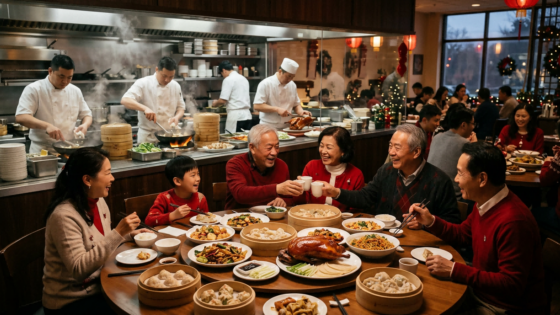
Jewish families are the historical foundation of Christmas Day Chinese restaurant dining, and many treat it with the same reverence as any other family tradition. At one Colorado Chinese restaurant, the manager reports the family receiving 63 reservations by early afternoon on Christmas Day — not counting walk-ins or takeout orders. These are customers who return every year, who may call a month in advance to secure their regular table, and who represent the most loyal segment of your Christmas Day revenue.
Some Chinese restaurants report that customers make their next year’s reservation on the way out the door from this year’s Christmas dinner. That level of loyalty is worth recognizing and rewarding — a handwritten note from the owner, a complimentary dessert for families who’ve been coming for years, or simply remembering that the Chen family always wants a table by the window.
The Broader Audience: Anyone Who Wants a Great Meal and an Open Restaurant
Beyond the Jewish community, Christmas Day Chinese restaurants draw a remarkably diverse crowd. Owners of prominent Chinese restaurants report seeing more non-Asian customers around Christmas than any other time of year, including significant numbers of Chinese, Korean, and Latino diners as well — people who simply want a festive, celebratory meal on a day when their usual options are closed. Many non-Jewish customers discovered the tradition through Jewish neighbors, coworkers, or friends, and adopted it for entirely practical reasons: the food is excellent, the restaurants are open, and the atmosphere feels celebratory without requiring participation in Christmas itself.
Operational Preparation: What Makes Christmas Day Run Smoothly
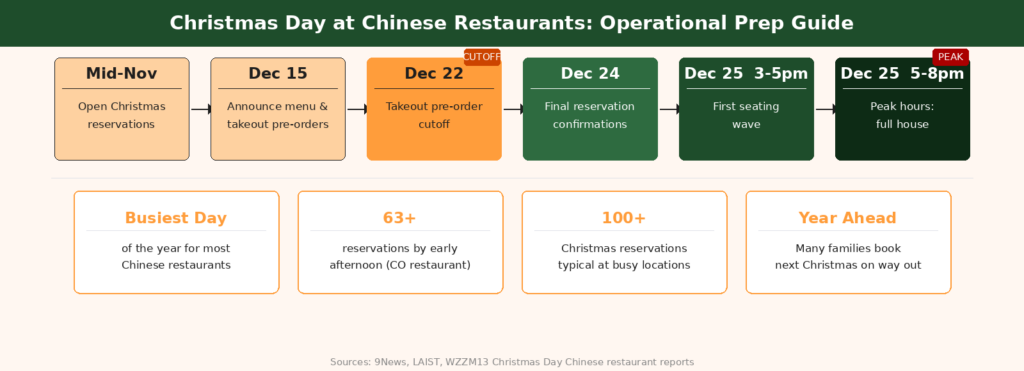
Take Reservations Early — Starting in November
Christmas Day reservations at popular Chinese restaurants fill up weeks in advance. Open your Christmas reservation window in mid-to-late November, before the December holiday rush makes it harder to get marketing attention. Announce the opening of Christmas bookings on your social channels and in your regular email communications. Returning customers — the Jewish families and loyal regulars who come every year — should be given first access, either through a direct email or a phone-first window before you open the online calendar.
Structure your reservation windows thoughtfully. Peak hours on Christmas Day typically run from late afternoon through evening — operators report peak hours between 4:30 and 8 pm, with the restaurant becoming full house with nowhere to walk during those windows. Stagger your seatings in 45-minute intervals to prevent the simultaneous arrival problem that overwhelms kitchens and hosts.
Run a Limited Menu Built for Speed
On Christmas Day, your most operationally sound decision is a simplified menu. Restaurant owners who’ve managed the Christmas rush for years describe adapting their operations with a limited menu focused on items the kitchen can prepare quickly and efficiently. The full menu can remain available, but your specials, staff recommendations, and set options should center on your fastest, most popular dishes — Peking duck, dim sum, whole fish, family-style plates that can be batched.
A Christmas Day family set menu — priced for 4 or more people, featuring your signature dishes, served family-style — simplifies ordering, speeds kitchen output, and often produces a higher per-table revenue than à la carte. It also reduces the coordination burden on servers who are managing full sections simultaneously.
| Operational Challenge | What Typically Goes Wrong | The Fix |
|---|---|---|
| Reservations | All tables booked for the same time slot | 45-minute staggered seatings from 3pm to 8pm |
| Takeout orders | Walk-in orders overwhelm prep | Advance-order-only policy with cutoff Dec 22nd |
| Phone volume | Staff can’t answer while managing tables | AI voice agent handles reservations and order intake |
| Kitchen output | Full menu creates ticket time unpredictability | Limited Christmas Day menu focused on batchable dishes |
| Staffing | Team burnout, reduced quality of service | Full team scheduled, bonus for Christmas Day work |
Takeout: Pre-Orders Only, Clear Cutoff Dates
Christmas Day takeout at Chinese restaurants is massive. Some operators report that the wait time for to-go orders can reach over an hour or two hours during peak windows on Christmas Day, with customers calling days in advance to reserve their pickup time. To avoid chaos, implement a pre-order-only policy for Christmas takeout and set a clear order cutoff — December 22nd is reasonable. Communicate this prominently on your social media, your phone greeting, and any flyers in the restaurant in the weeks leading up to December 25th.
Assign specific pickup time windows (e.g., 3pm–3:30pm, 4pm–4:30pm) and limit the number of orders per window. This smooths kitchen output, prevents a parking lot full of customers arriving simultaneously, and allows your staff to stage orders in advance rather than making each one to order as customers arrive.
The Phone Surge: Your Biggest Operational Variable
The Scale of Christmas Day Call Volume
Beginning in late November, your phone starts carrying Christmas Day traffic: reservation requests, menu questions, takeout pre-order calls, and inquiries about hours and availability. On Christmas Eve and Christmas morning, call volume spikes sharply as last-minute planners attempt to secure a table or pre-order a meal. Many of these calls will come while your staff is managing a full dining room with no one available to answer.
In our conversations with Chinese restaurant owners across New York, Christmas Day is the single moment they most consistently cite as a phone management failure point. The restaurant is full, every server is running plates, the host is managing waitlists, and the phone rings unattended. Every unanswered call in that window is a lost reservation, a lost takeout order, or a loyal customer who’ll remember that nobody picked up and feel less certain about coming back next year.
How Tunvo Handles the Christmas Rush
Tunvo’s AI voice agent answers every call in English and Mandarin — takes reservation requests, answers questions about your Christmas Day menu and hours, confirms takeout pre-order slots, and syncs everything directly to your MenuSifu POS. On December 25th, when your staff’s hands are full, the AI ensures that every caller gets a natural, immediate response. The customer who calls at 5pm on Christmas Eve asking if you have any tables left for tomorrow gets an answer. The family calling Christmas morning to confirm their 6pm reservation gets a confirmation. The takeout customer who missed the pre-order cutoff gets a clear explanation of the policy without your host having to step away from the door.
Christmas Day is when the revenue case for AI phone management is most obvious. Tunvo’s pricing is a fraction of the revenue a single missed reservation represents on your busiest day of the year. Setup takes 30 minutes and a 15-day free trial gives you time to have it running and tested before the holiday season arrives.
Building the Tradition Relationship With Your Customers
Make Returning Customers Feel Recognized
The families who eat at your restaurant every Christmas are among the most valuable customers you have. They return year after year, they bring the whole family, and they tell friends. Recognizing this relationship explicitly — a note from the owner on the table, a complimentary appetizer for families who’ve been coming for five or more years, a staff member who remembers their names — deepens the loyalty that makes Christmas Day such a reliable revenue day. You’re not just serving dinner; you’re participating in a family tradition.
Encourage the Next-Year Booking
At some Chinese restaurants, customers make their next Christmas reservation before they leave — walking out the door already looking forward to coming back. You can encourage this by having a booking card or QR code on the table, or by having your host casually mention that Christmas Day reservations for next year open in November. If a customer is satisfied enough to book next year on the way out, they’ve committed to spending another holiday with you — that’s the highest form of loyalty in the restaurant business.
Frequently Asked Questions
Why do Jewish people eat at Chinese restaurants on Christmas?
The tradition dates to turn-of-the-century New York, where Jewish and Chinese immigrant communities lived in close proximity on the Lower East Side. Chinese restaurants stayed open on Christmas, welcomed Jewish customers at a time when some other restaurants did not, and their menus happened to align reasonably well with Jewish dietary principles (no dairy-meat mixing). Over generations, eating Chinese food on Christmas became a meaningful cultural ritual for Jewish-American families — and has since been adopted by many non-Jewish Americans simply because the restaurants are open, the food is excellent, and the tradition carries a warm, communal energy.
How early should a Chinese restaurant start taking Christmas reservations?
Mid-to-late November is the right window to open Christmas reservations. This captures your most loyal returning customers early, gives you visibility into expected demand for inventory planning, and allows your marketing to get ahead of the December holiday noise. Some restaurants allow their most loyal annual customers to book by phone in the first week of November before the calendar officially opens — a small gesture that reinforces the relationship.
Should a Chinese restaurant offer a special Christmas menu or run the regular menu?
A dedicated Christmas Day menu — built around your most popular, fastest-executing dishes, offered as a family-style set for groups — typically outperforms the full menu operationally. You can keep the full menu available for à la carte orders, but the set menu should be prominently featured, recommended by staff, and priced to reflect the occasion. A family Christmas set at $180–240 for four (whole fish, Peking duck, dumplings, dessert) is often easier to execute at volume and yields higher per-table revenue than scattered individual orders.
What’s the best way to handle the phone volume on Christmas Day?
On Christmas Day, your phone will ring from the moment you open — and much of your staff won’t be able to answer it because they’re managing a full restaurant. The most effective solution is an AI voice agent like Tunvo, which handles calls in English and Mandarin automatically, takes reservations, answers questions about your menu and hours, and logs everything to your MenuSifu POS. For the days leading up to Christmas — when the pre-order and reservation surge begins — having the AI handle incoming calls means your team can focus on service prep rather than phone management.
—
Christmas Day is the moment Chinese restaurants earn the loyalty that lasts all year. Every call that rings out on December 25th — or in the weeks before it — is a family whose tradition goes to your competitor. Tunvo answers every call in English and Mandarin, takes reservations and orders, and syncs directly to your MenuSifu POS.
Book a Demo or Start Your 15-Day Free Trial.